
Guide
Van Gogh's Night Paintings and the Story of The Starry Night
The nights he painted from the Netherlands to Saint-Rémy, with The Starry Night at the heart of it all
Van Gogh’s night paintings include The Starry Night, painted at Saint-Rémy in June 1889 and now at the Museum of Modern Art in New York, which calls it one of his best-known paintings [1]. His other great nights, Café Terrace at Night, The Night Café and Starry Night Over the Rhône, all come from Arles in September 1888 [2][3][4]. Here is each one, where it is and what he said about it.
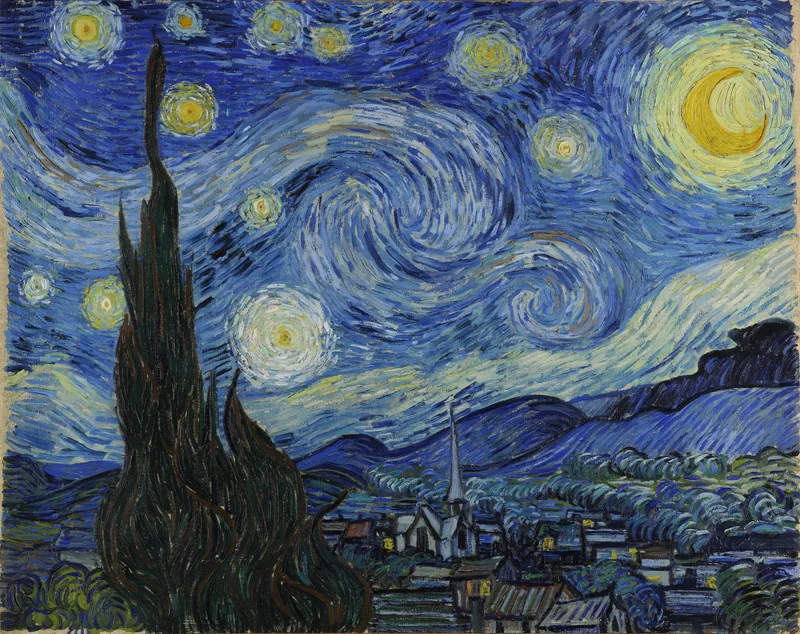
The Starry Night (June 1889), Museum of Modern Art
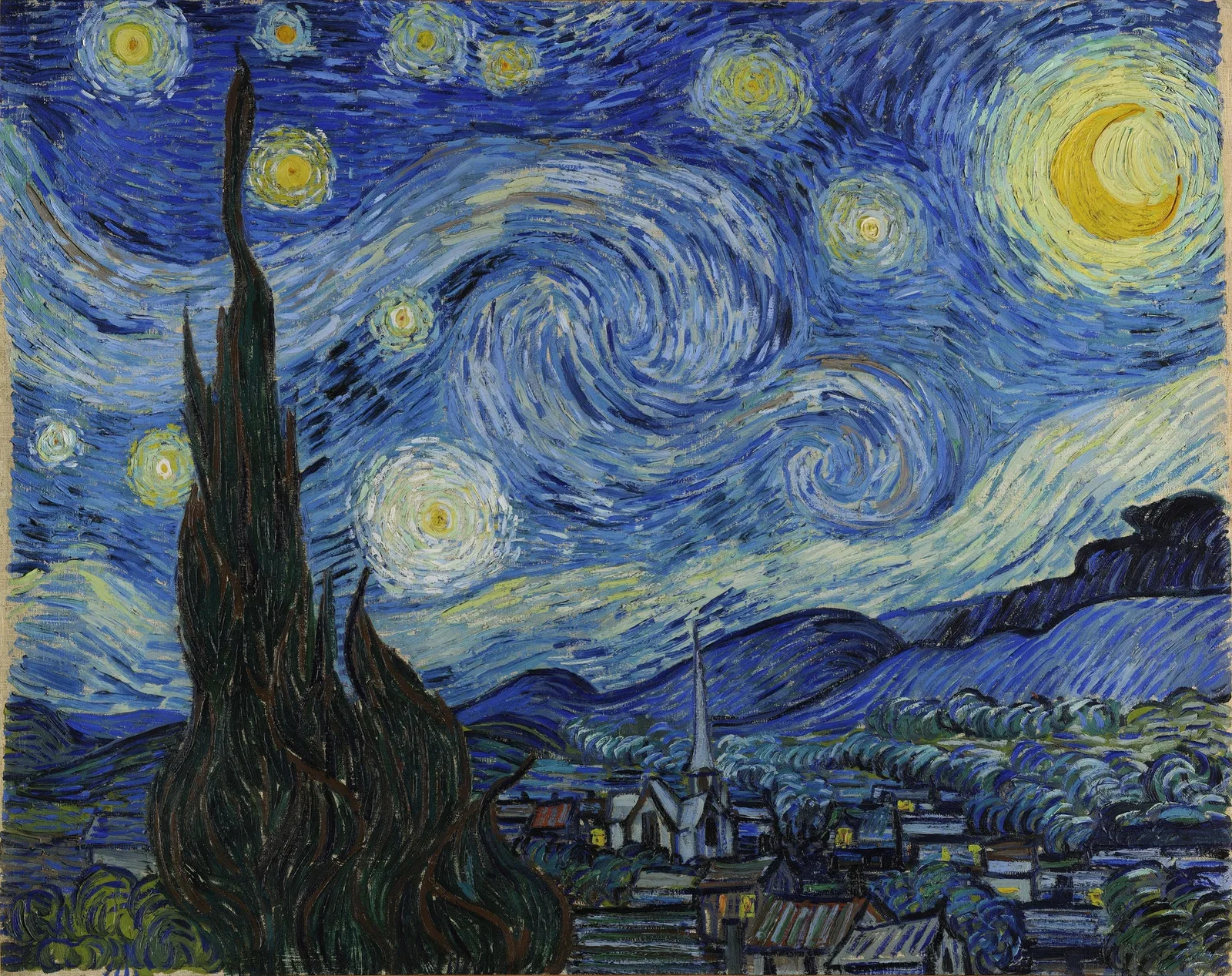
Start here, because this is the night everyone means. MoMA, which calls it one of his best-known paintings, dates it to mid-June 1889 and says it was inspired by the view from his window at the Saint-Paul-de-Mausole asylum in Saint-Rémy [1].
It is both observed and invented. The vision came at night, but he painted it in several sessions during the day [1]. The village could not be seen from his window, the cypress appears much closer than it was, and while some features of the sky were reconstructed as observed, he altered celestial shapes and added a sense of glow [1]. The sky is ruled by the bright moon at right and Venus at center left; the church steeple looks like those of his native Holland, and the whirling forms match published astronomical observations of nebulae, clouds of dust and gas [1].
How did it get to New York? In MoMA's record of its owners, the last two before the museum are Georgette P. van Stolk of Rotterdam, from 1906 to 1938, and Paul Rosenberg, from 1938 to 1941; the museum acquired it in 1941 [1]. The full journey is in where The Starry Night is today, and its value in how much The Starry Night is worth.
How he painted the night
In September 1888 he wrote to his sister Willemien in letter 678: “I definitely want to paint a starry sky now. It often seems to me that the night is even more richly coloured than the day, coloured in the most intense violets, blues and greens.” [2] He added a working rule: “it’s clear that to paint a starry sky it’s not nearly enough to put white spots on blue-black.” [2]
In Arles he took the easel outside after dark: “In the past they used to draw, and paint the picture from the drawing in the daytime. But I find that it suits me to paint the thing straightaway.” [2] He might mistake one tone for another in the dark, he admitted, but it was “the only way of getting away from the conventional black night with a poor, pallid and whitish light” [2]. Not every night picture was painted at night, though: MoMA notes that he painted The Starry Night in several sessions during the day [1].
Before Arles: dusk and lamplight (1883 to 1885)
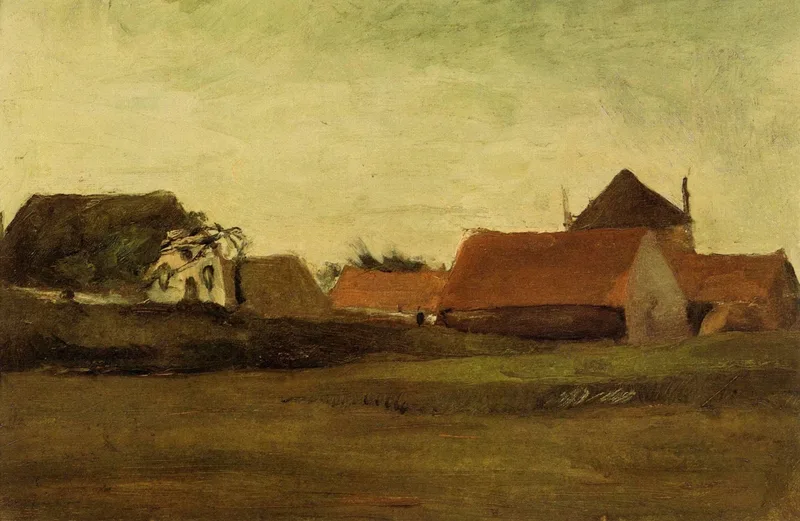
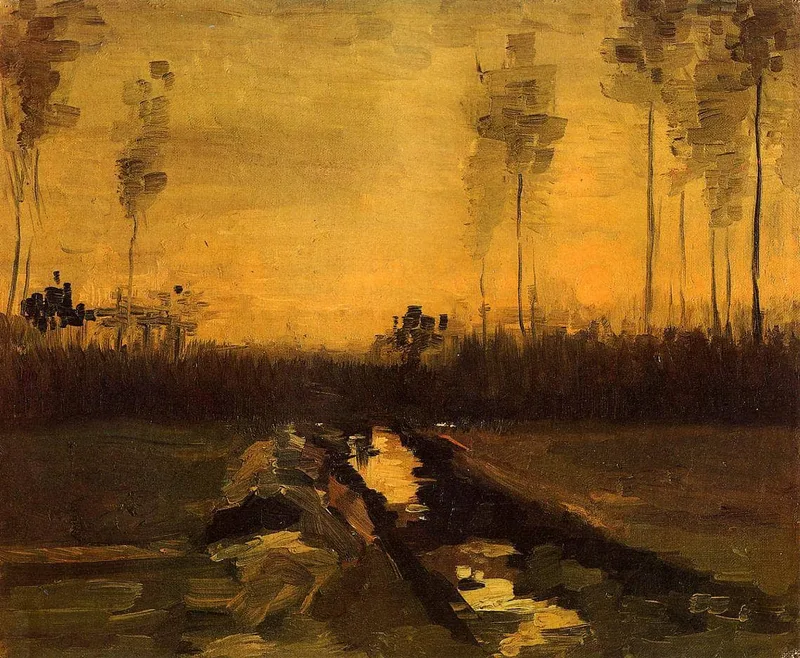
MoMA's 2008 exhibition Van Gogh and the Colors of the Night started well before the starry skies. Its checklist opens with early landscapes and peasant life, and only then reaches a section called Poetry of the Night [6]. The early dusk pictures are small. Twilight, Old Farmhouses in Loosduinen (1883) is oil on paper, 33 by 50 centimeters, in the Centraal Museum in Utrecht [6]. Evening Landscape (1885) is 35 by 43 centimeters, in the Museo Thyssen-Bornemisza in Madrid [6]; the museum calls it “almost nocturnal” and links it to the darkness Van Gogh admired in seventeenth-century Dutch painting [12].
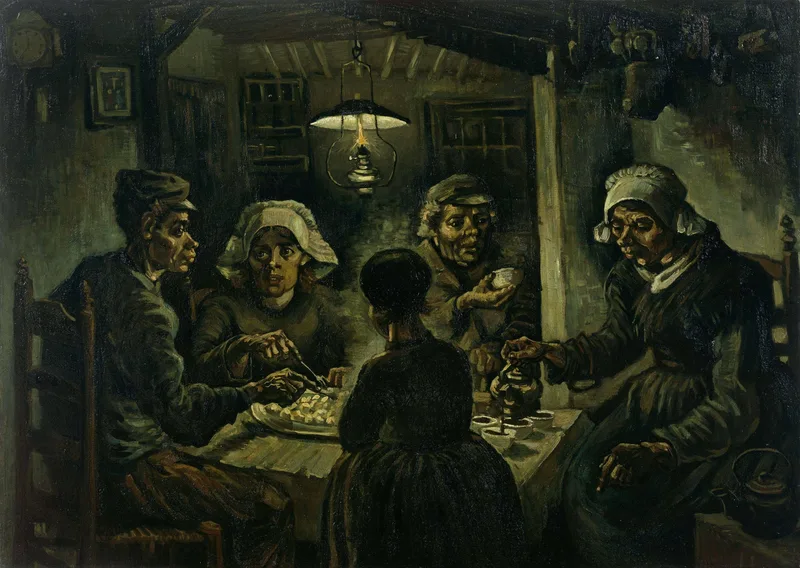
The big dark picture of this period is The Potato Eaters, also from 1885, 82 by 114 centimeters, in the Van Gogh Museum in Amsterdam [6]. A lamp hangs over the table, and the whole canvas is built from shadow. MoMA put it in the section on peasant life [6].
Hand-painted in oilFrom $350See sizes
Hand-painted in oilFrom $350See sizes
Hand-painted in oilFrom $350See sizes
The Night Café (September 1888), Yale University Art Gallery
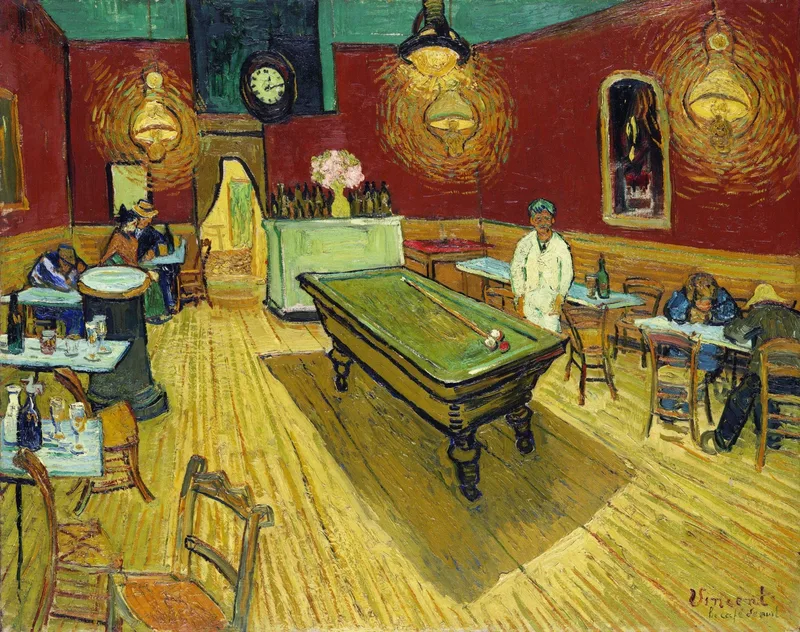
The Arles nights began indoors. On 8 September 1888 he told Theo in letter 676: “for 3 nights I stayed up to paint, going to bed during the day.” [3] He was blunt about the result, calling it “one of the ugliest I’ve done,” and explained the color: “I’ve tried to express the terrible human passions with the red and the green.” [3]
Then he listed the room: “The room is blood-red and dull yellow, a green billiard table in the centre, 4 lemon yellow lamps with an orange and green glow.” [3] The Night Café measures 72.4 by 92.1 centimeters and belongs to the Yale University Art Gallery [6]. Its darker side is part of 8 dark Van Gogh paintings.
Hand-painted in oilFrom $350See sizes
Café Terrace at Night (September 1888), Kröller-Müller Museum
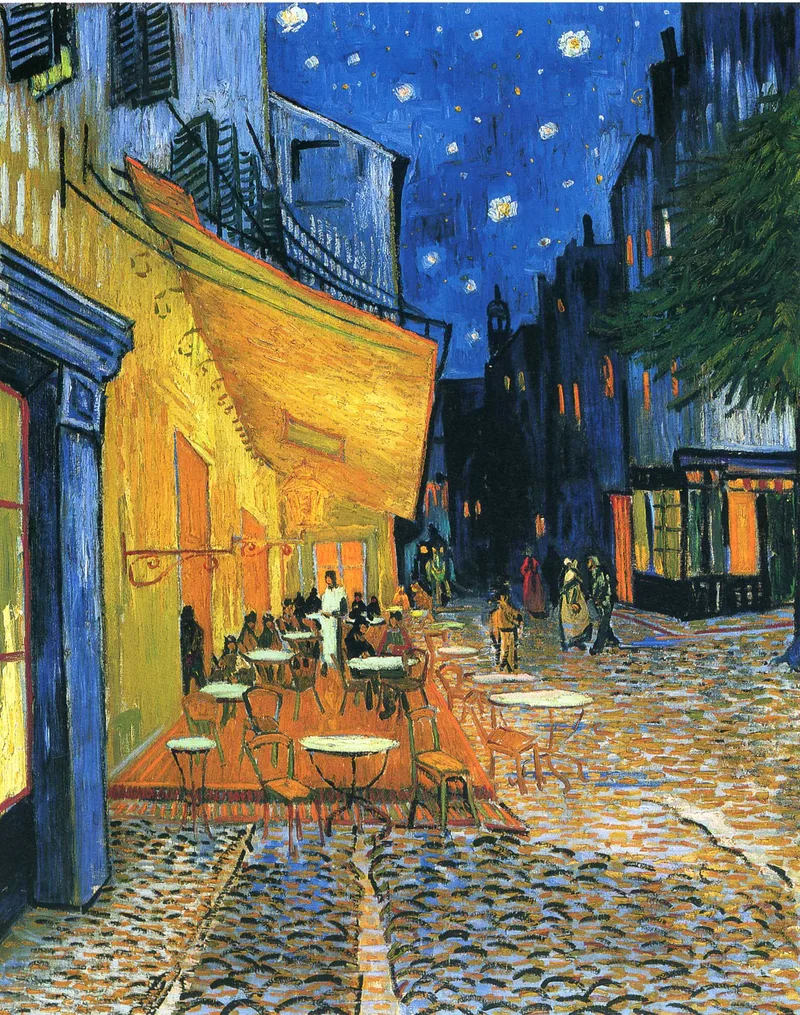
Days later he took the subject outdoors, painting the café terrace on the place du Forum on the spot and describing it to Willemien as “a painting of night without black” [2]. A huge yellow lantern lights the terrace, the façade and the pavement, and the cobblestones take on a violet-pink tinge, he wrote [2].
The Musée d’Orsay calls it the first corner of night sky he painted; the canvas is now at the Kröller-Müller Museum in Otterlo [5]. The whole story, from the real café to the night he painted it, is in the story behind Café Terrace at Night.
Eugène Boch, The Poet (1888), Musée d’Orsay
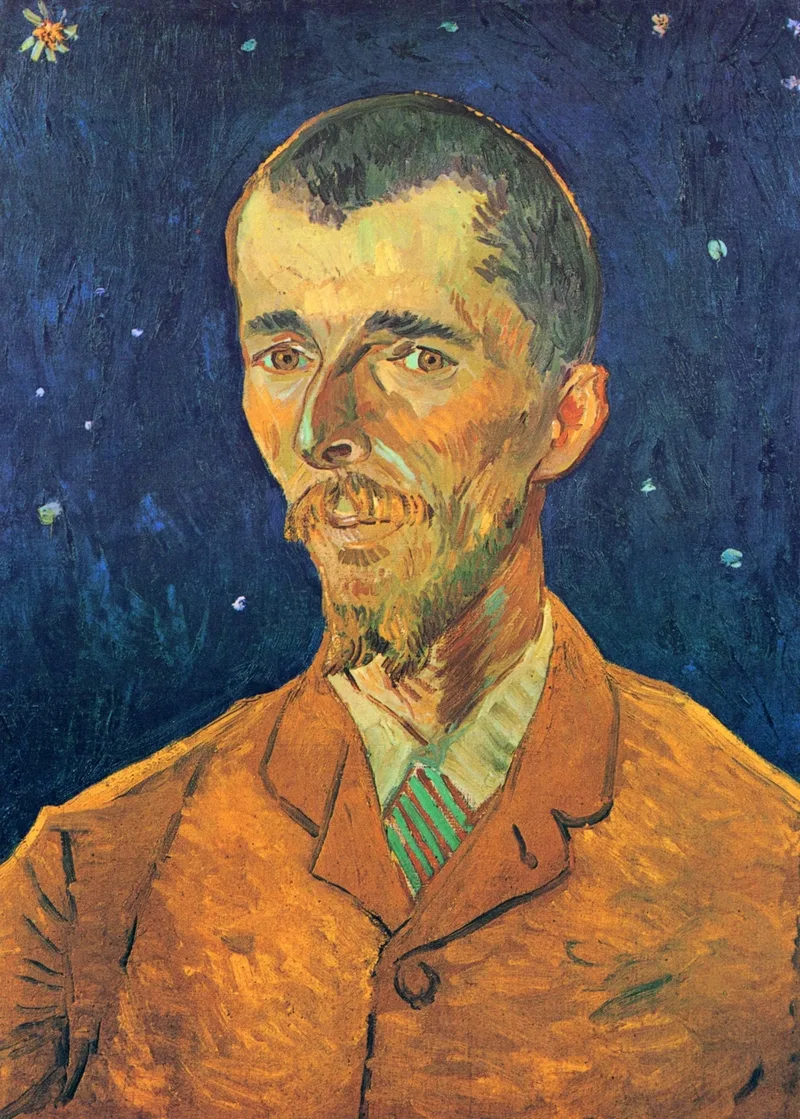
Not every night picture is a street. In the same letter he described a portrait of a young Belgian painter: “I’ve painted him as something of a poet, his refined and nervous head standing out against a deep ultramarine background of the night sky, with the twinkling of the stars.” [2] The editors identify it as the portrait of Eugène Boch [2]. It measures 60 by 45 centimeters and is at the Musée d’Orsay, which received it in 1941 as Boch’s bequest through the Société des Amis du Louvre [6].
Hand-painted in oilFrom $350See sizes
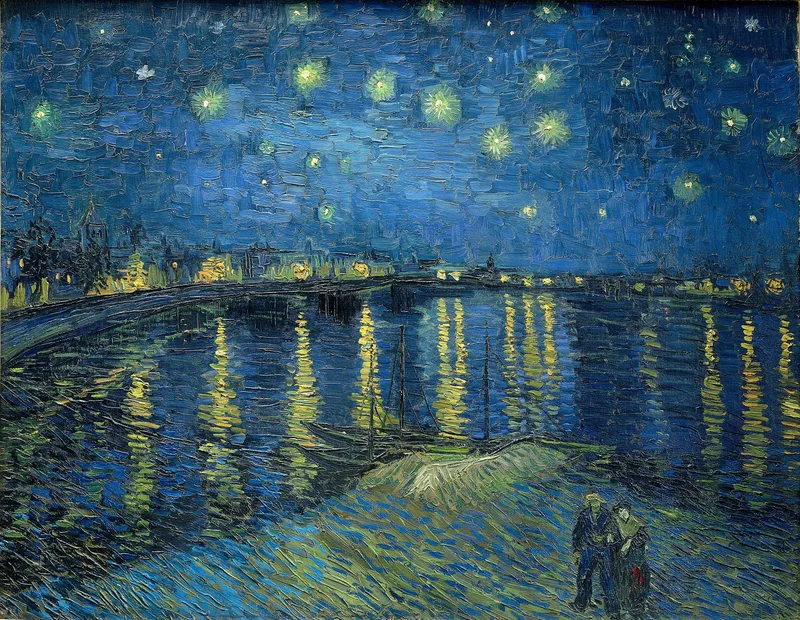
Starry Night Over the Rhône (September 1888), Musée d’Orsay
Around 29 September 1888 he sent Theo a sketch of a new square canvas in letter 691, “the starry sky at last, actually painted at night, under a gas-lamp.” [4] He listed the colors: “The sky is green-blue, the water is royal blue, the areas of land are mauve. The town is blue and violet.” [4] Over the town he picked out the Great Bear, and in front he placed two small figures of lovers [4].
The Musée d’Orsay, which owns Starry Night Over the Rhône as RF 1975 19, sums up its palette in a line: “Blues prevail: Prussian blue, ultramarine and cobalt.” The gaslights, it adds, “glimmer an intense orange and are reflected in the water” [5]. The museum notes that he had been preoccupied with “night effects” since he arrived in Arles in February 1888 [5].
Yes, the Rhône picture shares a name with the Saint-Rémy canvas above, but it is a different painting; how to tell the two apart has the side-by-side.
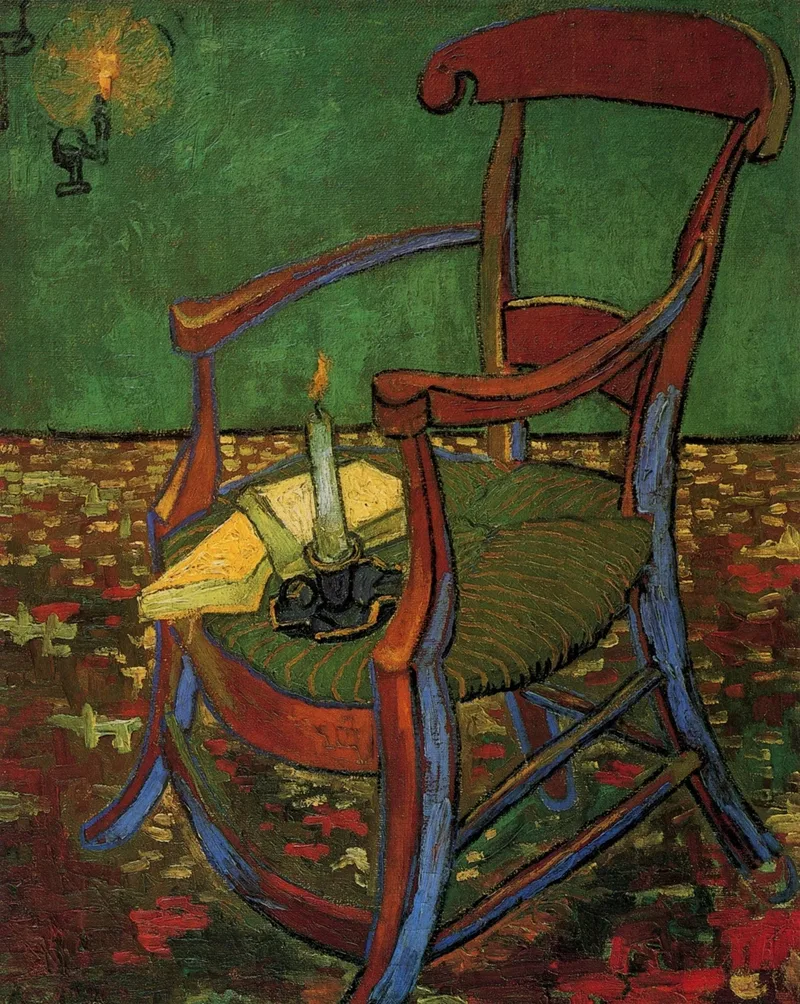
Gauguin’s Chair (1888), Van Gogh Museum
Back indoors, he painted a night picture with nobody in it. The Van Gogh Museum calls Paul Gauguin’s armchair a “portrait” of his absent friend: the modern novels and the burning candle on the seat stand for Gauguin’s character [11]. Using mainly red and green hues, Van Gogh tried to suggest the mood of night, and the bluish shadows and reflected light on the polished wood come from the gas lighting, with a gas lamp visible in the background [11]. MoMA's checklist gives its size as 90.5 by 72.5 centimeters [6].
Hand-painted in oilFrom $350See sizes
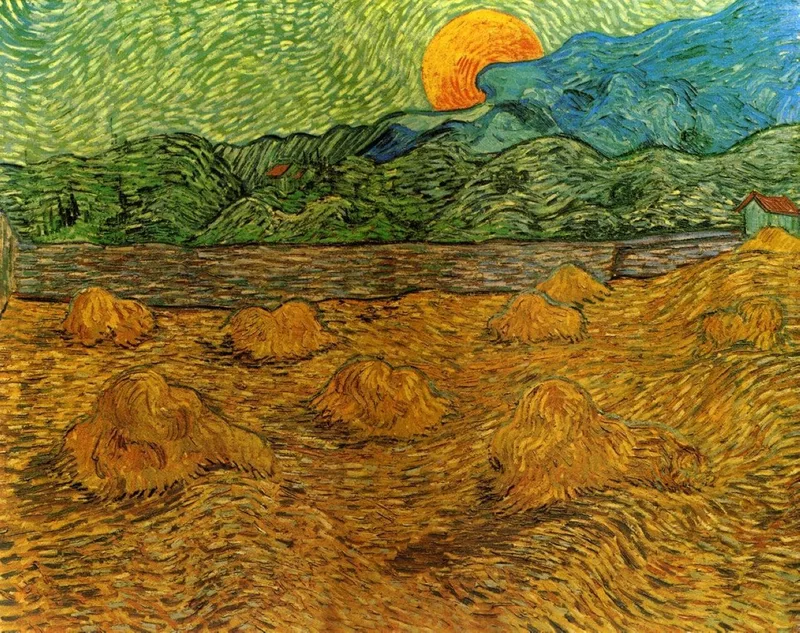
Landscape with Wheat Sheaves and Rising Moon (1889), Kröller-Müller Museum
In 1889 he painted a huge orange moon coming up over the hills behind a field of stacked wheat sheaves. The MoMA checklist places Landscape with Wheat Sheaves and Rising Moon in its section on sowers and wheatfields, and lists it as oil on canvas, 72 by 91.3 centimeters, in the Kröller-Müller Museum, Otterlo [6].
Hand-painted in oilFrom $350See sizes
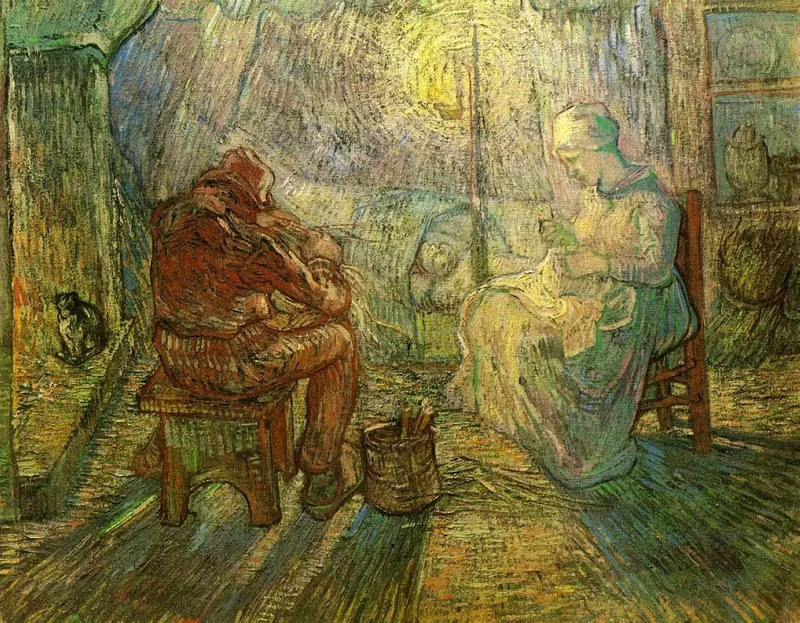
Evening (after Millet) (Saint-Rémy, 1889), Van Gogh Museum
At Saint-Rémy he also painted lamplight indoors. In Evening (after Millet), a peasant couple sit by the light of an oil lamp: the woman mends clothes, her husband works on a wicker basket, their child sleeps and a cat dozes by the fireplace [10]. While he was in the psychiatric hospital, Theo sent him prints after Jean-François Millet, and he used one as his model, “translating” the black-and-white print into color with gentle purple and violet tones [10].
Hand-painted in oilFrom $350See sizes
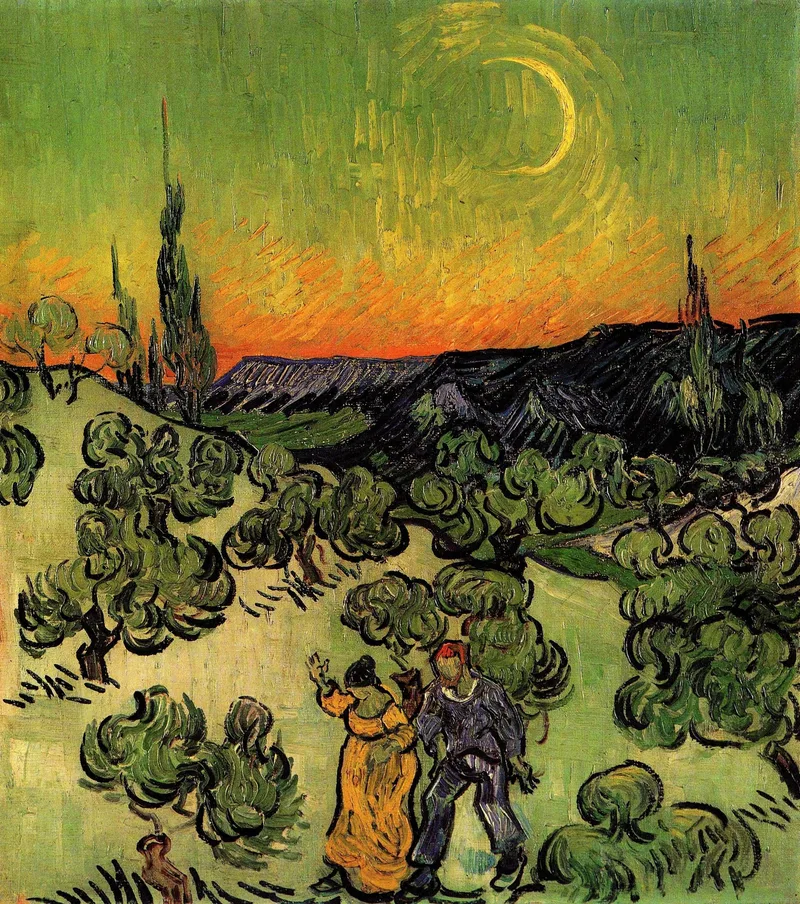
Landscape with Couple Walking and Crescent Moon (1889-90), MASP
A pair of walkers appears in this twilight scene, with a crescent moon over an orange horizon. The Museu de Arte de São Paulo (MASP), which owns it as Passeio ao crepúsculo, dates it to 1889-90 and lists it as oil on canvas, 52 by 47 centimeters, bought in 1958 [9]. MASP ties the sky to the one he saw from the asylum window at Saint-Rémy and notes that some interpreters see the red-haired man as the artist himself [9]. Find it on its artwork page.
Hand-painted in oilFrom $370See sizes
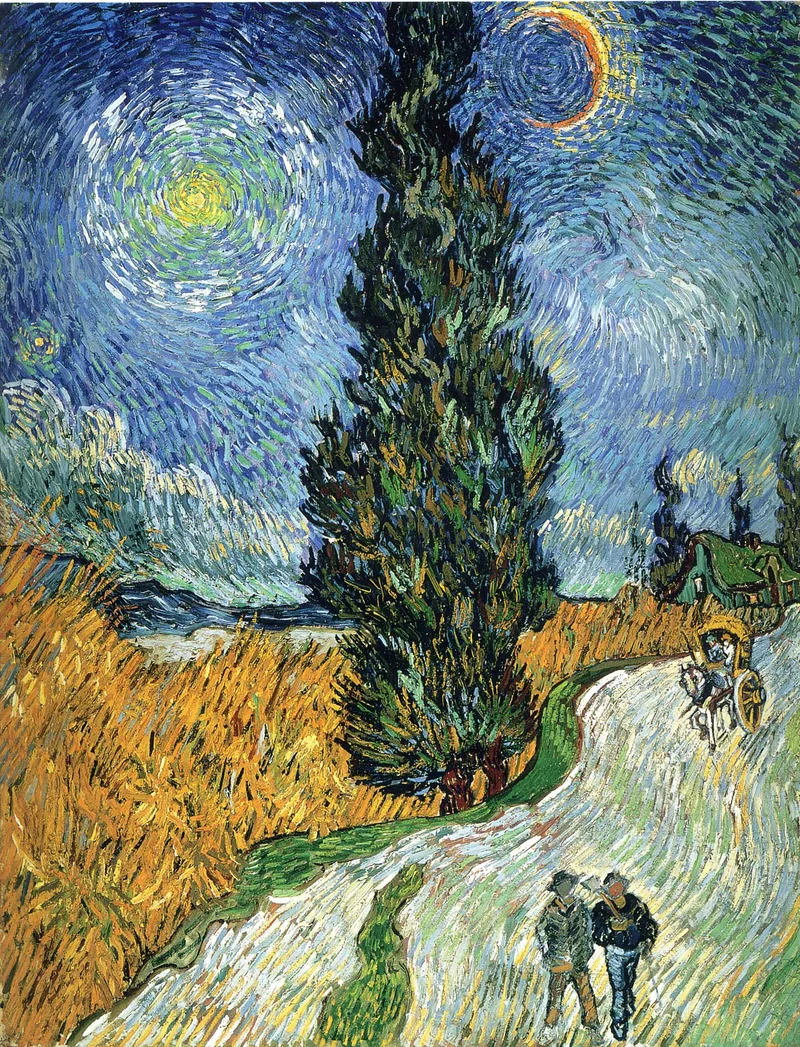
Country Road in Provence by Night (May 1890), Kröller-Müller Museum
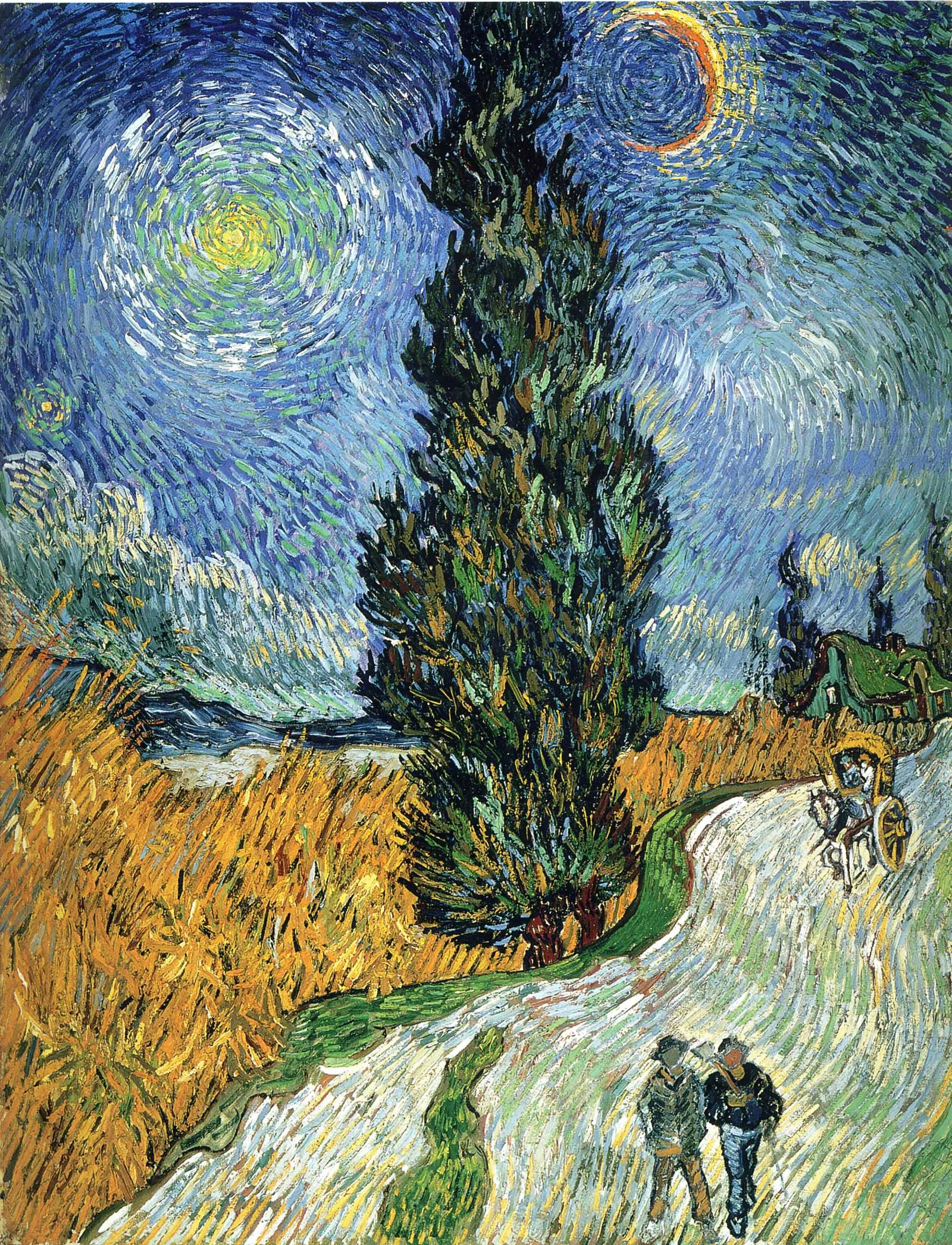
One of the last pictures he made in Provence shows a road under a tall cypress, with a crescent moon on one side and a bright star on the other, and two walkers and a carriage below. The Kröller-Müller dates Country Road in Provence by Night to about 12 to 15 May 1890 and says he painted it shortly before leaving the asylum at Saint-Rémy [7]. It is not a real place but a composition of his own, the museum adds, presumably a final reminder of Saint-Rémy and a summary of what he had seen in Provence [7].
For Van Gogh, the museum notes, the cypress was the ultimate symbol of Provence [7]. For his most famous paintings, by day and by night, see 15 famous Van Gogh paintings.
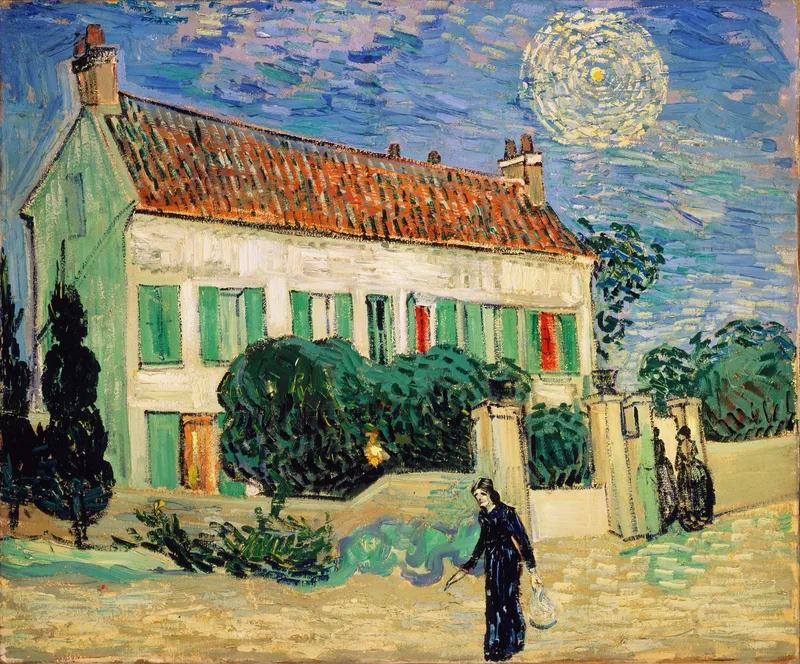
White House at Night (June 1890), Hermitage Museum
Near the end he painted a quiet house under a strange, haloed star at Auvers-sur-Oise. The Hermitage in Saint Petersburg dates White House at Night to June 1890 and lists it as oil on canvas, 59 by 72.5 centimeters [8]. Its commentary reads the picture as tense: the composition is frozen, built on stable horizontals and verticals that “can turn it into a prison”, the red splashes in the windows on the right are “alarming”, and Van Gogh would draw a star, “a sign of fate”, at moments of greatest anguish [8]. That is the museum's interpretation, not something he wrote himself.
Hand-painted in oilFrom $350See sizes
Questions and answers
Can you describe Vincent van Gogh's “The Starry Night”?
A swirling night sky over a small village, with a flame-like cypress at left. MoMA notes the bright moon at right and Venus at center left, a church steeple that looks Dutch rather than French, and whirling forms that match published astronomical observations of nebulae. It was inspired by the view from his asylum window, but painted by day [1].
How many versions of Starry Night did Van Gogh paint?
Was The Starry Night painted from life?
Only partly. MoMA says the vision took place at night, but the painting was made in several sessions during the day. The village could not be seen from his window, the cypress appears closer than it was, and he altered celestial shapes and added a sense of glow [1].
Written and fact-checked by the Vincent van Gogh Paintings editorial desk12 sourcesUpdated
Sources
- The Museum of Modern Art: Vincent van Gogh, The Starry Night, 472.1941Accessed
- Vincent van Gogh: The Letters, letter 678 to Willemien van Gogh, Arles, 9 and about 14 September 1888, with notesAccessed
- Vincent van Gogh: The Letters, letter 676 to Theo van Gogh, Arles, 8 September 1888Accessed
- Vincent van Gogh: The Letters, letter 691 to Theo van Gogh, Arles, on or about 29 September 1888Accessed
- Musée d’Orsay: Vincent van Gogh, La Nuit étoilée, RF 1975 19Accessed
- The Museum of Modern Art: Van Gogh and the Colors of the Night, exhibition checklist (PDF)Accessed
- Kröller-Müller Museum: Vincent van Gogh, Country Road in Provence by Night, KM 108.488Accessed
- The State Hermitage Museum: Vincent van Gogh, White House at NightAccessed
- MASP: Vincent van Gogh, Passeio ao crepúsculo (Landscape with Couple Walking and Crescent Moon), MASP.00113Accessed
- Van Gogh Museum: Vincent van Gogh, Evening (after Millet)Accessed
- Van Gogh Museum: Vincent van Gogh, Gauguin's ChairAccessed
- Museo Nacional Thyssen-Bornemisza: Vincent van Gogh, Evening LandscapeAccessed
Hand-painted oil reproductions
Paintings in this guide
 The Starry NightVincent van GoghFrom$350
- Café Terrace at Night (Place du Forum, Arles)Vincent van GoghFrom$350
- Starry Night Over the RhoneVincent van GoghFrom$350
 Road with CypressesVincent van GoghFrom$350
- Farmhouses in Loosduinen near The Hague at TwilightVincent van GoghFrom$350
- Landscape at DuskVincent van GoghFrom$350
- The Potato EatersVincent van GoghFrom$350
- The Night CafeVincent van GoghFrom$350
- Portrait of Eugene BochVincent van GoghFrom$350
- Paul Gauguin’s ArmchairVincent van GoghFrom$350
- Evening Landscape with Rising MoonVincent van GoghFrom$350
- Evening - The Watch (after Millet)Vincent van GoghFrom$350
- Landscape with Couple Walking and Crescent MoonVincent van GoghFrom$370
- White House at NightVincent van GoghFrom$350