
Guide
8 Scary Van Gogh Paintings and the Dark Stories Behind Them
A smoking skull, a hellish café, a bandaged ear and a field of crows, and what the records really say


The scariest Van Gogh paintings include a smoking skeleton he painted as a student joke in 1886 [1], a night café he said was a place where you can "go mad" [2], and Wheatfield with Crows, long misread as his farewell [8]. Here are eight of Van Gogh's paintings with a dark side, in the order he made them, and the true story behind each.
1. Head of a Skeleton with a Burning Cigarette (1886)
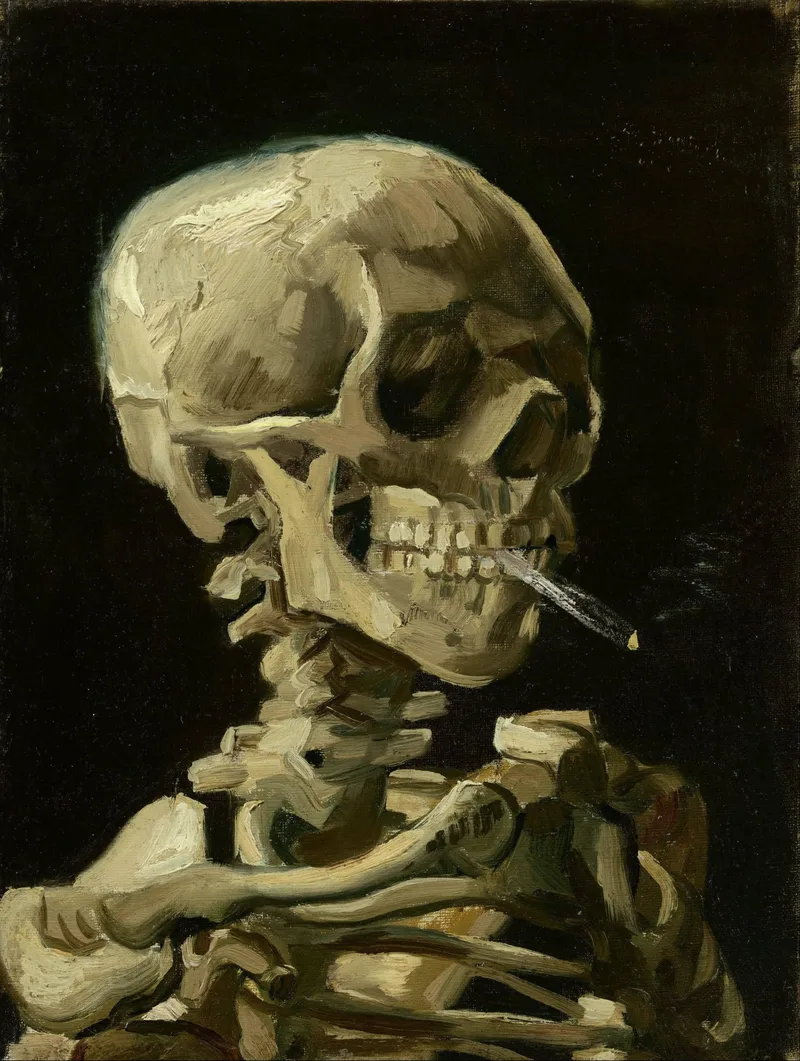
Why it is scary: a grinning skull with a lit cigarette. The real story is a joke. Head of a Skeleton with a Burning Cigarette was painted in Antwerp in January and February 1886 and measures 32.3 by 24.8 centimeters. The Van Gogh Museum catalogues it as F 212 / JH 999 and is blunt about it: "This skeleton with a lit cigarette in its mouth is a juvenile joke." [1]
Van Gogh was then a student at the Antwerp academy. Drawing skeletons was a standard exercise there, the museum explains, but painting them was not on the curriculum, so he must have made this canvas between or after lessons [1]. It also shows, the museum adds, that he had a good command of anatomy [1].
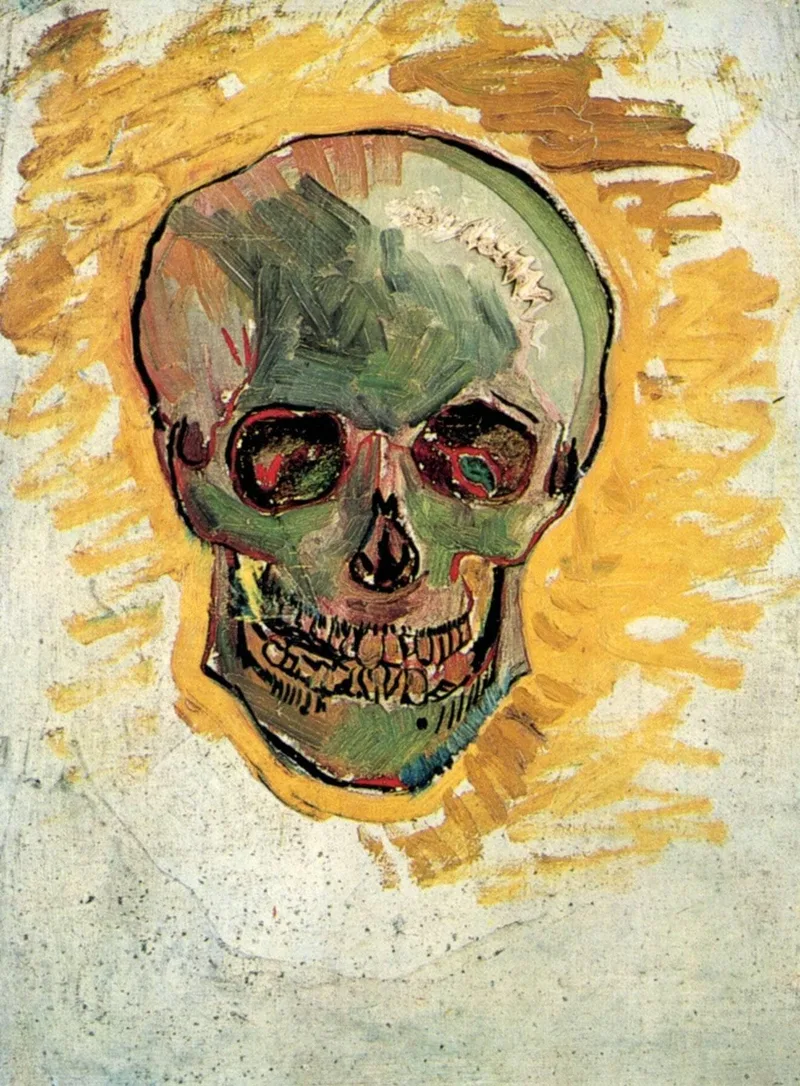
In Paris he returned to the subject. His Skull of May 1887 is a bare, staring head on a yellow halo, 42.4 by 30.4 centimeters [12]. It hides a secret: he painted it over an earlier picture, and the slow-drying zinc white he used to cover it has since cracked the top layer [12].
Hand-painted in oilFrom $350See sizes
2. The Night Café (1888)
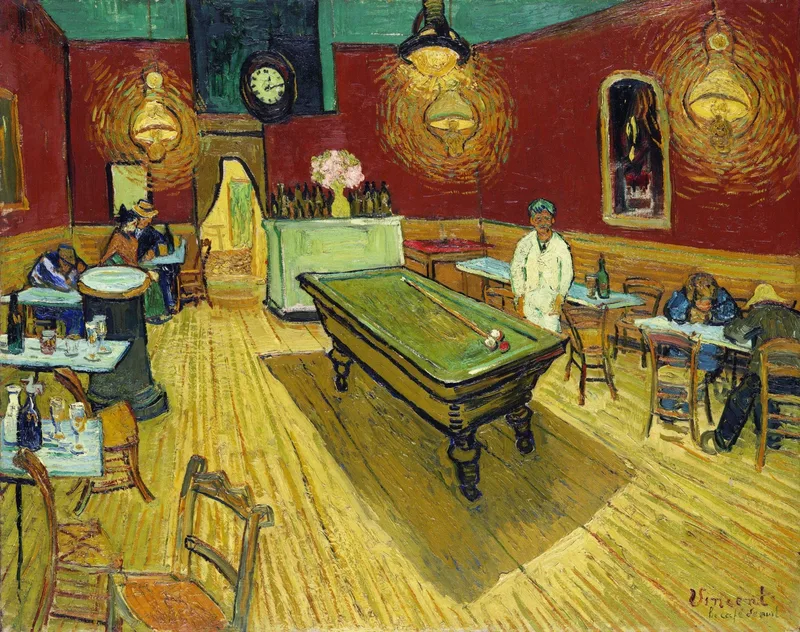
Why it is scary: a blood-red room with an empty billiard table under glaring lamps, and a man asleep at a table. In September 1888 in Arles he painted the inside of a café that stayed open all night [2][3]. On 9 September he explained it to Theo in letter 677: "In my painting of the night café I’ve tried to express the idea that the café is a place where you can ruin yourself, go mad, commit crimes." [2] He did it with color, "contrasts of delicate pink and blood-red and wine-red", in "an ambience of a hellish furnace, in pale sulphur" [2]. Then he softened it: "And yet with the appearance of Japanese gaiety and Tartarin’s good nature." [2]
The Night Café belongs to the Yale University Art Gallery, accession 1961.18.34 [3]. Yale identifies the room as the Café de la Gare, an all-night place on the Place Lamartine, and measures the canvas at 72.4 by 92.1 centimeters [3]. His other scenes after dark are gathered in Van Gogh's night paintings.
3. Self-Portrait with Bandaged Ear (1889)
Why it is scary: a bandaged head and a steady stare, painted after he mutilated himself. On 23 December 1888, after a heated argument with Paul Gauguin, Van Gogh, in utter confusion, cut off his left ear [9]. He was 35 [9]. For a long time nobody knew whether he had cut off the whole ear or part of it; drawings by his doctor, Félix Rey, found only recently, show that he cut off the entire ear [9]. The full background is in why Van Gogh cut off his ear.
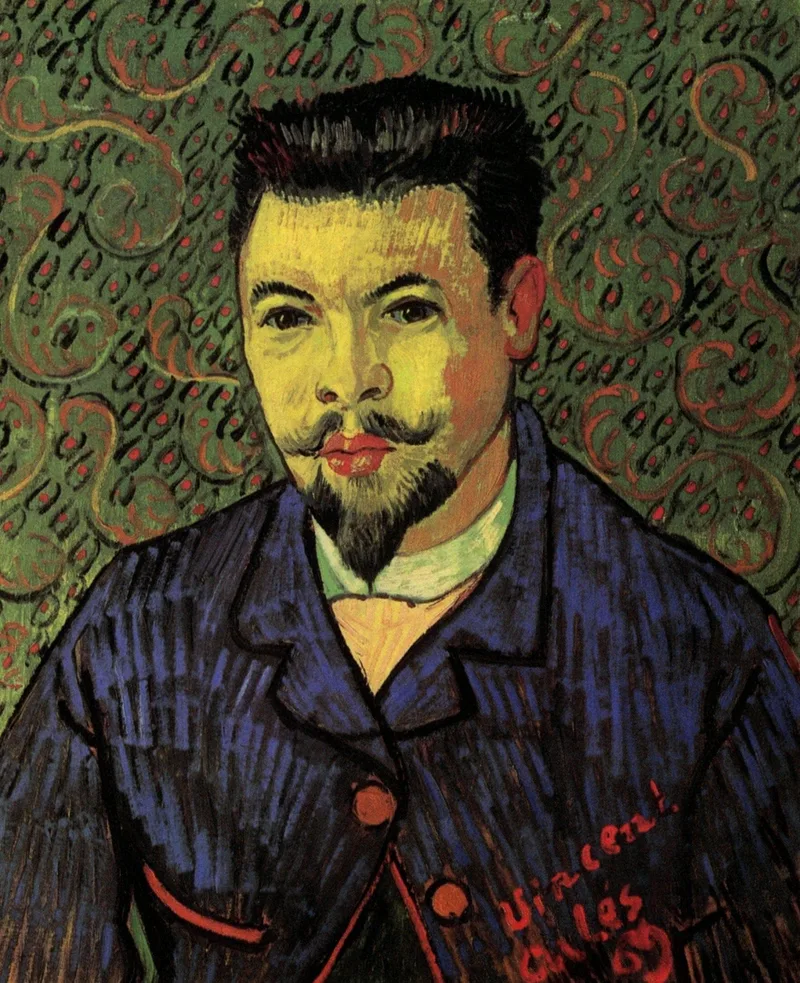
After two weeks in hospital he was allowed home and began painting again, and he painted himself twice with the bandage [9]. This version belongs to the Samuel Courtauld Trust; the other, with a pipe, is in a private collection [9]. Rey, who treated him [9], is the man in the Portrait of Doctor Félix Rey he painted in 1889.


Hand-painted in oilFrom $350See sizes
4. Still Life with a Plate of Onions (1889)
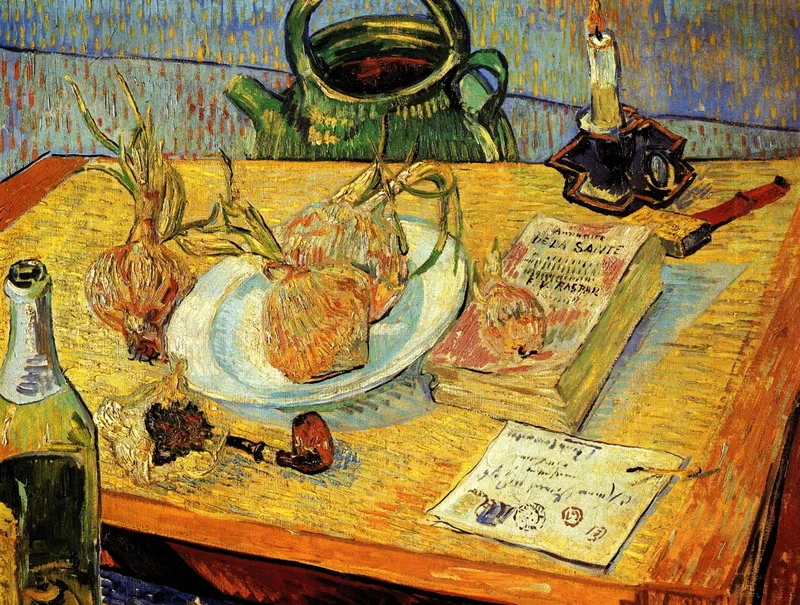
Why it is scary: nothing on the table is frightening until you read the objects. Alongside the bandaged-ear portraits, the Van Gogh Museum notes, he painted Still Life with a Plate of Onions, now in the Kröller-Müller Museum in Otterlo [9].
Almost everything on it is personal: his pipe and tobacco, the envelope of a letter from Theo, an empty bottle of absinthe, and a popular handbook he consulted to treat himself [9]. Read that way, it is a quiet record of his life just after the ear. Around it, his neighbors had become afraid of him and started a petition to have him locked up in a psychiatric hospital [9].
Hand-painted in oilFrom $350See sizes
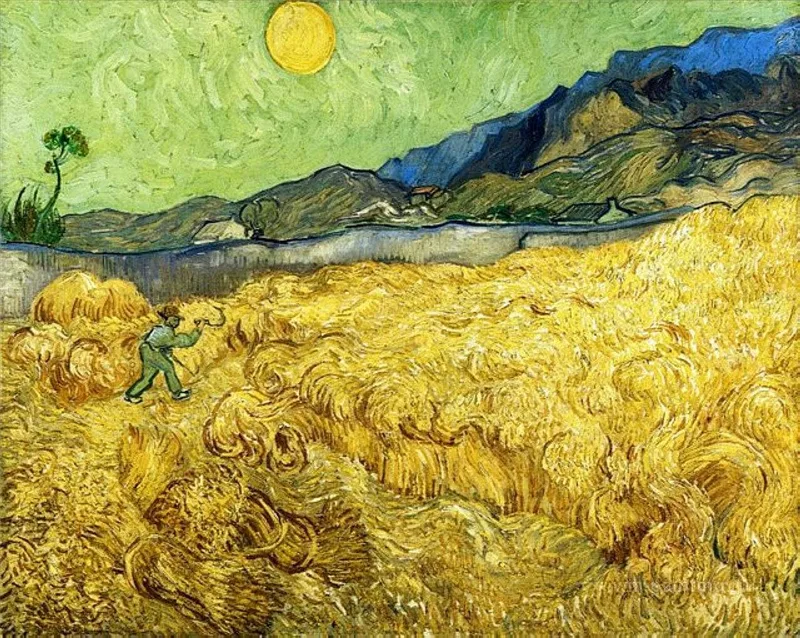
5. Wheatfield with a Reaper (1889)
Why it is scary: the reaper is death. In early September 1889 he told Theo about a man cutting wheat in the full heat of the day, in letter 800: "I then saw the image of death in it, in this sense that humanity would be the wheat being reaped." [6] The very next sentence turns it around: "But in this death nothing sad, it takes place in broad daylight with a sun that floods everything with a light of fine gold." [6] He even noticed the irony of where he stood: "I myself find that funny, that I saw it like that through the iron bars of a cell." [6]
The Van Gogh Museum holds Wheatfield with a Reaper, September 1889, 73.2 by 92.7 centimeters, F 618 [5]. He painted the walled field from his hospital room in Saint-Rémy, since for his first months there he was not allowed to leave the grounds [5]. For him, the museum says, wheat was a symbol of the eternal cycle of nature and the transience of life [5].
It is the second version. The all-yellow study he describes in the letter is F 617 [6], now at the Kröller-Müller Museum, which dates it from late June to early September 1889 [10]. F 618 is the repetition he was working on in the same letter [6]. Death, in other words, painted almost entirely in yellow, twice. Planning a trip to Amsterdam? Our list of must-see paintings at the Van Gogh Museum has more.


6. Pietà, after Delacroix (1889)
Why it is scary: a mother holding her dead son, painted by a man in an asylum. He took the theme and composition from a lithograph of a painting by Eugène Delacroix [4]. The Van Gogh Museum dates it to September 1889, 73 by 60.5 centimeters, F 630 / JH 1775, and calls it "more a variation on the original work than a copy" because he added his own color and handling [4].
It began with an accident. Van Gogh wrote that his lithograph had fallen into oil and paint and been spoiled, and that he occupied himself by painting it instead; the stained print still survives [4]. The museum also wonders whether he identified with the dead Christ, and quotes him telling Theo that, in his suffering, religious thoughts sometimes consoled him a great deal [9]. For pictures he explained in his own words, see what Van Gogh's paintings mean.


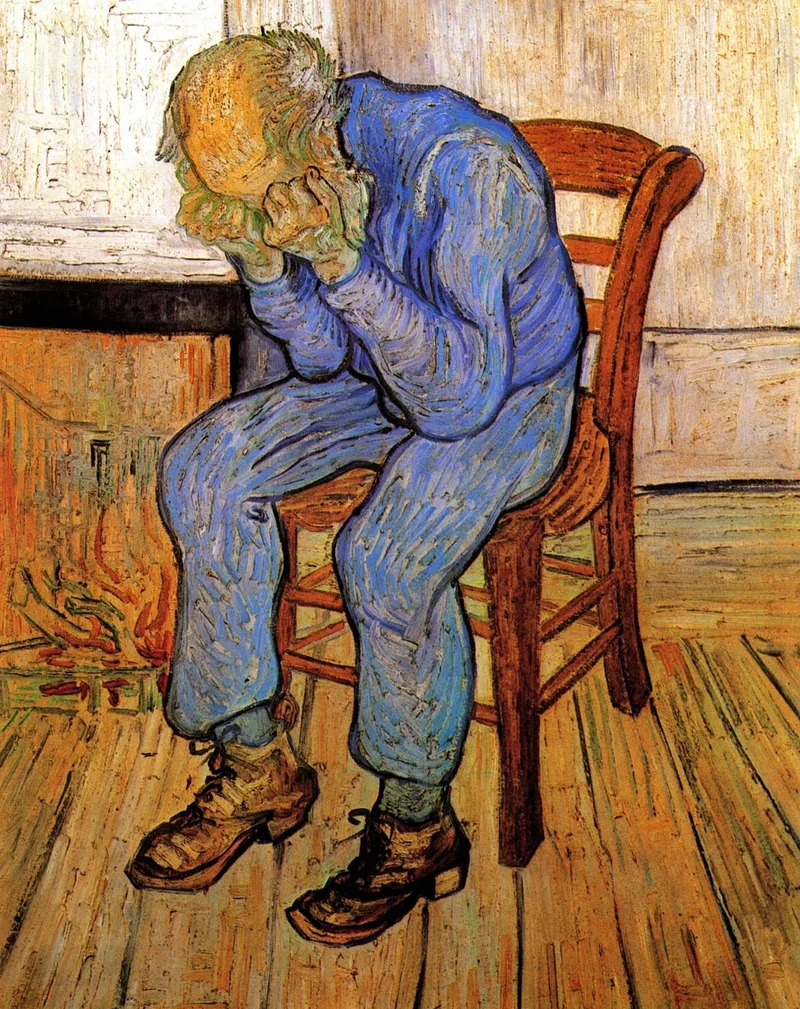
7. Sorrowing Old Man ('At Eternity's Gate') (1890)
Why it is scary: a man in blue on a chair by the fire, his face buried in his fists. Sorrowing Old Man is dated by the Kröller-Müller Museum to May 1890, oil on canvas, KM 111.041 [7].
Its story is about getting back to work. At the end of April 1890 Van Gogh was recovering from another deep depression and decided to rework some of his old figure drawings; this one repeats a drawing he made in The Hague in 1882 [7]. He had already made a lithograph of the same image in November 1882, of which seven impressions are known [11]. For the painting he changed the composition, possibly used the asylum's chair and stove, and likely asked a patient to pose [7]. The despair in the picture is real, but the canvas came from a plan to start painting again.


Hand-painted in oilFrom $350See sizes
8. Wheatfield with Crows (1890)
Why it is scary: black birds under a storm sky, and a path that leads nowhere. It dates from July 1890, the month of his death, and has traditionally been called his last painting, but The Art Newspaper's Van Gogh specialist Martin Bailey calls that a myth: recent research shows the work he painted on the morning he shot himself was Tree Roots [8]. The circumstances are covered in how Van Gogh died.
The ominous reading has a history. Theo's wife, Jo Bonger, wrote decades later that the catastrophe approached "like the ominous black birds that dart through the storm over the wheatfields" [8]. Irving Stone's 1934 novel Lust for Life and the 1956 film, which ends with Kirk Douglas painting the crows just before a gunshot, fixed the link in the public mind [8]. Van Gogh himself told Theo and Jo that in these wheatfields under turbulent skies he had tried to express sadness and extreme loneliness, and that the canvases would also show what he found healthy and fortifying about the countryside [8]. Bailey sees both: real foreboding, and ripening wheat, soaring birds and volatile weather that make it "full of life" [8]. The field lay on the plateau above Auvers-sur-Oise, five minutes' walk from his inn [8].


Questions and answers
What are some dark facts about Vincent van Gogh's life?
He cut off his left ear in December 1888 and suffered repeated attacks afterward. His neighbors in Arles petitioned to have him locked up, and in May 1889 he voluntarily entered the psychiatric hospital in Saint-Rémy. In July 1890 he shot himself in the chest [9].
Was Wheatfield with Crows Van Gogh's last painting?
Probably not. It dates from July 1890 and was long called his last work, but Martin Bailey of The Art Newspaper says recent research shows he painted Tree Roots on the morning he shot himself. The link to his death was fuelled by a 1934 novel and a 1956 film [8].
What did Van Gogh want The Night Café to feel like?
In letter 677 he wrote that he tried to express the idea that the café is a place where you can ruin yourself, go mad, commit crimes. He used pink, blood-red and wine-red, but also kept some Japanese gaiety [2].
Is Van Gogh's skeleton with a cigarette a serious painting?
The Van Gogh Museum calls it a juvenile joke. He painted it in early 1886 while studying at the art academy in Antwerp, where drawing skeletons was a standard exercise, though painting them was not on the curriculum [1].
Written and fact-checked by the Vincent van Gogh Paintings editorial desk12 sourcesUpdated
Sources
- Van Gogh Museum: Head of a Skeleton with a Burning Cigarette, s0083V1962Accessed
- Vincent van Gogh, The Letters: letter 677 to Theo van Gogh, Arles, 9 September 1888, with notesAccessed
- Yale University Art Gallery: Vincent van Gogh, Le café de nuit (The Night Café), 1961.18.34Accessed
- Van Gogh Museum: Pietà (after Delacroix), s0168V1962Accessed
- Van Gogh Museum: Wheatfield with a Reaper, s0049V1962Accessed
- Vincent van Gogh, The Letters: letter 800 to Theo van Gogh, Saint-Rémy, 5 and 6 September 1889, with notesAccessed
- Kröller-Müller Museum: Sorrowing Old Man ('At Eternity's Gate'), KM 111.041Accessed
- The Art Newspaper (Martin Bailey): Van Gogh's mysterious Wheatfield with Crows, what does it really mean?Accessed
- Van Gogh Museum: Vincent's Illness and the Healing Power of ArtAccessed
- Kröller-Müller Museum: Wheat Field with Reaper and Sun, KM 101.173Accessed
- Van Gogh Museum: At Eternity's Gate (lithograph), p0007V1962Accessed
- Van Gogh Museum: Skull, s0123V1962Accessed
Hand-painted oil reproductions
Paintings in this guide
- Skull of a Skeleton with Burning CigaretteVincent van GoghFrom$350
- The Night CafeVincent van GoghFrom$350
- Wheat Field with Reaper and SunVincent van GoghFrom$350
- SkullVincent van GoghFrom$350
 Portrait of Dr. Felix ReyVincent van GoghFrom$350
- Still Life with Drawing Board, Pipe, Onions and Sealing-WaxVincent van GoghFrom$350
- Old Man in Sorrow (On the Threshold of Eternity)Vincent van GoghFrom$350