
Guide
How Did Van Gogh Die? What Happened in Auvers in July 1890
His last weeks in Auvers, told through his letters, the paintings he made there and the people who were beside him


Van Gogh died on 29 July 1890 in Auvers-sur-Oise, France, two days after he shot himself in the chest with a revolver in a field near the village [1][2]. He was 37 [10]. He walked back to his inn badly wounded and told the innkeeper “I tried to kill myself”, and his brother Theo was with him when he died [1][2].
What happened in Auvers in July 1890?
Van Gogh left the psychiatric clinic at Saint-Rémy in May 1890, hoping to live independently with his condition, and arrived in Auvers-sur-Oise, an artists’ village about 30 kilometers from Paris, on 20 May [1]. He wanted to be closer to Theo, and the village had a doctor, Paul Gachet, who could keep an eye on him [1]. He found a certain peace there and soon began to paint prolifically, about seventy pictures in roughly two months, more than one a day, by the Musée d’Orsay’s count, the final chapter of Van Gogh’s paintings [1][8]. The Auvers-sur-Oise period gathers that work in one place.
On Sunday 27 July he did not come back for his evening meal, and the Ravoux family, who knew how punctual he was about dinner, began to worry [1][5]. Around nine o’clock he came in badly wounded. When Arthur Ravoux asked what he had done, he replied: “I tried to kill myself” [1]. Dr Gachet examined the wound and wrote to Theo that “he has wounded himself” [5]. Theo rushed from Paris the next morning and never left the bedside; Vincent was conscious, and the brothers were able to talk [1]. He died in the night, on 29 July 1890, with Theo beside him [1][2]. The table below puts the last weeks in order.
| Date | What happened | Source |
|---|---|---|
| 20 May 1890 | Arrives in Auvers and meets Dr Gachet | [1] |
| About 10 July 1890 | Letter 898: “my life, too, is attacked at the very root” | [3] |
| 23 July 1890 | Begins the unfinished letter later found on him | [4] |
| 27 July 1890, about 9 p.m. | Returns to the Auberge Ravoux with a gunshot wound | [1] |
| 28 July 1890 | Theo, told that morning, rushes from Paris to the bedside | [1] |
| 29 July 1890 | Vincent dies, with Theo at his bedside | [1][2] |
| 30 July 1890, 3 p.m. | Funeral cortège from the inn to the cemetery | [1] |
| 1905 and 1914 | Remains reinterred; Theo, who died in 1891, laid beside him | [1] |
Dates follow the Van Gogh Museum’s account of the last days [1] and the letters edition [3][4]. The 23 July letter was never finished or sent [4].
How did Van Gogh spend his last weeks in Auvers?
He worked, and he worked fast. He rented a small attic room at the Auberge Ravoux, used the “Painter’s Room” downstairs to paint and store his canvases, and set off each day to work in the countryside around the village [1]. The Ravoux family grew used to the routine [1].
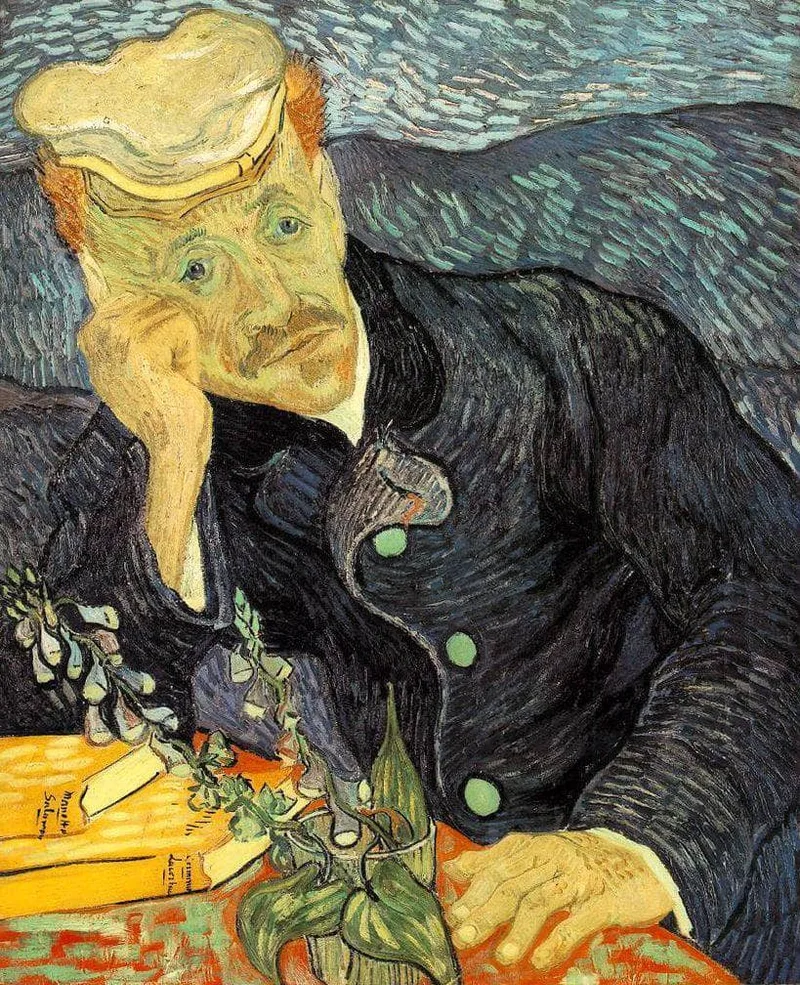
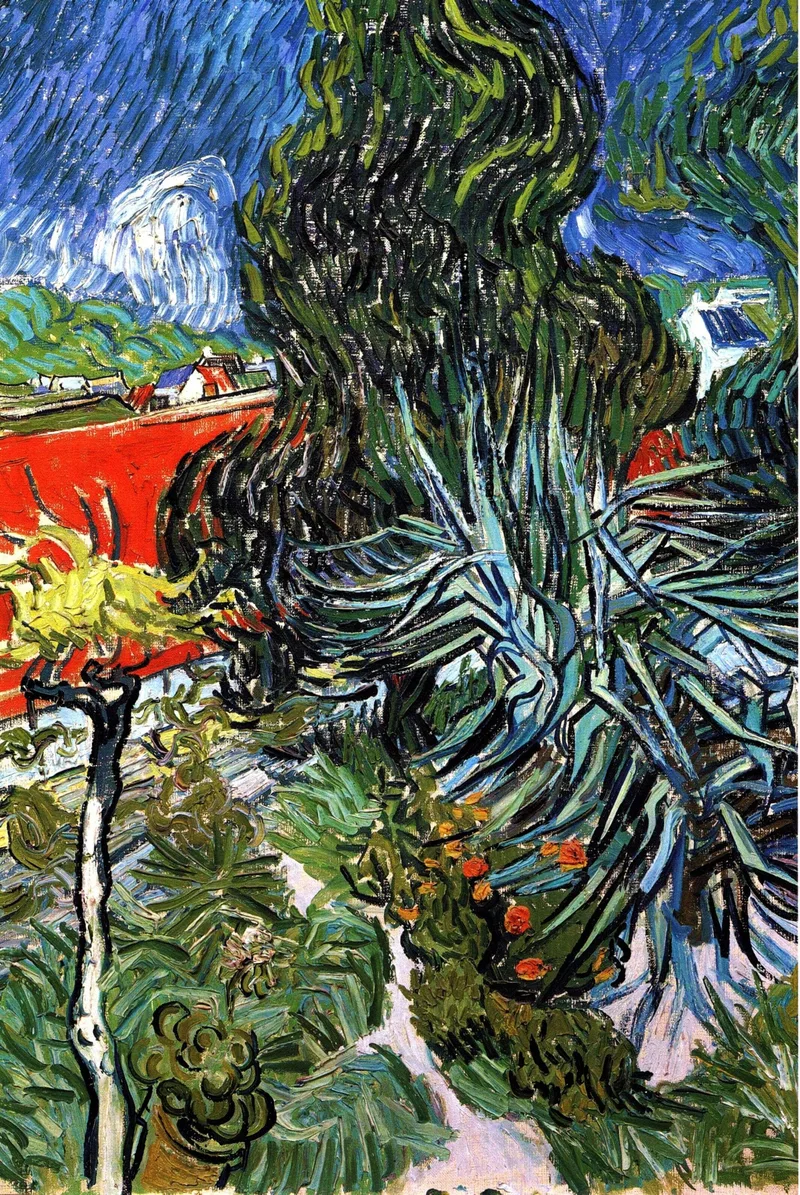
Dr Gachet became a regular stop. Vincent visited his home often; Gachet did not treat him as a patient, but talked with him at length and encouraged him to paint [1]. Gachet was an art lover and taught Vincent to etch, which is how the small print of the doctor with his pipe came to be made [1]. In June Vincent also painted him in oil, in the Portrait of Doctor Gachet [5]. The innkeeper’s daughter, Adeline Ravoux, was 13 that summer, and he painted her portrait too [11].
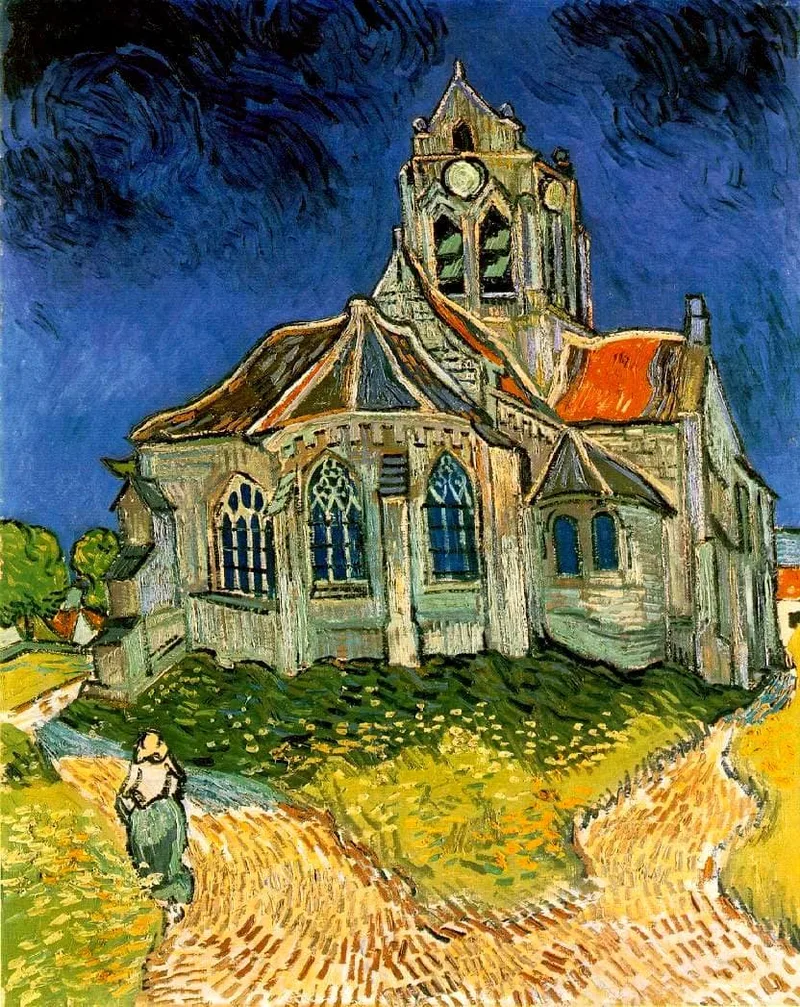
One canvas stands out for the village itself. The Church at Auvers is, in the Musée d’Orsay’s words, the only painting that represents the Auvers church in full [8].

Hand-painted in oilFrom $350See sizes

.jpg)


Hand-painted in oilFrom $350See sizes
Why did Van Gogh take his own life?
His letters show that his mental health had been getting worse since the beginning of July [1]. After a visit to Theo and Jo in Paris that did not go smoothly, he wrote to them that “my life, too, is attacked at the very root, my step also is faltering” [3]. In the same letter he described new canvases of “immense stretches of wheatfields under turbulent skies”, in which he had tried “to express sadness, extreme loneliness” [3]. The letters edition names two likely candidates, F 778 (the Van Gogh Museum’s Wheatfield under Thunderclouds) and the Wheatfield with Crows at the top of this page [3]. The museum adds that he was exhausted, uncertain about the future and felt he had failed as a man and as an artist, even though he was starting to win recognition [2].
Increasing loneliness and the idea that he was nothing but a burden to Theo, who now had a wife, a baby son and trouble at work, might have contributed, the museum says [1][5]. Experts brought together by the Van Gogh Museum in 2016 found that he recovered after each earlier crisis and could work, but that his anxiety and loneliness grew steadily until 27 July [9]. A 2020 study describes severe depressive episodes from which he never fully recovered [10]. His first crisis, in Arles, is told in why Van Gogh cut off his ear, and his final letters can be read with our guide to Van Gogh’s letters.


“Ah well, I risk my life for my own work and my reason has half foundered in it”
What were Van Gogh’s last words?
There is no single agreed record, because what we have comes from Theo’s letters, written down afterward. Theo told their mother that Vincent said, “I would so like to go,” and that an hour later he had his wish: “Life weighed so heavily on him” [1]. Three days after Vincent’s death, Theo wrote more to his wife Jo: “One of his last words was: this is how I wanted to go & it took a few moments & then it was over & he found the peace he hadn’t been able to find on earth” [5]. The famous line “the sadness will last forever” does not appear in these sources.
Was Van Gogh murdered?
The idea surfaced seriously in 2011, when Steven Naifeh and Gregory White Smith argued in Van Gogh: The Life that a 16-year-old summer visitor, René Secrétan, shot him and that Van Gogh protected the boy by claiming suicide [5]. Their case rests on an interview Secrétan gave in 1957 [5]. In 2020 three authors test-fired the same model of revolver at different ranges and concluded that, without a described powder burn, a self-inflicted wound was not probable, while admitting that “it is clearly impossible to definitively prove suicide or murder” [7].
Martin Bailey of The Art Newspaper sets out the case against. Gachet, Theo, Émile Bernard and Gauguin all described a suicide; Secrétan never said he fired the shot; and the innkeeper’s daughter, Adeline Ravoux, later recalled Vincent telling the police that what he had done was nobody else’s business, although she said so in the 1950s [5]. The Van Gogh Museum is blunt: “Vincent himself stated that he had attempted to take his own life. The recently raised theory that he had been shot by schoolboys is entirely unfounded and can be dismissed.” [1]
Where is Van Gogh buried?
The Catholic priest in Auvers refused to hold the funeral in his church, presumably because he saw the death as a suicide [5]. So at three o’clock on Wednesday 30 July the cortège left the Auberge Ravoux for the cemetery, led by Theo and followed by friends from Paris, the Ravoux family, neighbors and villagers [1]. Theo wrote that the grave lay “in a sunny spot amid the wheatfields” [1]. Theo himself died in 1891; Vincent’s remains were reinterred in 1905, and Theo was laid beside him in 1914 [1].
When he died, his work was known only to a small circle, but that changed quickly after 1900, thanks to the efforts of his sister-in-law, Jo van Gogh-Bonger [1]. How little he sold in his lifetime is the subject of how many paintings Van Gogh sold.
Questions and answers
What were Van Gogh’s last words?
Where did Van Gogh shoot himself?
In a field near Auvers, according to the Van Gogh Museum [2]. Émile Bernard wrote that he went “behind the château”; the traditional spot is a wheatfield behind the Château de Léry, but the researcher Wouter van der Veen has proposed that the “château” was a smaller mansion a minute’s walk from the inn [6].
How old was Van Gogh when he died?
He was 37. He died on 29 July 1890 from the consequences of a gunshot wound he had inflicted on himself two days earlier [10].
Did Van Gogh shoot himself in the chest or the stomach?
Written and fact-checked by the Vincent van Gogh Paintings editorial desk11 sourcesUpdated
Sources
- Van Gogh Museum: The Last Days of Vincent van GoghAccessed
- Van Gogh Museum: Vincent van Gogh’s DeathAccessed
- Vincent van Gogh, The Letters: letter 898, to Theo van Gogh and Jo van Gogh-Bonger, Auvers-sur-Oise, on or about 10 July 1890Accessed
- Vincent van Gogh, The Letters: RM25, unfinished letter to Theo van Gogh, Auvers-sur-Oise, 23 July 1890Accessed
- The Art Newspaper (Martin Bailey): Van Gogh’s suicide, ten reasons why the murder story is a myth (revised 20 June 2025)Accessed
- The Art Newspaper (Martin Bailey): Where did Van Gogh shoot himself? (20 October 2023)Accessed
- Arenberg, Di Maio and Baden, “A Reevaluation of the Death of Vincent van Gogh: Suicide or Murder?”, American Journal of Forensic Medicine and Pathology 41 (2020), PubMed abstractAccessed
- Musée d’Orsay: The Church in Auvers-sur-Oise, View from the Chevet (Google Arts & Culture)Accessed
- Van Gogh Museum: Expert Meeting and Symposium On the Verge of Insanity (September 2016)Accessed
- Nolen, van Meekeren, Voskuil and van Tilburg, “New vision on the mental problems of Vincent van Gogh”, International Journal of Bipolar Disorders 8 (2020), PubMed abstractAccessed
- Cleveland Museum of Art: Adeline Ravoux, Vincent van Gogh, 1890 (1958.31)Accessed
Hand-painted oil reproductions