Hand-painted in oil
About this Artwork
Auvers, 1890
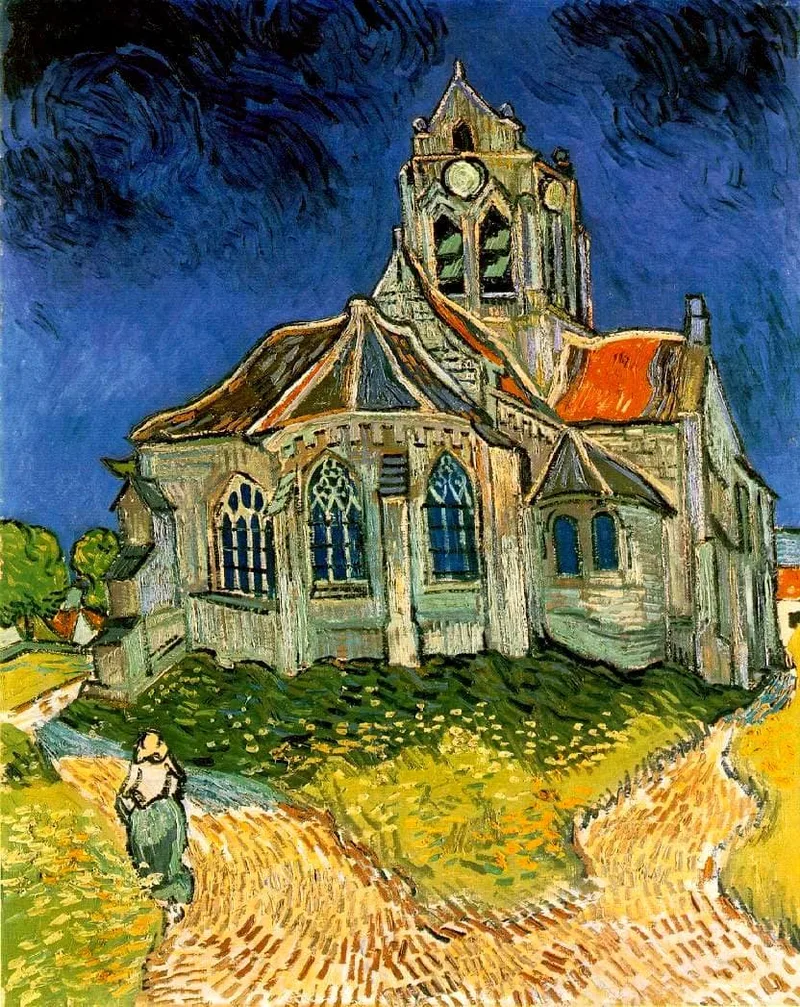
The last of the five places, and the shortest: roughly seventy days between arrival and death, with about as many canvases. This catalogue lists twenty-one works whose titles name Auvers, all dated 1890, and this church is among them. The record files it under landscape and under cultural heritage, religious — the building is the subject, not a congregation or a rite.
The palette at the end
Three families are measured here: yellow, indigo and green. Three is more than most works in this catalogue carry, and the presence of indigo alongside yellow is the contrast that the Auvers and Saint-Rémy canvases return to. By 1890 brown and ochre together account for about one work in ten, against roughly seven in ten in 1884.
What the record holds
1890, 74 by 94 cm, held at the Musée d'Orsay in Paris. A great deal is said elsewhere about this painting; what the record sustains is a church at Auvers, painted in the final year, now in Paris.
Sources
4 references- Vincent van Gogh — Wikipedia
Vincent Willem van Gogh (Dutch: [ˈvɪnsɛnt ˈʋɪləɱ vɑŋ ˈɣɔx] ; 30 March 1853 – 29 July 1890) was a Dutch Post-Impressionist painter who is among the most famous and influential figures in the history of Western art. In just over a decade he c
- The Church at Auvers — Wikidata
description: painting by Vincent van Gogh; inception: 1890-06; dimensions: 94 × 74 cm; collection: Musée d'Orsay
- The Church at Auvers — Wikipedia
The Church at Auvers is an oil painting created by Dutch Post-Impressionist artist Vincent van Gogh in June 1890 which now hangs in the Musée d'Orsay in Paris, France. The painting depicts the Église Notre-Dame-de-l'Assomption in Auvers-sur
- Vincent van Gogh - The Church in Auvers-sur-Oise, View from the Chevet - Google Art Project — Wikimedia Commons
High-resolution image of the work, hosted on Wikimedia Commons.