Guide
The Story Behind Van Gogh's Café Terrace at Night (1888)
A real café, a sky full of stars, and a painter working by gaslight in the street
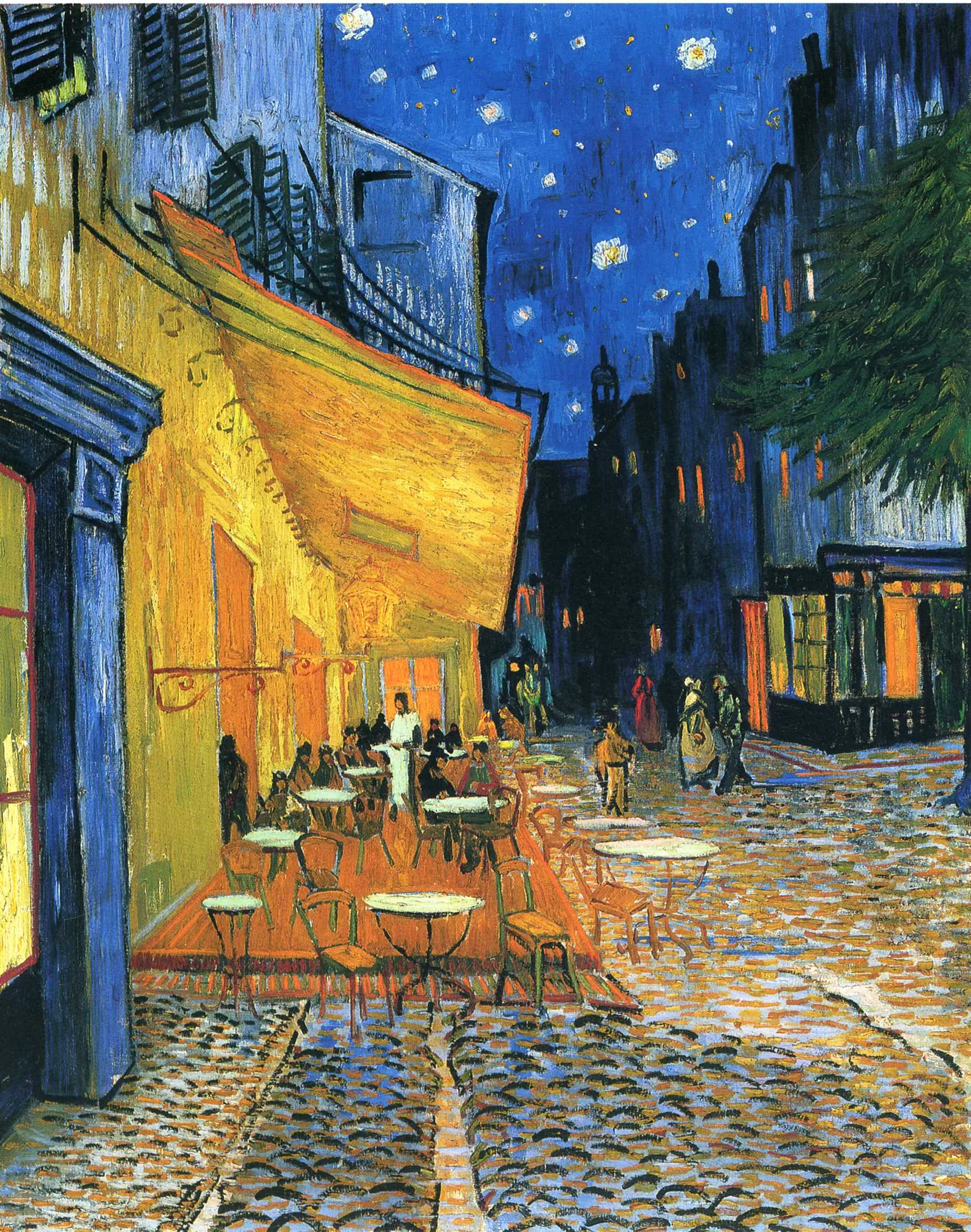
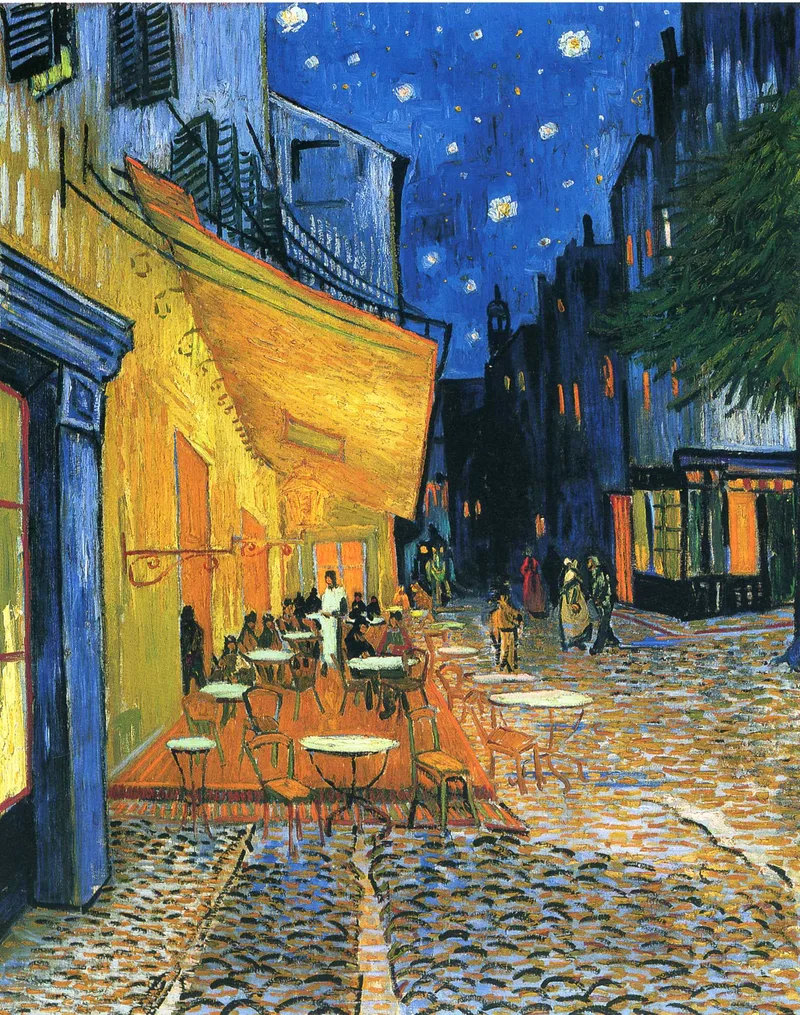
Van Gogh painted Café Terrace at Night on the spot, after dark, on the Place du Forum in Arles in mid-September 1888 [1][2]. He told his sister it was "a painting of night without black" [2]. The café was real, he knew it well [4], and the canvas now hangs in the Kröller-Müller Museum in Otterlo, the Netherlands [1].
A week of night work in Arles
On Sunday, 16 September 1888, Van Gogh listed his week's work for his brother Theo in letter 681. After a garden picture, he wrote: "The second shows the outside of a café, lit on the terrace outside by a large gas-lamp in the blue night, with a patch of starry blue sky." [3] The editors of the letters identify that canvas as Café terrace at night, F 467 / JH 1580 [3], and place its making in the week of 10 to 15 September [2].
The Kröller-Müller dates the painting to about 16 September 1888 [1]. It also points to a lovely detail: later astronomical research found the constellations painted just as they appeared on the night of 16 or 17 September 1888 [1]. The canvas measures 80.7 by 65.3 centimeters, a little smaller than the no. 30 canvases, roughly 92 by 73 centimeters, that he used for most of the paintings he listed to his friend Eugène Boch on 2 October [4]. For the rest of that busy year, see Van Gogh in Arles.
The real café on the Place du Forum
The place was real. The letters edition identifies the pavement café as the Grand Café du Forum, on the Place du Forum in Arles [2]. He and Boch used to go there. Writing to the Belgian painter Eugène Boch on 2 October 1888, in letter 693, he listed among his new canvases "a view of the café on place du Forum, where we used to go, painted at night." [4]
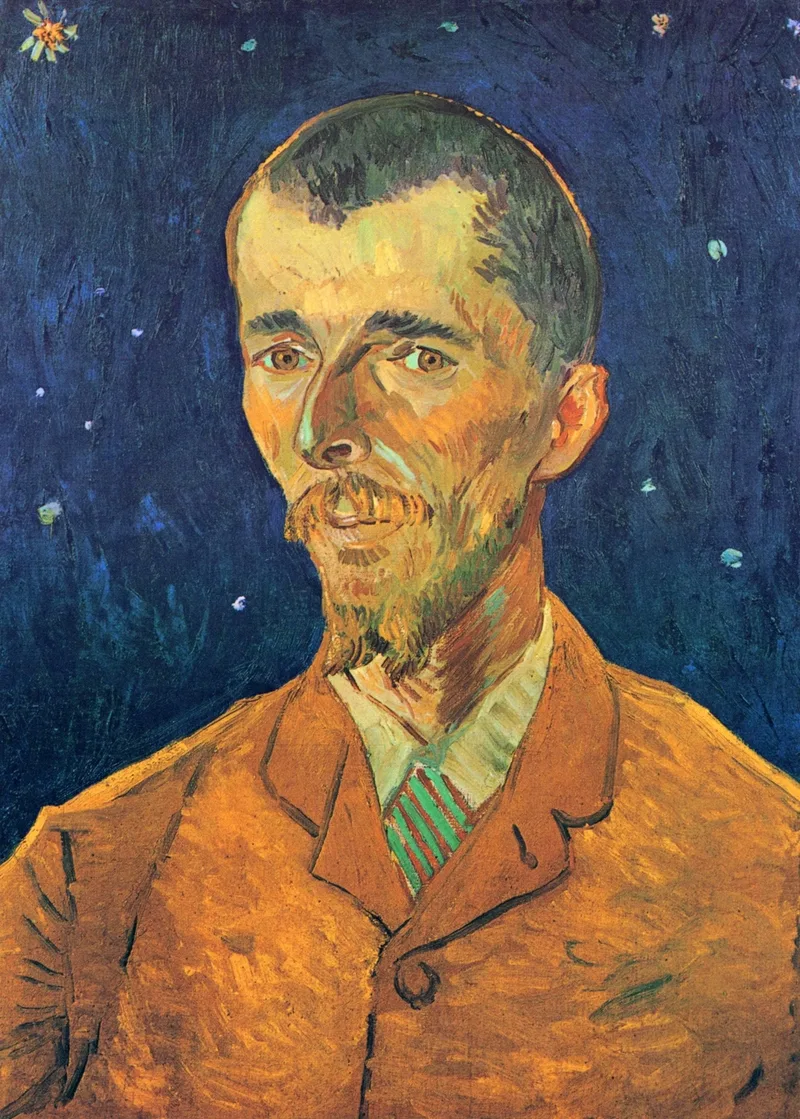
He had also painted Boch himself. In the first part of letter 678, written on 9 September, he described "the portrait of a young Belgian Impressionist", "something of a poet", his head standing out against a deep ultramarine night sky with the twinkling of the stars [2]. The editors identify it as the portrait of Eugène Boch, known as The Poet [2].
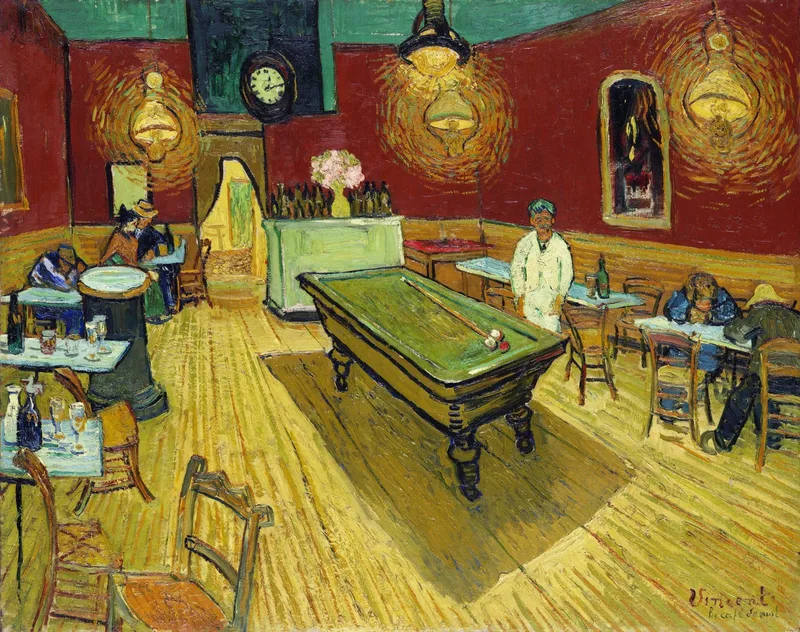
The terrace was not his first café that month. A few days earlier, in that same letter, he told his sister Willemien: "I’ve just finished a canvas of a café interior at night, lit by lamps." [2] That interior is The Night Café, a red room with a green billiard table [2]. The terrace took the same subject outdoors, into the street.
Hand-painted in oilFrom $350See sizes
The letter that describes the painting
The fullest description is in the second part of letter 678 to Willemien, written around 14 September 1888 [2]. He described the gables of the houses as dark blue or violet, with a green tree, under a blue sky studded with stars, and then summed it up: "Now there’s a painting of night without black." [2]
The same letter names a literary spark. He asked whether Willemien had read Guy de Maupassant's novel Bel-Ami, because its opening describes "a starry night in Paris, with the lighted cafés of the boulevard", and "it’s something like the same subject that I’ve painted just now." [2] The editors add a gentle correction: Maupassant's opening describes brightly lit cafés on a summer evening but never mentions a starry sky [2]. If you want to read letters like this one yourself, start with our guide to reading Van Gogh's letters.
“On the terrace, there are little figures of people drinking. A huge yellow lantern lights the terrace, the façade, the pavement, and even projects light over the cobblestones of the street, which takes on a violet-pink tinge.”
Painting outdoors, after dark
"I enormously enjoy painting on the spot at night," he told Willemien [2]. He admitted the risk: "It’s quite true that I may take a blue for a green in the dark, a blue lilac for a pink lilac, since you can’t make out the nature of the tone clearly." [2] The Kröller-Müller explains why he accepted it: he painted the terrace in situ and in the dark because colors look different at night than by day [1].
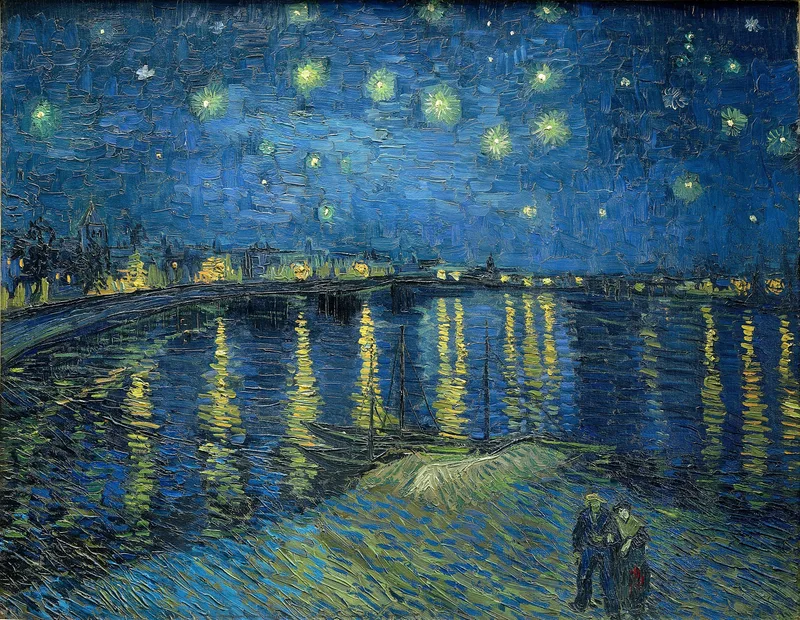
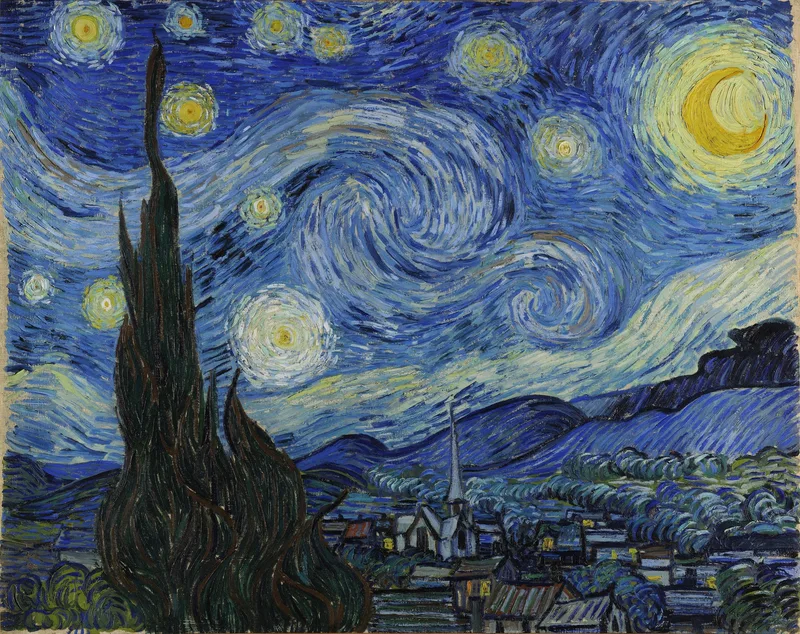
The terrace was a first. The Musée d'Orsay calls it the first corner of night sky he painted, followed by the view of the Rhône now in Paris [5]. That next canvas, Starry Night Over the Rhône, is a different picture from The Starry Night, which the museum says came a few months later, after he was confined to a mental institution [5]. Our guide to the two Starry Nights separates them.
Hand-painted in oilFrom $350See sizes
What the picture shows, and what people read into it
The Kröller-Müller points to the strongest effect: the warm yellow, green and orange under the awning set against the deep blue of the starry sky, made deeper by the dark blue houses behind [1]. Joachim Pissarro, who curated MoMA's exhibition of the night pictures, told Smithsonian magazine that "in paintings such as the Arles café at night, his touch is more restrained and you really see his intelligence at work." [6]
That is a curator's reading, and it is labeled as one. The three letters quoted here talk about color, gaslight, painting on the spot and a novel [2][3][4]; none of them assigns the café a hidden message. His other night canvases from Arles and Saint-Rémy are gathered in Van Gogh's night paintings, and the bigger question of symbolism is in what Van Gogh's paintings mean.
Where to see Café Terrace at Night today
The painting belongs to the Kröller-Müller Museum in Otterlo, inventory KM 108.565, and on 12 October 2026 the museum's page listed it as on display [1]. The museum owns 88 Van Gogh paintings, most of them bought between 1908 and 1930 by its founder, Helene Kröller-Müller [7].
As of October 2026, the museum is showing all 88 together for the first time since 1984, in the exhibition Van Gogh, All Our Paintings, which runs from 15 September 2026 to 3 January 2027, with the café terrace among the highlights [7]. For other pictures worth a trip, start with 15 famous Van Gogh paintings and where to see them.
Questions and answers
Where is Vincent van Gogh Café Terrace at Night?
What is the story behind Van Gogh?
Did Van Gogh paint Café Terrace at Night outdoors, at night?
Written and fact-checked by the Vincent van Gogh Paintings editorial desk9 sourcesUpdated
Sources
- Kröller-Müller Museum: Vincent van Gogh, Terrace of a Café at Night (Place du Forum), KM 108.565Accessed
- Vincent van Gogh, The Letters: letter 678 to Willemien van Gogh, Arles, 9 and about 14 September 1888, with notesAccessed
- Vincent van Gogh, The Letters: letter 681 to Theo van Gogh, Arles, 16 September 1888, with notesAccessed
- Vincent van Gogh, The Letters: letter 693 to Eugène Boch, Arles, 2 October 1888, with notesAccessed
- Musée d'Orsay: Vincent van Gogh, La Nuit étoilée, RF 1975 19Accessed
- Smithsonian Magazine: Van Gogh's Night VisionsAccessed
- Kröller-Müller Museum: Van Gogh, All Our Paintings (exhibition, 15 September 2026 to 3 January 2027)Accessed
- Van Gogh Museum: Vincent van GoghAccessed
- Van Gogh Museum: Why Did Vincent van Gogh Cut off His Ear?Accessed
Hand-painted oil reproductions