
The Starry Night vs Starry Night Over the Rhône
Published · Art & See editorial desk
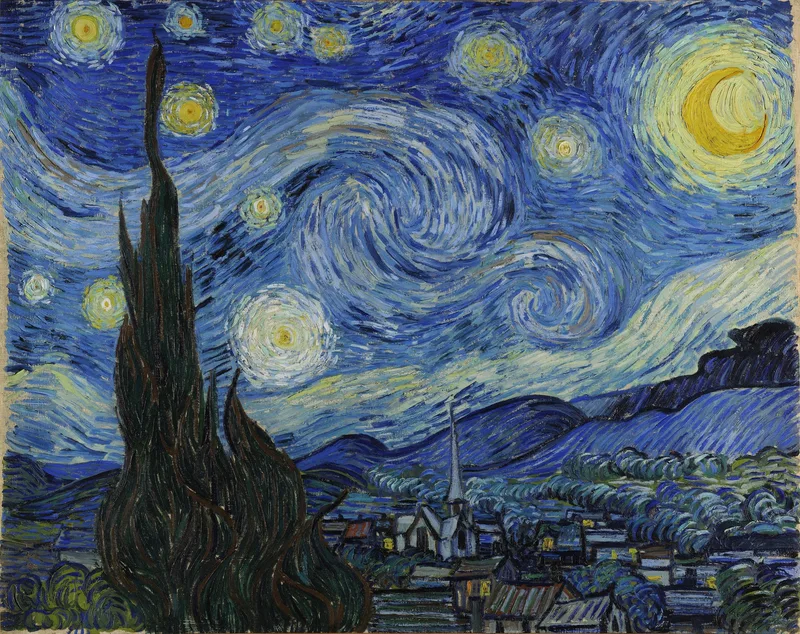
The Starry Night at MoMA and Starry Night Over the Rhône at the Musée d’Orsay are different paintings. Their similar names conceal a difference in date, place and composition: Saint-Rémy in June 1889 for the former, and Arles in September 1888 for the latter. [1][2]
MoMA: Saint-Rémy, June 1889
MoMA records The Starry Night as oil on canvas, 73.7 by 92.1 centimetres, object 472.1941. Its account connects the picture with Saint-Paul-de-Mausole in Saint-Rémy and explains that observation was combined with invention. The village was based on other views, rather than being visible exactly as painted from the artist’s window. [1]
The prominent cypress, village and strongly patterned sky help distinguish the composition. They do not make it a literal map of everything seen in one moment. MoMA also explains that the painting was worked on during daylight, despite its night subject. [1]
Musée d’Orsay: the Rhône at Arles
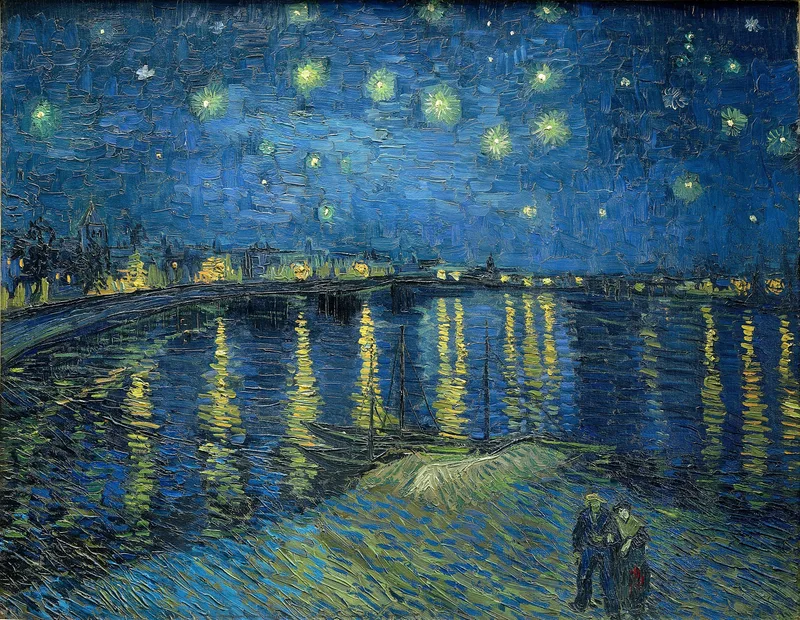
The Musée d’Orsay titles its work La Nuit étoilée and records it as RF 1975 19, oil on canvas, 73 by 92 centimetres. Its account places the river scene in September 1888 at Arles and describes the city lights reflected in the water and two figures in the foreground. [2]
The dimensions here follow the current museum record. They refer to the unframed work, not the larger framed measurements listed separately. Small differences among published measurements should not be silently resolved by borrowing a number from another painting.
The letter belongs to the Rhône picture
Letter 691 to Theo, dated by the scholarly edition to about 29 September 1888, discusses a night scene with water, gaslight and two foreground figures. Editorial note 1 links its enclosed sketch to Starry Night Over the Rhône, F474/JH1592. That evidence should not be transferred to the later Saint-Rémy canvas. [3]
A practical comparison
Use MoMA’s object number for the cypress-and-village painting and the Orsay accession number for the river scene. Then compare the date and place recorded by each institution. A file labelled simply “Starry Night” is insufficient for attaching dimensions, a quotation or a museum location.
Keep interpretation separate from identification. A discussion of expressive colour does not establish a medical diagnosis, and a painted star pattern does not by itself prove an exact observational time. The secure comparison begins with two object records, then adds only the contextual evidence that belongs to each work.
| Painting | Place and date | Collection | Canvas |
|---|---|---|---|
| The Starry Night | Saint-Rémy-de-Provence, June 1889 | MoMA, New York — 472.1941 | 73.7 × 92.1 cm [1] |
| Starry Night over the Rhône | Arles, September 1888 | Musée d’Orsay, Paris — RF 1975 19 | 72.5 × 92 cm [2] |
Dimensions and dates as the two museums record them; frames excluded. The Rhône picture is the earlier of the two by nine months. [1][2]