
Guide
Van Gogh's Self-Portraits: Over 35 Faces, Period by Period
More than 35 faces in a few short years, and what each period tells you about the man behind them


Van Gogh painted more than 35 self-portraits, over 25 of them in Paris between 1886 and 1888, and the Courtauld Gallery in London calls its Self-Portrait with Bandaged Ear (1889) “this famous painting” [1][7]. Here are his faces in order, period by period, with where to see each one.
How many self-portraits did Van Gogh paint?
More than 35, according to the Van Gogh Museum, and 39 if you count drawings as well as paintings [1][2]. Only one portrait photograph of him survives, taken when he was 19, so nearly everything we know about his looks comes from these pictures: red hair, green eyes and an angular face, different every time [1]. The surviving photos are covered in are there any real photos of Van Gogh.
He was not being vain. He wanted to practice painting people, and he was the cheapest model he had: as the museum puts it, you always have access to a patient model [1][2]. To save money he sometimes painted on the back of other canvases, and you can find five such double-sided self-portraits in the Van Gogh Museum’s online collection [1]. They sit within the wider group of Van Gogh’s portraits on this site.
The Netherlands and Antwerp: practice before the mirror
The self-portraits do not begin in the north. Behind his first one as an artist lay more than five years of practice in the Netherlands and in Antwerp, and by 1886 he was eager to make his name as a painter in Paris [3]. A hidden self-portrait discovered in 2022 in the National Galleries of Scotland in Edinburgh shows how little he wasted: he sometimes painted on the back of older work [1].
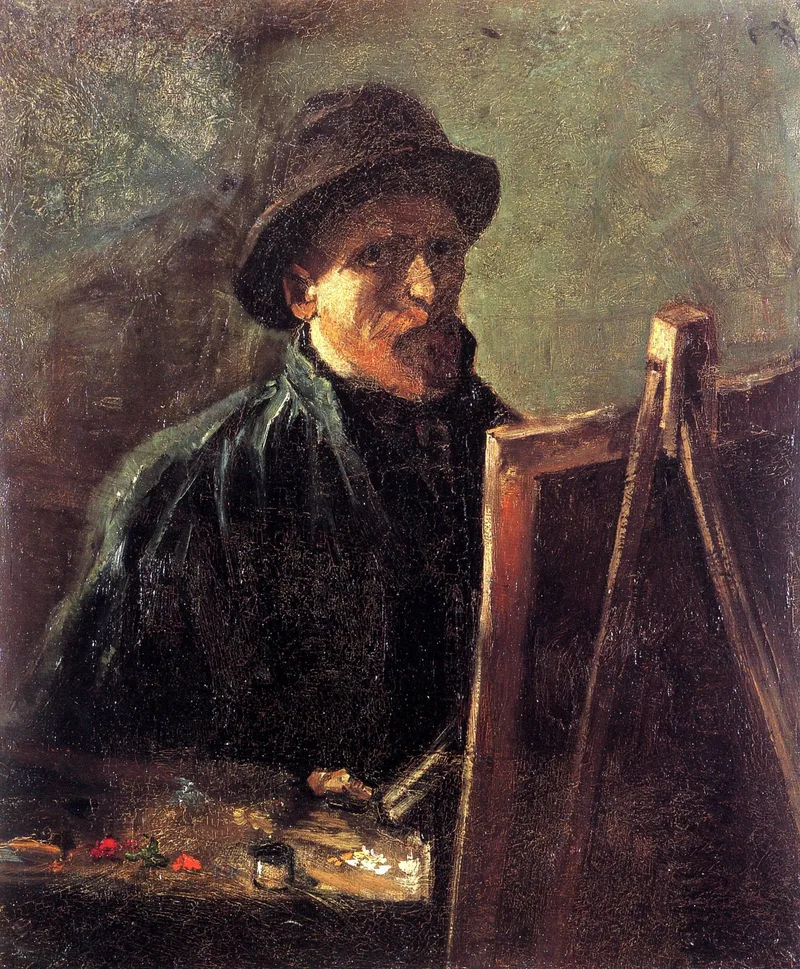
The Van Gogh Museum calls its Self-Portrait as a Painter of 1886, painted between September and November that year, one of the earliest self-portraits he made, and the first in which he showed himself as an artist [3]. Look at the palette. It is covered with splotches of pure, unmixed color, and through its two holes you can see his thumb and two brushes [3].
Hand-painted in oilFrom $350See sizes
Paris, 1886 to 1888: over 25 faces
Most of the self-portraits come from his two years in Paris: over 25 of them, painted when he was short of money and struggled to find models [1]. You can watch him change from picture to picture.
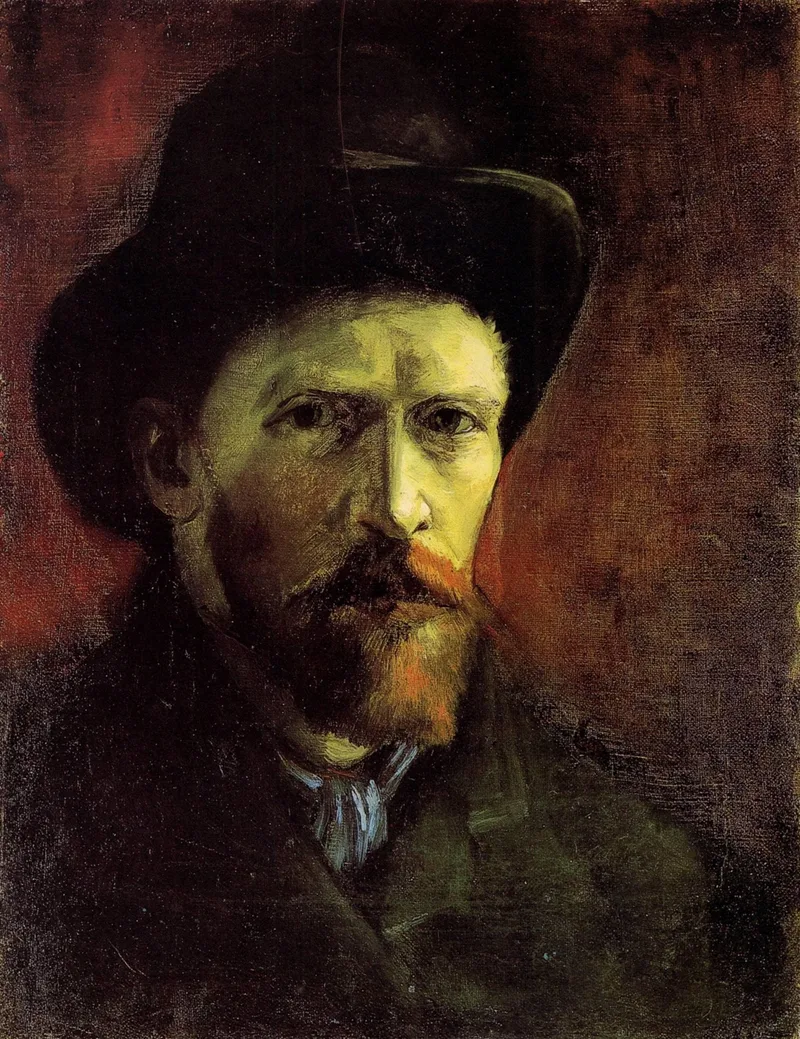
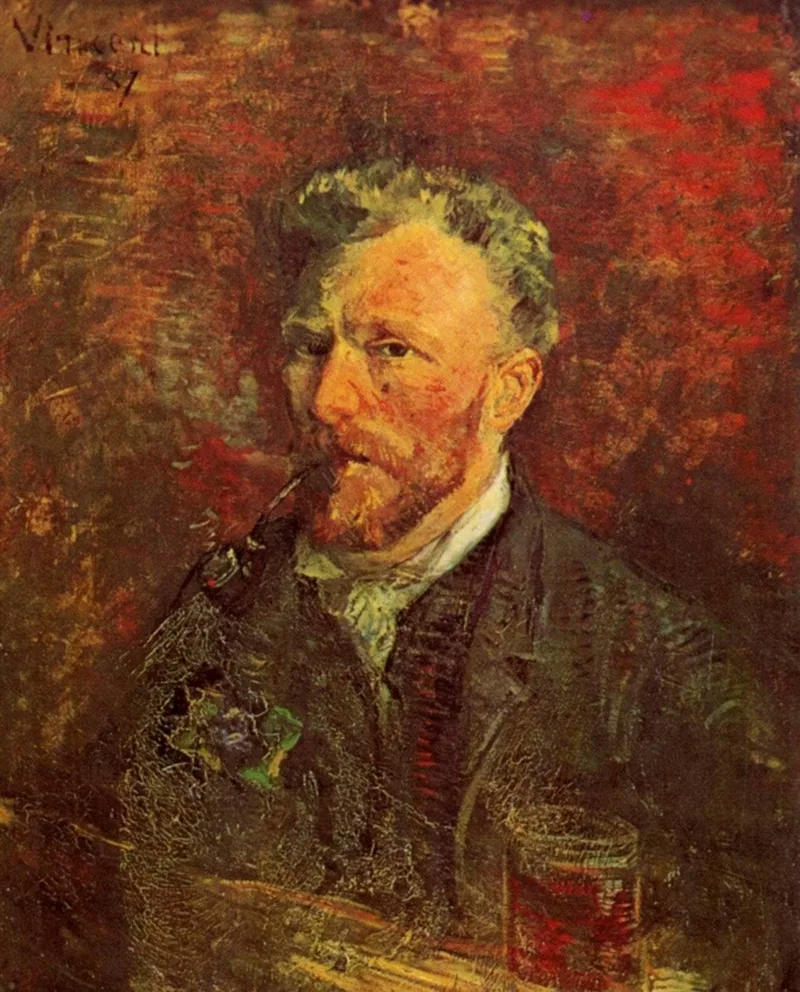
First came darker faces. In Self-Portrait with Pipe he tried out the approach to color and light of Adolphe Monticelli, the older French painter he admired for his rich palette and thick paint, and the pale face stands out against a warm, dark red background [11]. In the glass portrait, he sits with a well-filled glass at hand; to save money he often painted over earlier works, and research found a semi-nude woman under the pipe-smoking face [12]. The museum notes he was a regular in Parisian cafés [12].
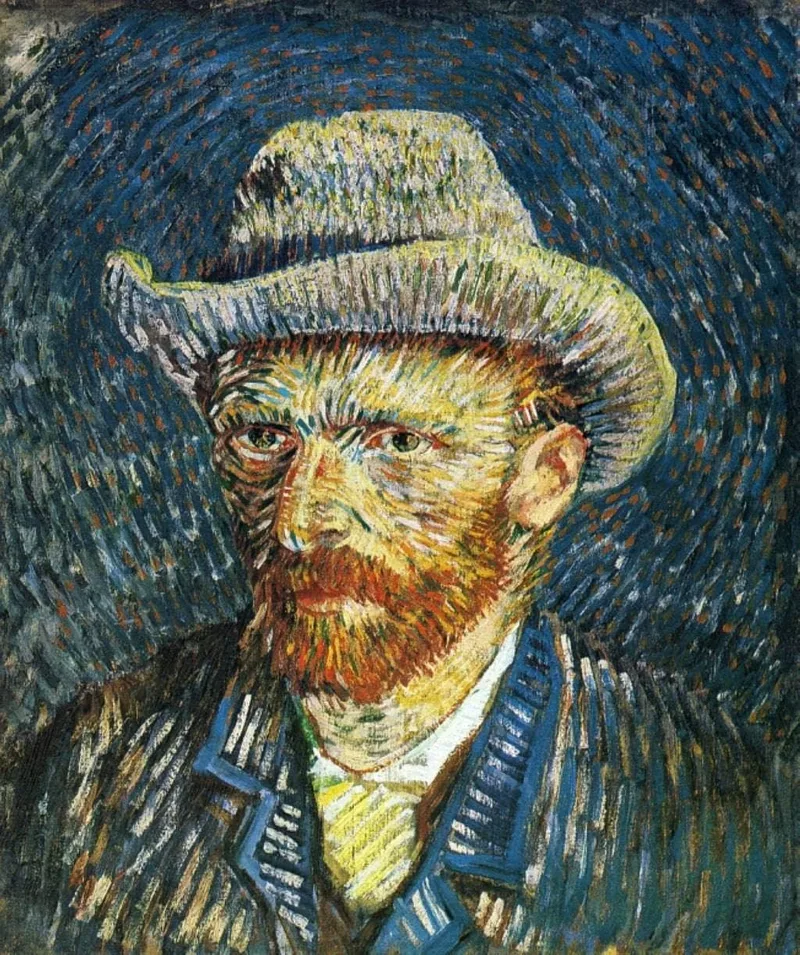
Then the color arrives. In the Self-Portrait with Grey Felt Hat he lays short stripes of paint in different directions, a technique he picked up from the Pointillists and used in his own way; around his head they form a kind of halo [4]. The museum calls it one of his boldest color experiments in Paris, with blue against orange and red against green [4]. Time has softened it: the red pigment has faded, so purple strokes now read as blue [4].
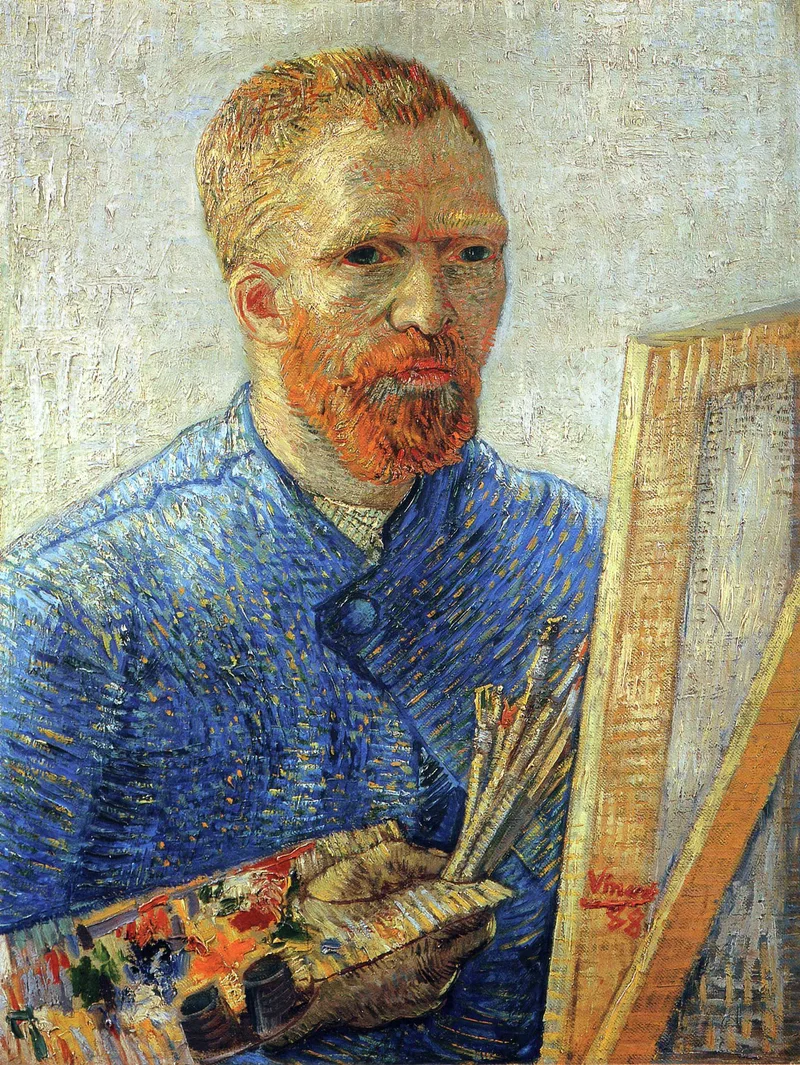
Then he left. Self-Portrait as a Painter, made between December 1887 and February 1888, was the last work he produced in Paris; the city had exhausted him, mentally and physically [5]. On his palette are the same complementary pairs he used for the picture, red and green, yellow and purple, blue and orange, like the blue smock against the orange-red beard [5]. The museum adds that his yellow straw hat is now firmly associated with him and his love of the sun and the color yellow [1].

Hand-painted in oilFrom $350See sizes
Hand-painted in oilFrom $350See sizes

Hand-painted in oilFrom $350See sizes
Arles, 1888 to 1889: the Japanese study and the bandaged ear
In Arles he tried on a new look. In September 1888 he told his sister Willemien in letter 678: “I’ve also done a new portrait of myself, as a study, in which I look like a Japanese.” [6] The editors of his letters identify it as the 1888 self-portrait now at Harvard, in the collection of the Fogg Art Museum [6].
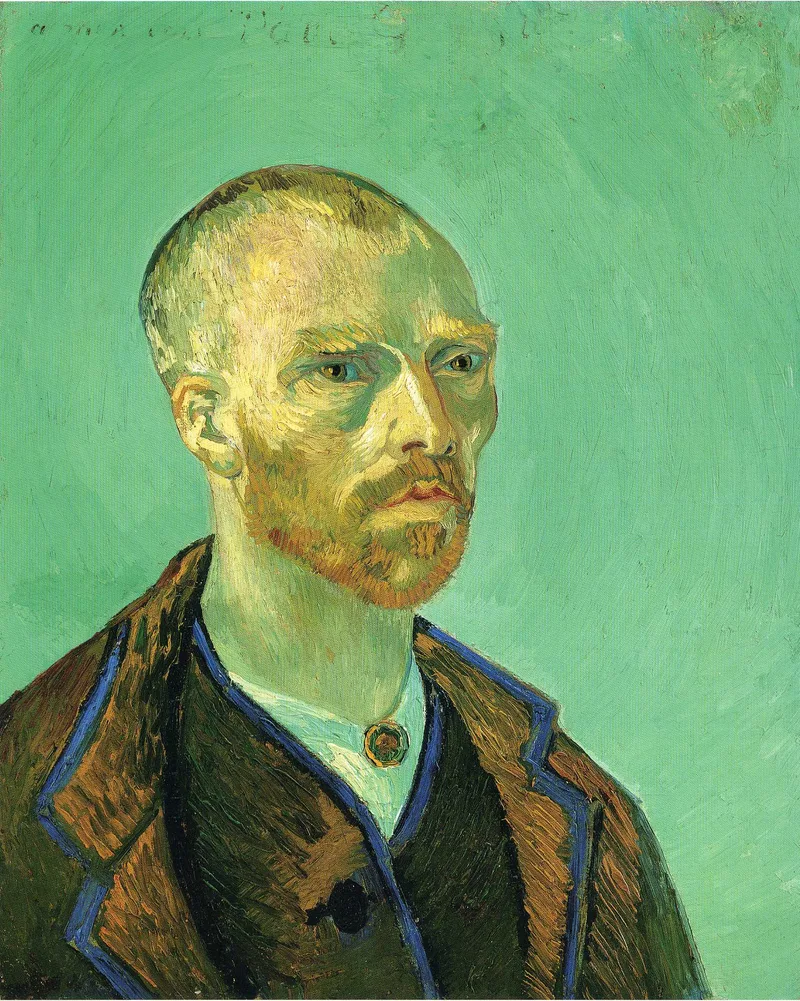
Then came the crisis. On 23 December 1888 he cut off his left ear, and he later recorded it in two self-portraits; one, with a pipe, is in a private collection [1]. The other is the Courtauld’s Self-Portrait with Bandaged Ear, painted in January 1889, a week after he left the hospital [7]. The bandage covers his left ear, which looks like the right because he painted himself in a mirror, and the fur cap was a recent purchase to hold the bandage in place and keep out the cold [7]. For the night itself, read why Van Gogh cut off his ear.


Saint-Rémy, 1889: the asylum self-portraits
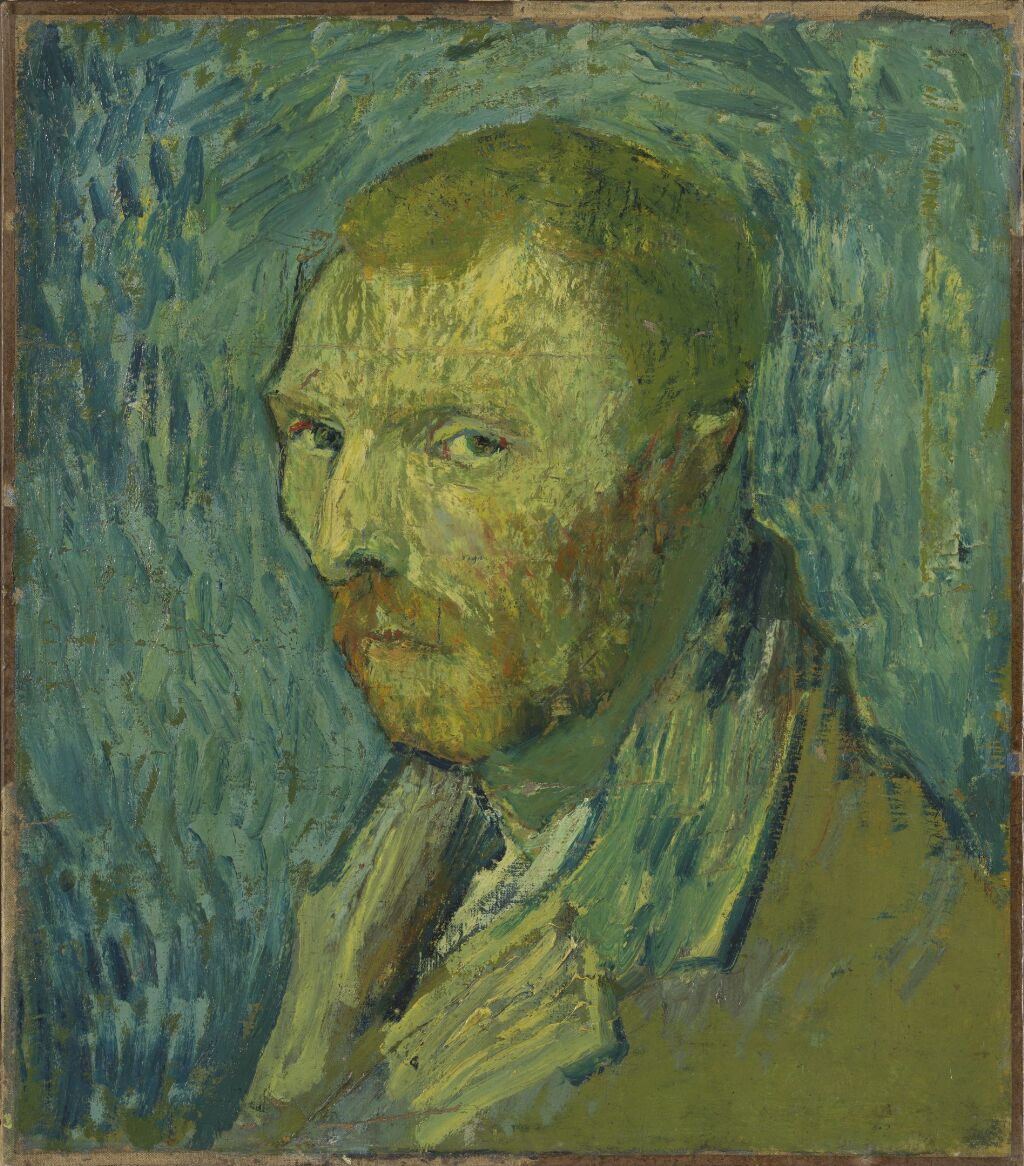
At the asylum in Saint-Rémy he turned to his own face again. The self-portrait now in Oslo is, in The Art Newspaper’s words, “a highly disturbing image” [9]. Researchers date it to late August 1889, just as he was emerging from a severe mental crisis, and the Van Gogh Museum’s senior researcher calls it the “only work Van Gogh is known to have painted while suffering from psychosis” [9]. When Norway’s National Museum bought it in 1910, it was the first Van Gogh self-portrait to enter a public collection anywhere, and after years of doubt it was authenticated in January 2020 [9].
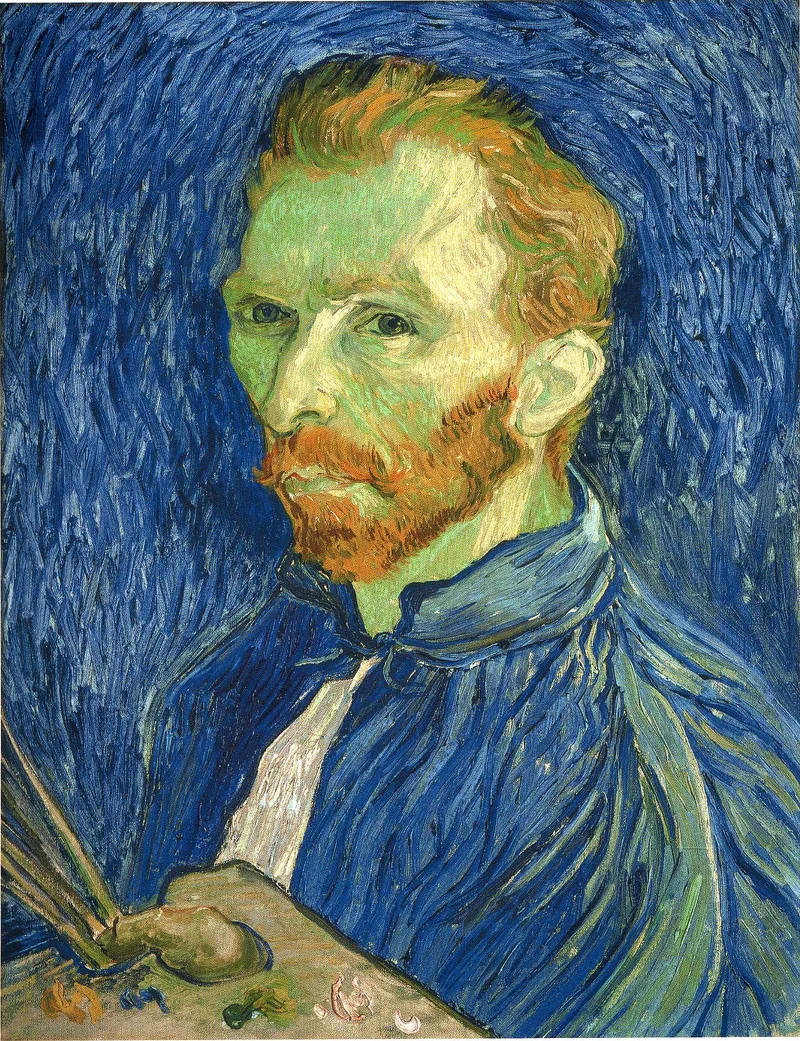
Soon after, on 5 and 6 September, he told Theo in letter 800 that “it’s not easy to paint oneself either” and that he was working on two self-portraits at once [8]. He began the first on the day he got up, “thin, pale as a devil”; it is dark violet blue, and today it is the self-portrait with palette in the National Gallery of Art in Washington [8]. The second, three-quarter length on a light background, is in the Musée d’Orsay in Paris, and he thought it showed he looked a great deal healthier than in his Paris portraits [8].
He was still talking about that light one the next summer. In June 1890 he told his sister that Dr Gachet was enthusiastic about it, described it as “a fine southern blue” with a light lilac suit, and set out his ambition: “I would like to do portraits which would look like apparitions to people a century later.” [10]
Which is the most famous Van Gogh self-portrait?
If fame means the story people know, start with Self-Portrait with Bandaged Ear: its owner, the Courtauld, calls it “this famous painting,” and it is one of the two self-portraits in which he recorded the injury to his ear [1][7]. If you mean the face people picture, the credit goes to the self-portraits as a group. The Van Gogh Museum says they have been reproduced an infinite number of times since the early 20th century and put a face to the archetype of the artist as tortured genius [1].
To see how they rank against his landscapes and still lifes, read 15 famous Van Gogh paintings and where to see them. For how a friend saw him, see Gauguin’s portrait of Van Gogh painting sunflowers.
Where to see Van Gogh’s self-portraits
Amsterdam has the early ones: the Van Gogh Museum holds the Paris pictures discussed here [3][4][5][11][12]. The later faces are spread out, from Cambridge, Massachusetts, to London, Oslo, Washington and Paris [6][7][9][8]. Museums lend works and rotate displays, so check the museum’s own page as of October 2026 before you travel. If Amsterdam is on your list, our must-see paintings at the Van Gogh Museum will help you plan.
| Self-portrait | Date | Where to see it |
|---|---|---|
| Self-Portrait as a Painter | September to November 1886 | Van Gogh Museum, Amsterdam [3] |
| Self-Portrait with Pipe | September to November 1886 | Van Gogh Museum, Amsterdam [11] |
| Self-Portrait with Glass | January 1887 | Van Gogh Museum, Amsterdam [12] |
| Self-Portrait with Grey Felt Hat | 1887 | Van Gogh Museum, Amsterdam [4] |
| Self-Portrait as a Painter | December 1887 to February 1888 | Van Gogh Museum, Amsterdam [5] |
| Self-portrait as “a Japanese” | By mid-September 1888 | Harvard University Art Museums (Fogg Art Museum), Cambridge, Massachusetts [6] |
| Self-Portrait with Bandaged Ear | January 1889 | The Courtauld Gallery, London [7] |
| Self-Portrait with Bandaged Ear and Pipe | 1889 | Private collection [1] |
| Self-portrait (Oslo) | Late August 1889 | Nasjonalmuseet, Oslo [1][9] |
| Self-portrait, dark violet blue | September 1889 | National Gallery of Art, Washington [8] |
| Self-portrait, light background | September 1889 | Musée d’Orsay, Paris [8] |
Dates and locations from the owning museum’s page, the Van Gogh Museum’s stories, The Art Newspaper and the artwork records of the scholarly edition of Van Gogh’s letters [1][3][4][5][6][7][8][9][11][12].
Questions and answers
How many self-portraits did Van Gogh paint?
What’s the most famous Van Gogh self-portrait?
The Courtauld Gallery in London calls its Self-Portrait with Bandaged Ear “this famous painting” [7]. He painted it in January 1889, a week after he left the hospital [7]. Another standout is the Grey Felt Hat portrait, which the Van Gogh Museum calls one of his boldest color experiments in Paris [4].
Where did Van Gogh paint his self-portrait?
Written and fact-checked by the Vincent van Gogh Paintings editorial desk12 sourcesUpdated
Sources
- Van Gogh Museum: 5x Van Gogh’s Self-PortraitsAccessed
- Van Gogh Museum: Why did Vincent van Gogh paint so many self-portraits?Accessed
- Van Gogh Museum: Self-Portrait as a Painter, 1886, s0160V1962Accessed
- Van Gogh Museum: Self-Portrait with Grey Felt Hat, 1887, s0016V1962Accessed
- Van Gogh Museum: Self-Portrait as a Painter, 1887–1888, s0022V1962Accessed
- Vincent van Gogh: The Letters, letter 678 to Willemien van Gogh, Arles, 9 and about 14 September 1888, with note 14 and artwork recordsAccessed
- The Courtauld: Vincent van Gogh, Self-Portrait with Bandaged EarAccessed
- Vincent van Gogh: The Letters, letter 800 to Theo van Gogh, Saint-Rémy, 5 and 6 September 1889, with notes and artwork recordsAccessed
- The Art Newspaper: Not a fake: Van Gogh self-portrait is his only work painted while suffering psychosis, experts say (20 January 2020)Accessed
- Vincent van Gogh: The Letters, letter 879 to Willemien van Gogh, Auvers-sur-Oise, 5 June 1890, with notes and artwork recordsAccessed
- Van Gogh Museum: Self-Portrait with Pipe, 1886, s0158V1962Accessed
- Van Gogh Museum: Self-Portrait with Glass, 1887, s0161V1962Accessed
Hand-painted oil reproductions
Paintings in this guide
- Self Portrait with Felt HatVincent van GoghFrom$350
- Self Portrait Dedicated to Paul GauguinVincent van GoghFrom$350
- Self Portrait with PalletteVincent van GoghFrom$370
- Self-Portrait with Dark Felt Hat at the EaselVincent van GoghFrom$350
- Self-Portrait with Dark Felt HatVincent van GoghFrom$350
- Self-Portrait with Pipe and GlassVincent van GoghFrom$350
- Self Portrait as an ArtistVincent van GoghFrom$350