
Guide
10 Must-See Paintings at the Van Gogh Museum in Amsterdam
Your short list for Amsterdam, with what to look for in each painting and what a visit costs
The most famous paintings in the Van Gogh Museum are Sunflowers, Almond Blossom, The Bedroom and The Potato Eaters, the four masterpieces the museum says you will “obviously see” in its permanent collection [1]. Add six more, from Irises to two Paris self-portraits, and you have ten must-sees for Amsterdam, with what to look for in each, who owns them and what a ticket costs as of October 2026 [11].
How this list was chosen
The Van Gogh Museum answers the question itself. As of October 2026, its page on the permanent collection names four masterpieces and lists nine collection highlights [1]. We keep seven of those, then add three pictures that tell his story inside the building: his house in Arles, his painting of Gauguin’s chair and his last self-portrait from Paris. For Van Gogh’s paintings in other collections, start from our home page.
One tip before you go. To see which works are on view on the day of your visit, the museum suggests checking its online collection with the “on view” box ticked, as of October 2026 [1].
That is a short list on purpose. The museum owns more than 200 paintings and nobody sees them all in one afternoon [12].
1. Sunflowers (1889)
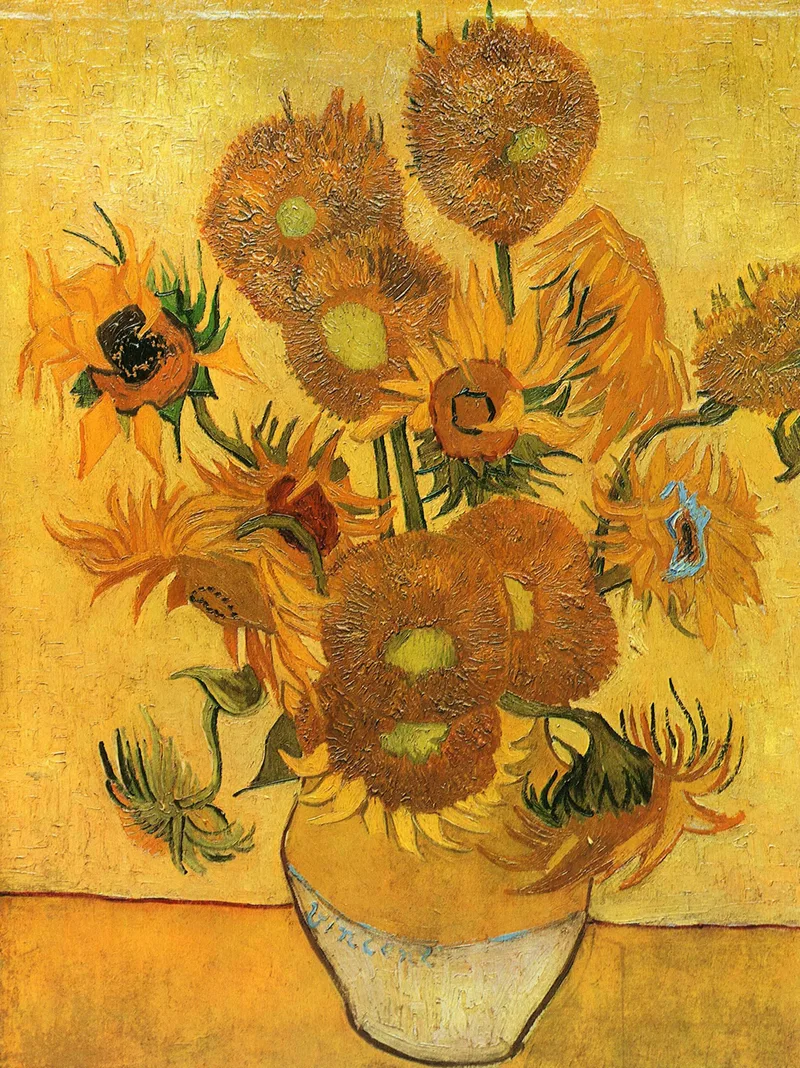
Painted in Arles in January 1889, this canvas measures 95 by 73 centimeters [3]. The museum calls the sunflower paintings “among his most famous” and explains the idea: five large canvases of sunflowers in a vase, in three shades of yellow and nothing else, to show that an image could be built from variations of a single color without losing any eloquence [3].
What to look for: this is a copy, and the museum is open about it. Van Gogh hung the first two sunflower paintings in Gauguin’s room in the Yellow House; Gauguin later asked for one as a gift, which Vincent was reluctant to give, and he afterwards made two loose copies, one of which is this picture [3]. To him, he wrote, the sunflowers communicated gratitude [3]. The other versions around the world are untangled in which Sunflowers is which.
Hand-painted in oilFrom $350See sizes
2. Almond Blossom (1890)
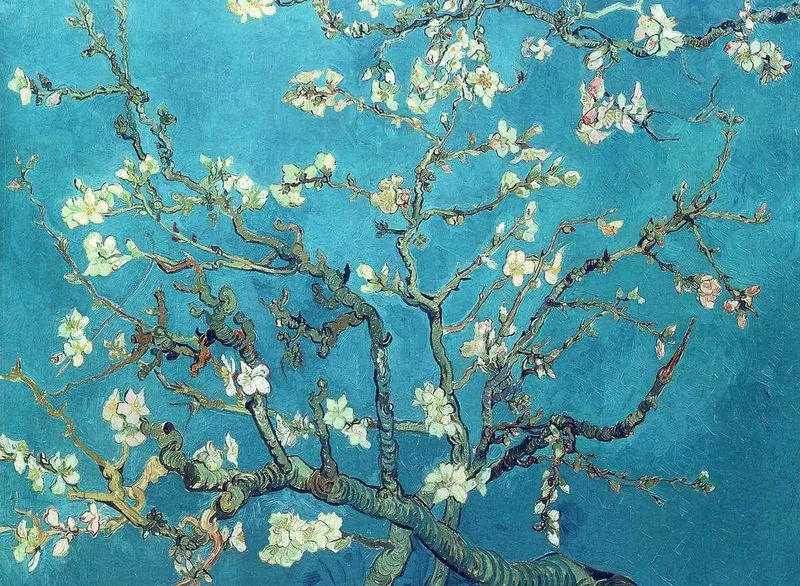
Painted at Saint-Rémy in February 1890, Almond Blossom was a gift for Theo and his wife Jo, who had just had a baby son, Vincent Willem [4]. In the letter announcing the birth, Theo wrote that they would name the boy after Vincent and hoped he would be as determined and courageous as his uncle [4].
What to look for: the branches against the blue sky. Almond trees flower early in spring, which made them a symbol of new life, and the subject, the bold outlines and the placing of the tree all come from Japanese printmaking [4]. The museum says this was the work that stayed closest to the hearts of the Van Gogh family, and that the baby it celebrated went on to found the Van Gogh Museum [4].
3. The Bedroom (1888)
Painted in Arles in October 1888, The Bedroom measures 72.4 by 91.3 centimeters and shows his room in the Yellow House, which he furnished himself with simple furniture and his own work on the walls [5]. The bright colors were meant to express absolute rest, or sleep [5].
What to look for: the colors you see are not quite the ones he painted. Research shows the strong contrasts are the result of discoloration, and the walls and doors were originally purple rather than blue [5]. The odd angle of the back wall is not a mistake, because the corner really was skewed, and he deliberately flattened the room and left out the shadows so it would look like a Japanese print [5]. When he saw his canvases again after his illness, he judged the bedroom the best of them [5].


4. The Potato Eaters (1885)
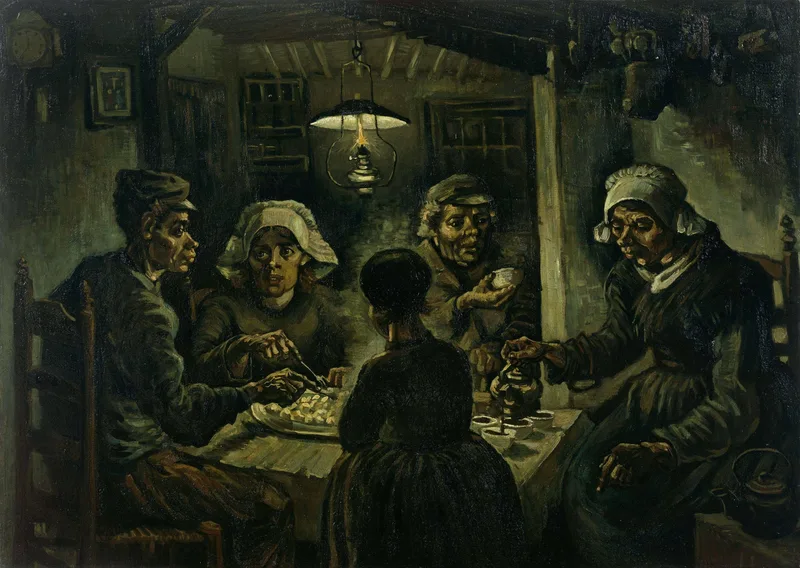
Painted in Nuenen in April and May 1885, The Potato Eaters was his showpiece, a difficult composition chosen to prove he was on his way to becoming a good figure painter [6].
What to look for: the hands and the color. He gave the peasants coarse faces and bony, working hands to show the harsh reality of country life, and painted the five figures in earth colors [6]. The message mattered more to him than correct anatomy. Critics attacked the dark colors and the mistakes in the figures, yet today the museum calls it one of his most famous works [6].
Hand-painted in oilFrom $350See sizes
5. Irises (1890)
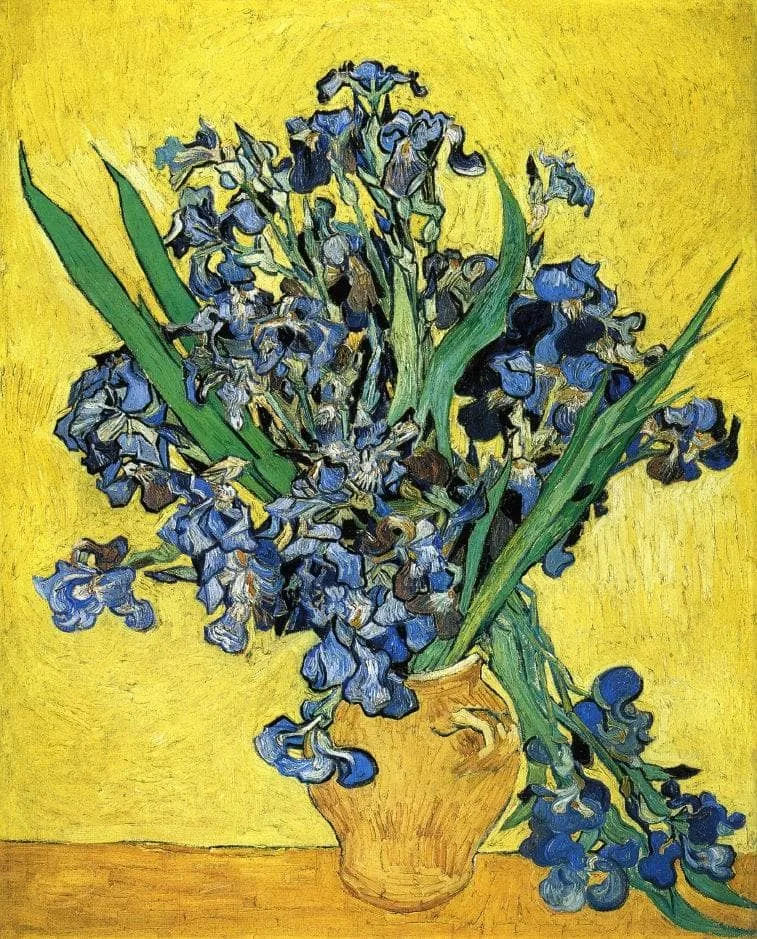
Painted in May 1890 in the psychiatric hospital at Saint-Rémy, this bouquet measures 92.7 by 73.9 centimeters [7]. For Van Gogh it was mainly a study in color: by placing the flowers against a yellow background, he made their decorative shapes stand out even more strongly [7].
What to look for: the blue. The Irises in a vase were originally purple, but the red pigment has faded and they have turned blue [7]. He painted two pictures of this bouquet; in the other, he set purple and pink against green [7].
6. The Harvest (1888)
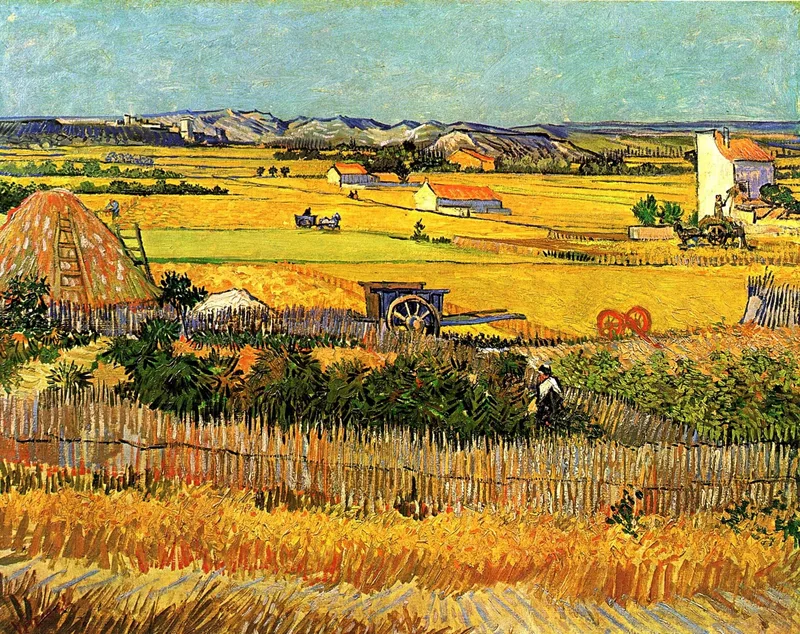
Painted in Arles in June 1888, The Harvest captures the flat, sunbaked land around the town, with the azure blue of the sky set against yellow and green fields [8]. He worked in the wheatfields for days at a time under the burning sun, finishing ten paintings and five drawings in just over a week, until a heavy storm ended the harvest season [8].
What to look for: the stages of the harvest. There is a half-mown wheatfield, ladders, several carts and a reaper working in the background, which is why he titled it La moisson, The Harvest [8]. Van Gogh considered it one of his most successful paintings [8].
Hand-painted in oilFrom $350See sizes
7. The Yellow House (1888)
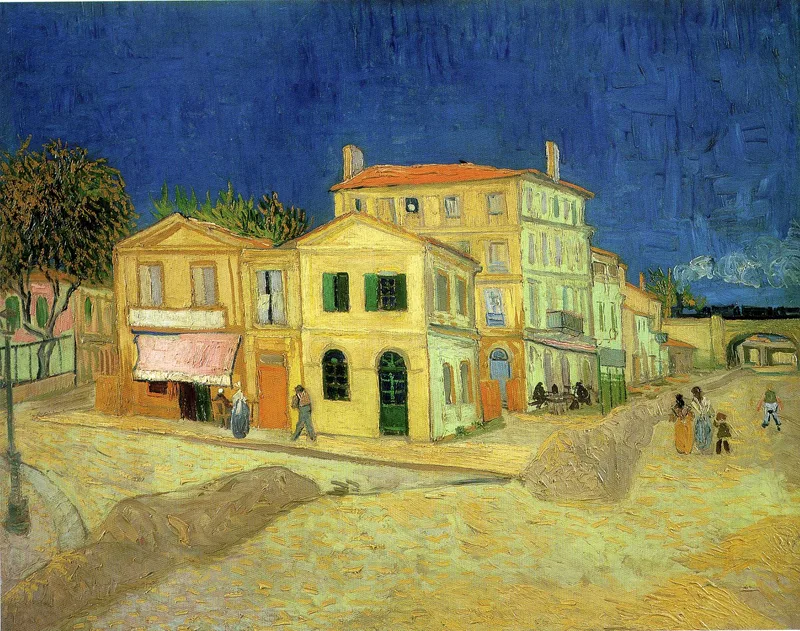
This is the house where it all happened. Van Gogh dreamed of an artists’ community in his Yellow House in Arles, and when Paul Gauguin arrived in October 1888, the dream seemed to come true [10]. The museum holds his painting of the house and its street, The Yellow House [10].
What to look for: keep this picture in mind as you walk on. The Bedroom shows a room inside this house [5], and the next painting on this list is about the friend who came to stay [10].
8. Gauguin’s Chair (1888)
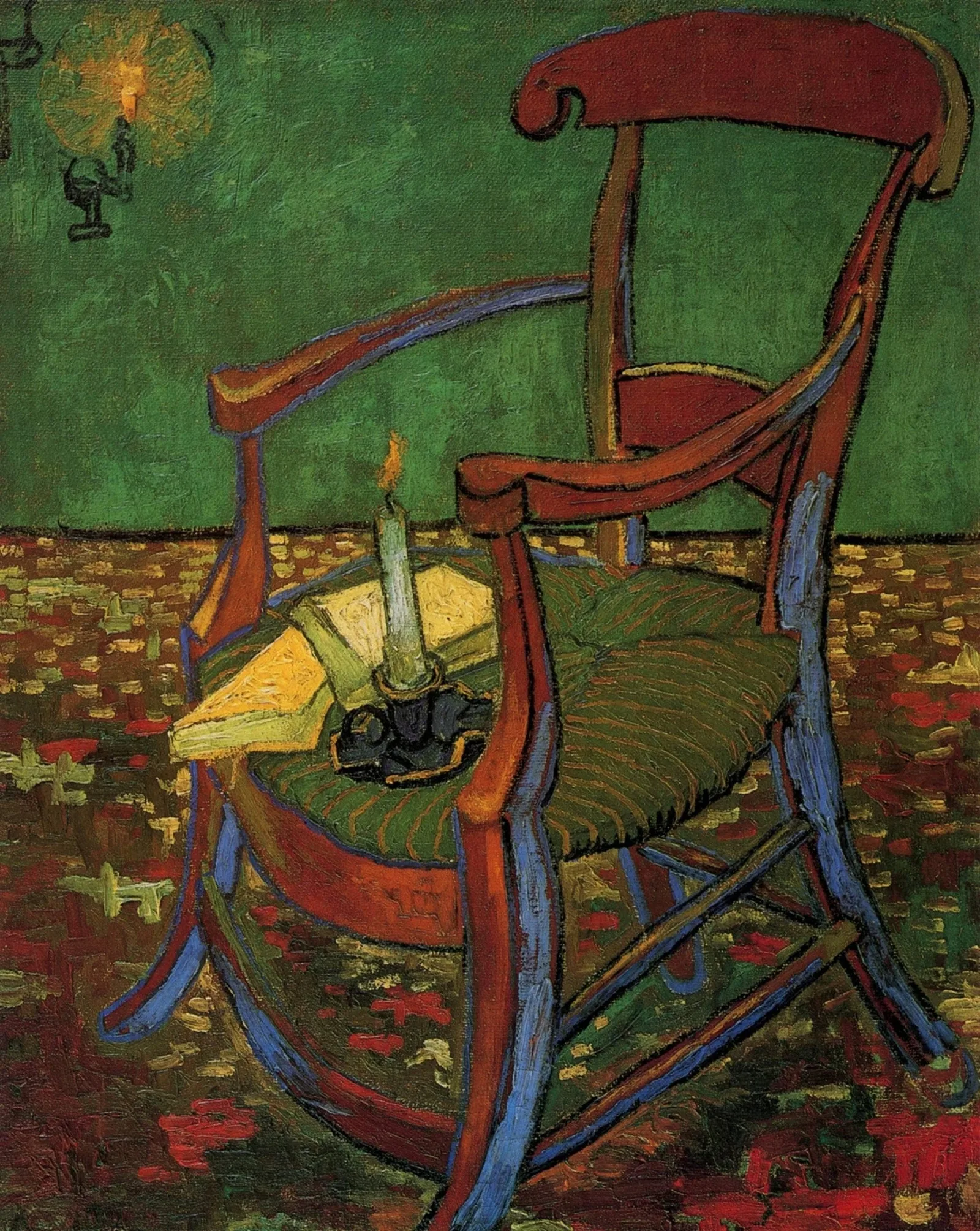
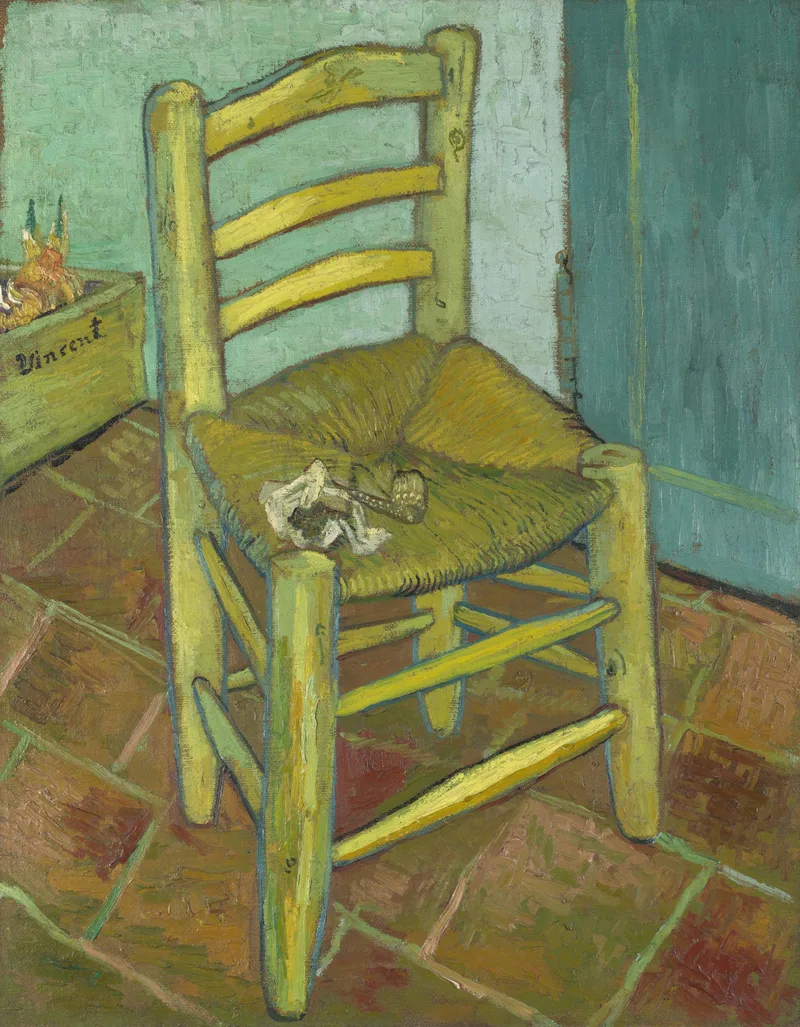
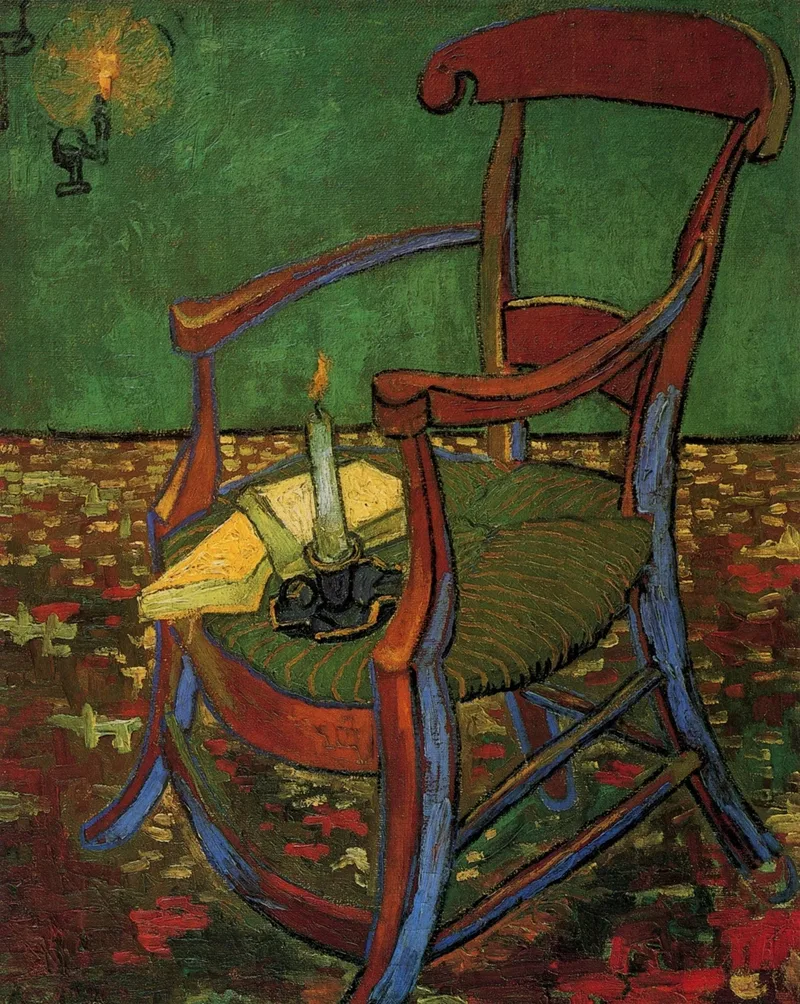
The two painters started out working happily side by side, but their arguments about art grew frequent and sometimes heated: Vincent believed in working from reality, Gauguin painted from memory and imagination [10]. Van Gogh painted two chairs that, the museum says, you could see as portraits of the two artists [10].
What to look for: the objects on the seat. In Gauguin’s Chair, the lamp, the candlestick and the book stand for the nocturnal dream world, and so for imagination [10]. Its partner, Van Gogh’s Chair with its onions, stands for nature and painting from reality, and belongs to the National Gallery in London [10]. On 23 December 1888, after a heated argument, Vincent cut off his left ear [10]. Why it happened is explained in why Van Gogh cut off his ear.
Hand-painted in oilFrom $350See sizes
9. Self-Portrait with Straw Hat (1887)
The museum lists this 1887 portrait among its collection highlights [1]. Most of his self-portraits, over 25, were painted in Paris between 1886 and 1888, when he was short of money and struggled to find models, so he painted himself [9].
What to look for: the hat. The museum says the yellow straw hat is now firmly associated with Vincent and his love of the sun and the color yellow [9]. Keep an eye out, too, for portraits on the backs of other paintings: he sometimes painted them there to save money, and you can find five such self-portraits in the museum’s online collection [9].


10. Self-Portrait as a Painter (1888)
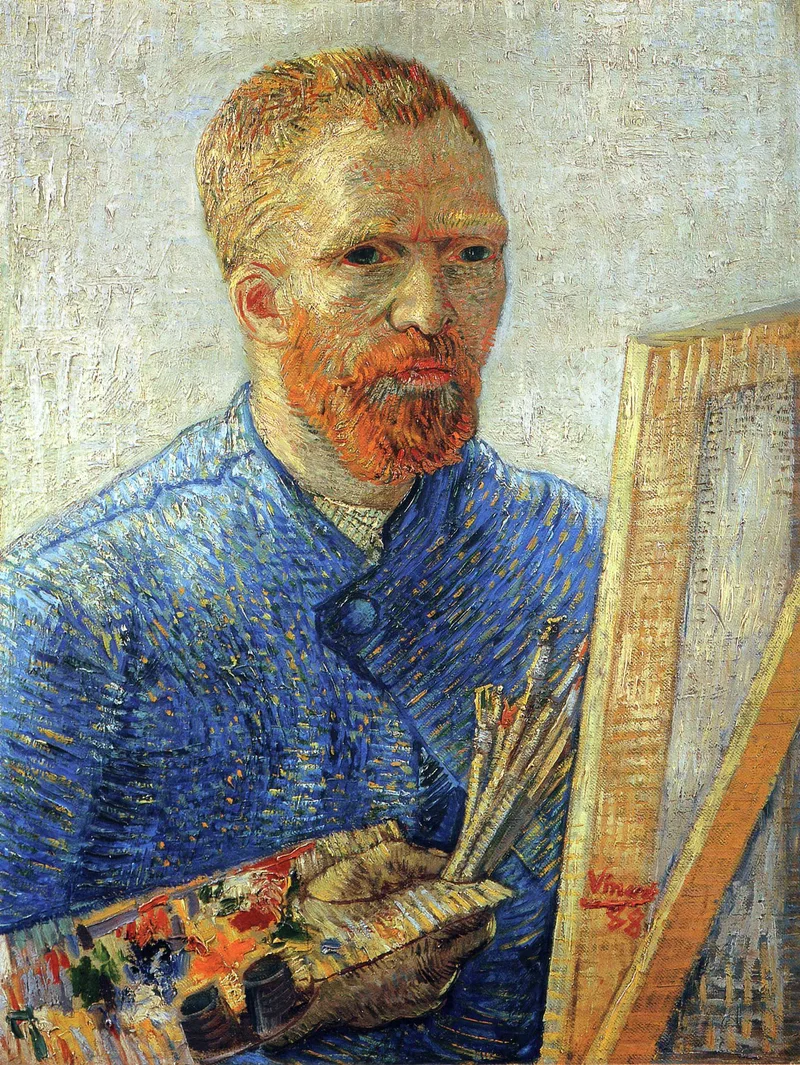
This is how he left Paris. Self-Portrait as a Painter was the last self-portrait he made there. He described himself in it as unkempt and sad, and the museum adds that this is how he felt at the time, mentally and physically exhausted [9].
What to look for: the palette in his hand and the look on his face. In his self-portraits, the museum notes, he often presented himself as restrained and serious, with a look of concentration [9]. The rest of his faces, from Paris to Saint-Rémy, are in Van Gogh’s self-portraits.
Hand-painted in oilFrom $350See sizes
Who owns the Van Gogh paintings in Amsterdam?
The museum shows the world's largest collection of Van Gogh's work, more than 200 paintings, 500 drawings and almost all of his letters [12]. Legally, though, the paintings belong to the Vincent van Gogh Foundation [3]. In 1962 Van Gogh's family sold the whole collection to this foundation, and in return the Dutch state agreed to build and run a museum, which opened in 1973 [12].
You can see the same chain of ownership in the museum's own records. Sunflowers, for example, was inherited by Jo van Gogh-Bonger and her son Vincent Willem, passed in 1962 to the foundation, and has hung at the Van Gogh Museum since 1 July 1994 [3].
How much does the Van Gogh Museum cost, and how do you plan the day?
As of October 2026, an adult ticket costs €25 and rises to €26 from 1 January 2027. Visitors under 18 get in free, and as of October 2026 students pay €16 with a student card, valid until 31 December 2026 [11]. One ticket covers the permanent collection and the current exhibitions, with no exhibition fee [11].
Tickets are sold online only, and every visitor needs one with a start time, even Museumkaart holders, who get in free but must still book [11]. The museum warns against third-party sellers and names its official resellers on the ticket page [11].
As of October 2026, the museum is open daily, with late opening until 9 pm on most Fridays, and its main entrance is on Museum Square, at Museumplein 6 [2]. From Amsterdam Central Station, take tram 2, 5 or 24 and get off at the Museumplein stop [2]. Visitors who cannot get around the museum on their own may bring a companion for free [2].
Two famous canvases are not on the museum's highlights list, and its own page points visitors looking for them to stories on where to find them [1]. For those two, read where The Starry Night is today and the story behind Café Terrace at Night. For the wider canon, see 15 famous Van Gogh paintings and where to see them.
Questions and answers
What art museums have Van Gogh paintings?
Who owns most of Van Gogh's paintings?
The Vincent van Gogh Foundation owns the collection shown in Amsterdam, the world's largest, with more than 200 paintings. The family sold it to the foundation in 1962, and the Dutch state agreed to build and run the Van Gogh Museum for it [12].
How much does the Van Gogh Museum cost?
As of October 2026, adults pay €25 (€26 from 1 January 2027), visitors under 18 get in free, and students pay €16 until 31 December 2026. Tickets are online only, with a start time, and cover the permanent collection and current exhibitions [11].
Written and fact-checked by the Vincent van Gogh Paintings editorial desk12 sourcesUpdated
Sources
- Van Gogh Museum: The Permanent Collection, Van Gogh’s MasterpiecesAccessed
- Van Gogh Museum: Address and Opening HoursAccessed
- Van Gogh Museum: Sunflowers, 1889, s0031V1962Accessed
- Van Gogh Museum: Almond Blossom, 1890, s0176V1962Accessed
- Van Gogh Museum: The Bedroom, 1888, s0047V1962Accessed
- Van Gogh Museum: The Potato Eaters, 1885, s0005V1962Accessed
- Van Gogh Museum: Irises, 1890, s0050V1962Accessed
- Van Gogh Museum: The Harvest, 1888, s0030V1962Accessed
- Van Gogh Museum: 5x Van Gogh’s Self-PortraitsAccessed
- Van Gogh Museum: Vincent’s Illness and the Healing Power of ArtAccessed
- Van Gogh Museum: Tickets and Ticket PricesAccessed
- Van Gogh Museum: General FactsheetAccessed
Hand-painted oil reproductions
Paintings in this guide
- Branches with Almond BlossomVincent van GoghFrom$350
- Still Life with IrisesVincent van GoghFrom$350
- The Yellow HouseVincent van GoghFrom$350
 Paul Gauguin’s ArmchairVincent van GoghFrom$350
- Still Life - Vase with Fifteen SunflowersVincent van GoghFrom$350
- The Potato EatersVincent van GoghFrom$350
- Harvest at La Crau, with Montmajour in the BackgroundVincent van GoghFrom$350
- Van Gogh’s ChairVincent van GoghFrom$350
- Self Portrait as an ArtistVincent van GoghFrom$350