
Guide
Are There Real Photos of Van Gogh? The One Picture We Have
One photograph survives, the famous boyhood one is his brother, and the painted faces fill in the rest

Yes, but just one: a portrait photograph taken in The Hague in January 1873, when Vincent van Gogh was 19, is the only portrait photo of him the Van Gogh Museum accepts today. [1][2][6] Beyond it there is a view of him from behind, a boyhood photo that turned out to be Theo, and faces experts doubt. [1][8] For the grown man, you have Van Gogh's paintings of himself. [3]
What is the one real photo of Van Gogh?
It is the portrait at the top of this page, taken by a photographer in The Hague named Jacobus de Louw. The Art Newspaper credits the picture to him and gives its Van Gogh Museum number, b4784. [6] It was taken a few months before Vincent left for his first job abroad, as an art dealer in London. [2]
Look closely and you see what the museum calls a slightly gruff expression. [3] The picture was published in 1914 as the only known photographic portrait of Vincent, and it has that status once again. [1] After the age of 19, he never had another portrait photograph taken. [2]
Isn't there a photo of Van Gogh at 13?
You have probably seen it: a curly-haired boy with pale eyes and a striped tie. It was first shown as Vincent at a 1957 exhibition organized by the Belgian researcher Mark Edo Tralbaut, and it went on to appear in countless biographies. [7] For about 60 years it was a case of mistaken identity. [1]
Doubts began in 2014, when a Dutch television program compared it with the 1873 portrait. [7] Then Yves Vasseur noticed that the photographer, Balduin Schwarz, only set up his studio in Brussels in 1870, when Vincent was already 17. [1][7] Theo, on the other hand, moved to Brussels early in 1873 to work for Goupil & Cie, and his letters show he had his photo taken there in February of that year, at 15. [1][7]
A forensic comparison by Zeno Geradts, a University of Amsterdam professor, found a “high likelihood” that the boy is Theo, and the museum accepted the result in 2018. [2]

Are there any other photos that might show him?
The museum lists two, and neither is a clear portrait. In 1971 a group photograph of pupils at the HBS, a secondary school in Tilburg, taken in 1866 or 1867, was found; it possibly includes Vincent. [1]
The other dates from 1886–1887, during his Paris years. It shows him from behind, sitting opposite Émile Bernard on the banks of the Seine near Asnières. [1] The Art Newspaper sums it up: the 1873 picture is the only proper photograph of him as an adult, and one other shows him at a distance from behind. [6]
What about the photo of Van Gogh at a table with Gauguin?
In 2015 a tintype from 1887 went to auction at Romantic Agony in Brussels. Some scholars said Van Gogh sits third from the left, with Émile Bernard and Paul Gauguin at the same table, in a picture believed to be by the amateur photographer Jules Antoine. [8]
Be careful with it. Van Gogh never mentions the gathering in his letters, and the photo expert at the Van Gogh Museum simply did not see a likeness. [8] The picture failed to reach its asking price of $136,000. [8] For the museum, the count stays at one portrait photo. [3]
Why didn't Van Gogh want to be photographed?
The Van Gogh Museum puts it plainly: he was not fond of portrait photography, certainly not in his later life. [7] He said so himself. Writing to his sister Willemien from Saint-Rémy on 19 September 1889, he added that such portraits “are faded more quickly than we ourselves, while the painted portrait remains for many generations.” [4]
In June 1890, writing from Auvers about his portrait of Dr Gachet, he went further: “I would like to do portraits which would look like apparitions to people a century later. So I don’t try to do us by photographic resemblance but by our passionate expressions.” [5] More of his correspondence is gathered in our guide to Van Gogh's letters.
Money mattered too. He painted over 35 self-portraits, more than 25 of them in Paris between 1886 and 1888, when he was short of money and struggled to find models. [3] He sometimes painted them on the back of other paintings to save money. [3] After he cut off his ear in December 1888, he even reported on it in two self-portraits. [3] Our guide to Van Gogh's self-portraits goes through the whole series, period by period.


“I myself still find photographs frightful and don’t like to have any, especially not of people whom I know and love.”
So what did Van Gogh actually look like?
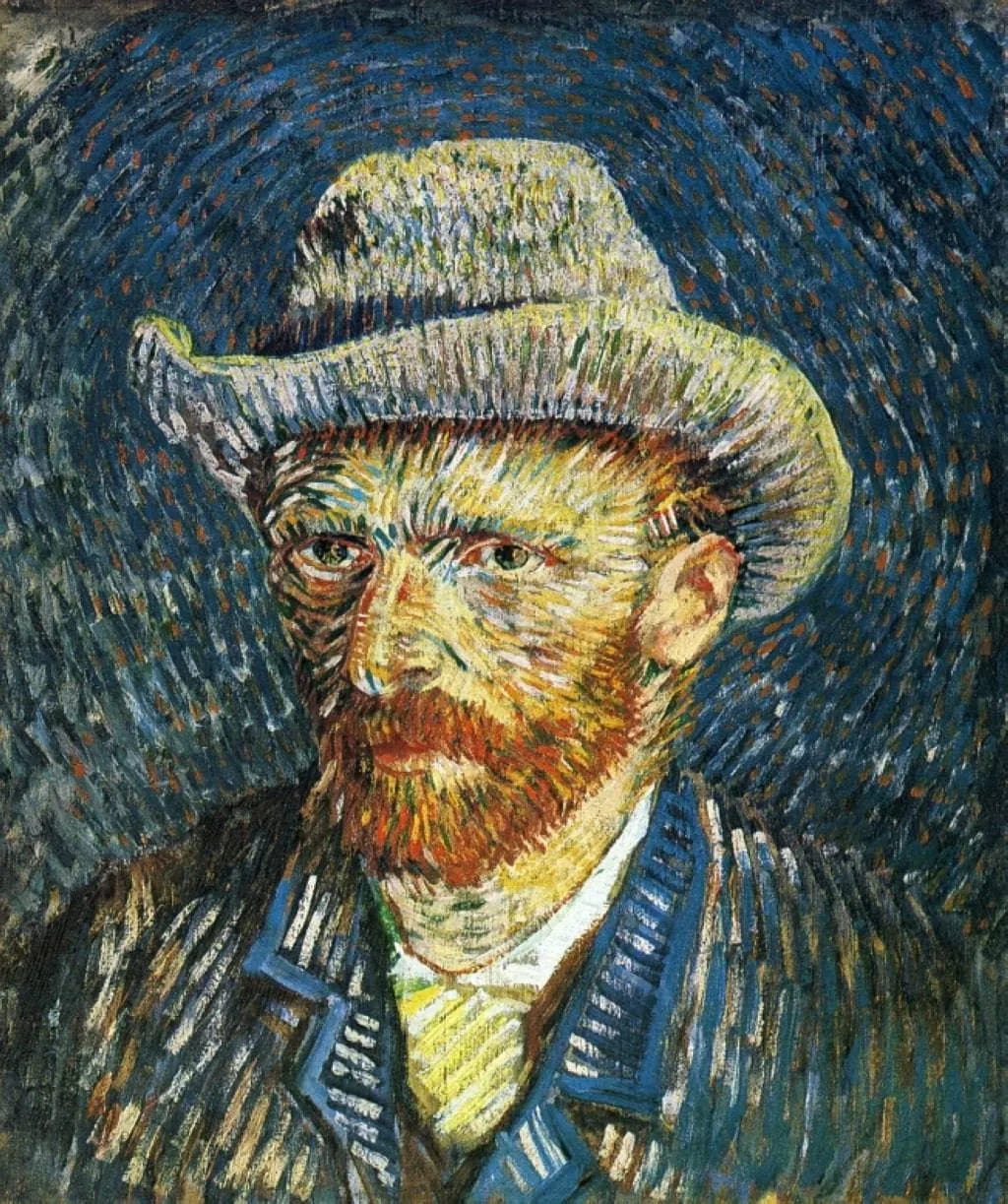
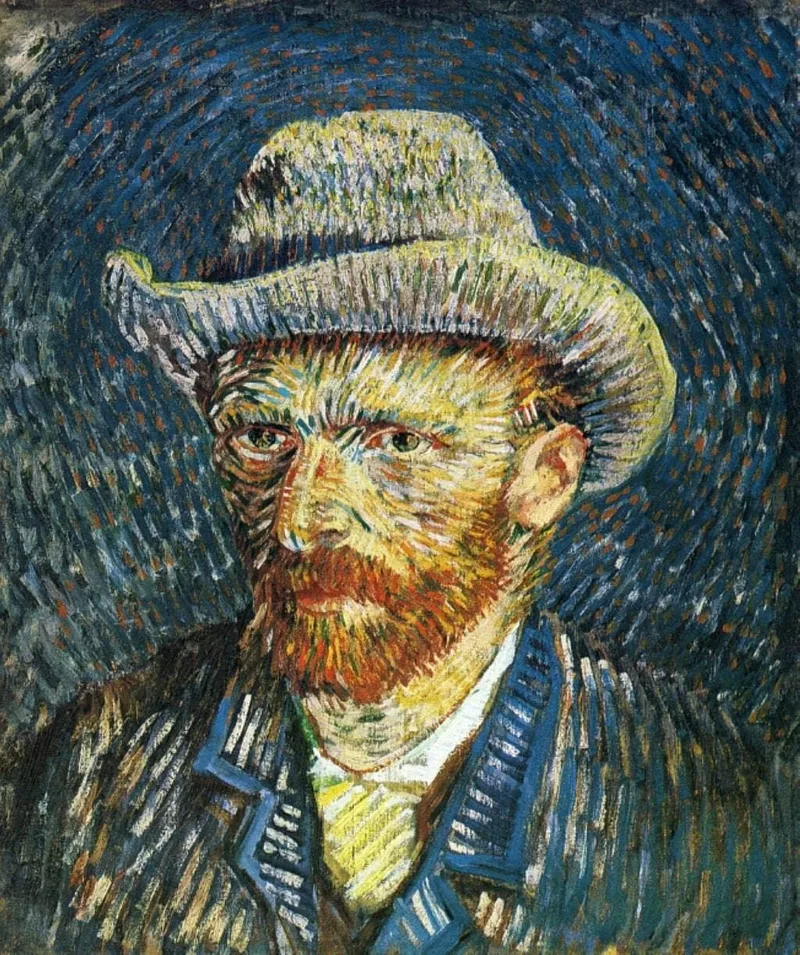
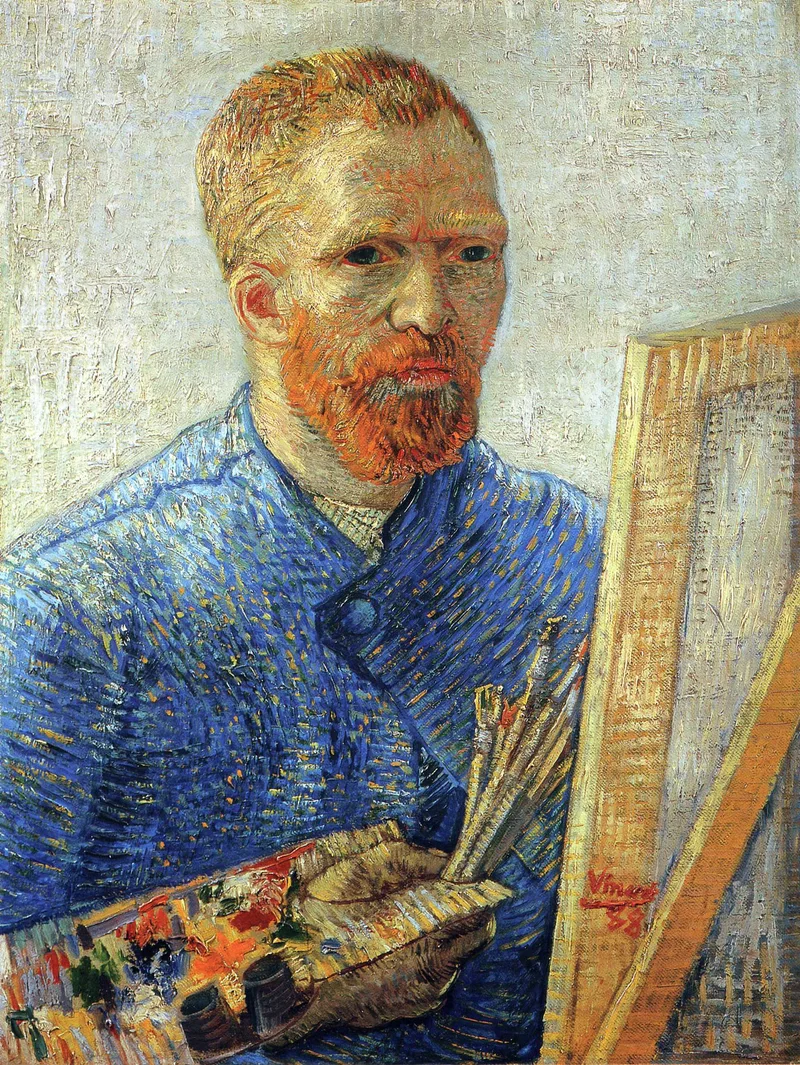
His self-portraits tell us he had red hair, green eyes and an angular face, yet each of those faces is different. [3] Compare two Paris pictures with the 1873 photo at the top. In Self-Portrait with Grey Felt Hat, from the autumn of 1887, the short strokes of paint follow the outline of his head and form a kind of halo. [12] In Self-Portrait as a Painter, from the winter of 1887–88, he holds a palette and brushes behind his easel, in the bright, almost unblended colors of a modern artist. [11]
The second one is the last he made in Paris. [3] You can look at either in detail on its page: Self-Portrait with Grey Felt Hat and Self-Portrait as a Painter. To browse more faces, try our portrait paintings.

Hand-painted in oilFrom $350See sizes
Which portraits by other artists look most like him?
For a likeness by another hand, the museum points to the modest 1886 portrait by John Peter Russell as the most accurate. [1] Russell, an Australian painter, met Vincent in Cormon's studio in Paris and painted him in a conventional, realistic style that is clearly influenced by photography. [9] The painter Archibald Standish Hartrick, who met Vincent at Russell’s studio, thought it the most accurate portrait of Van Gogh, more realistic than any of his self-portraits. [9] Vincent himself asked Theo to take good care of it, because it meant a lot to him. [9]
Paul Gauguin's version is an interpretation, not a record. In Arles in 1888 he painted Vincent at work in front of a vase of sunflowers, although it was December and the flowers were long out of season. [10] Nine months later, Vincent wrote to Theo about this portrait: “My face has lit up after all a lot since, but it was indeed me, extremely tired and charged with electricity as I was then.” [10] Read the whole story in our guide to Gauguin's portrait of Van Gogh.


Questions and answers
Are there any actual photos of Vincent van Gogh?
What is the most famous picture of Van Gogh?
Are any of Van Gogh's relatives alive today?
His brother Theo's family line continued. When the museum announced in 2018 that the boyhood photo shows Theo, it quoted Willem van Gogh, a great-grandson of Theo and an adviser to the museum's board, who said he was pleased the mystery had been solved. [7]
Written and fact-checked by the Vincent van Gogh Paintings editorial desk12 sourcesUpdated
Sources
- Van Gogh Museum: Mistaken Identity, Vincent and TheoAccessed
- The Art Newspaper: Mistaken identity, new discovery means there is only one known photograph of Vincent van Gogh (29 November 2018)Accessed
- Van Gogh Museum: Van Gogh's Self-PortraitsAccessed
- Vincent van Gogh, The Letters: letter 804, to Willemien van Gogh, Saint-Rémy-de-Provence, 19 September 1889Accessed
- Vincent van Gogh, The Letters: letter 879, to Willemien van Gogh, Auvers-sur-Oise, 5 June 1890Accessed
- The Art Newspaper: Newly discovered photograph depicts the man who got Van Gogh fired as an art dealer (19 October 2018)Accessed
- Van Gogh Museum press release: Photo of Vincent van Gogh turns out to be his brother Theo (2018)Accessed
- Smithsonian Magazine: Is This a Photograph of Vincent Van Gogh? (24 June 2015)Accessed
- Van Gogh Museum collection: John Russell, Portrait of Vincent van Gogh (s0273V1962)Accessed
- Van Gogh Museum collection: Paul Gauguin, Vincent van Gogh Painting Sunflowers (s0225V1962)Accessed
- Van Gogh Museum collection: Self-Portrait as a Painter (s0022V1962)Accessed
- Van Gogh Museum collection: Self-Portrait with Grey Felt Hat (s0016V1962)Accessed
Hand-painted oil reproductions


.jpg)