Guide
Why Van Gogh's Sunflowers Are Fading and What Museums Do
Yes, slowly and in patches. Here is what the scientists found, and what the museum changed because of it.

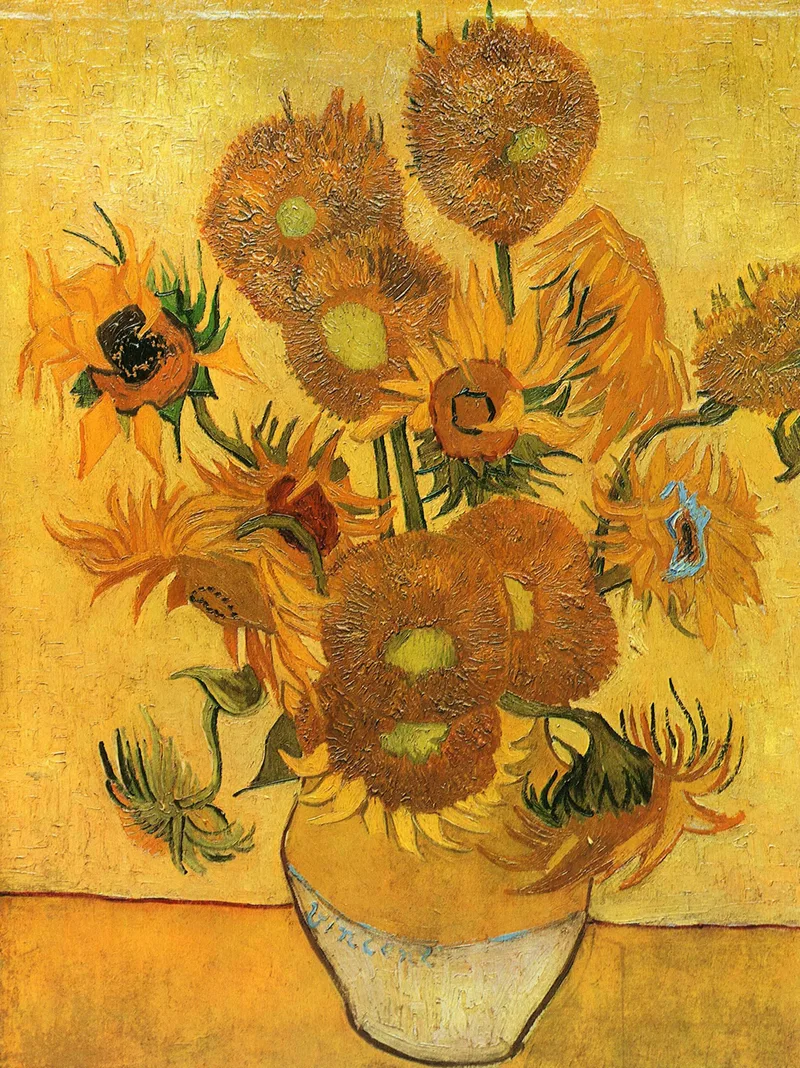
Yes, partly: in the Van Gogh Museum’s Sunflowers of January 1889, a red paint called geranium lake has faded and a yellow called chrome yellow has darkened, according to the museum’s own research. [1][2] In 2018 the yellow change was still invisible to the naked eye, but scientists have mapped where to watch for it. [4]
Which Sunflowers is fading? The versions
The research is about one canvas: the Van Gogh Museum’s Sunflowers, painted in Arles in January 1889. It is oil on canvas, 95 by 73 centimeters, catalogued as F458. [2] It repeats the version from the summer of 1888 that now hangs in the National Gallery in London, and the museum’s study confirmed that link. [1]
Van Gogh painted five large canvases of sunflowers in a vase, now in museums in Amsterdam, Munich, London, Tokyo and Philadelphia. [2][9] Counting two more, the London gallery puts the total at seven: one is in a private collection and one was destroyed during the Second World War. [6] Our guide to telling the Sunflowers versions apart sorts out which is which. The chemistry study covers the Amsterdam picture only, so that is the one we follow.
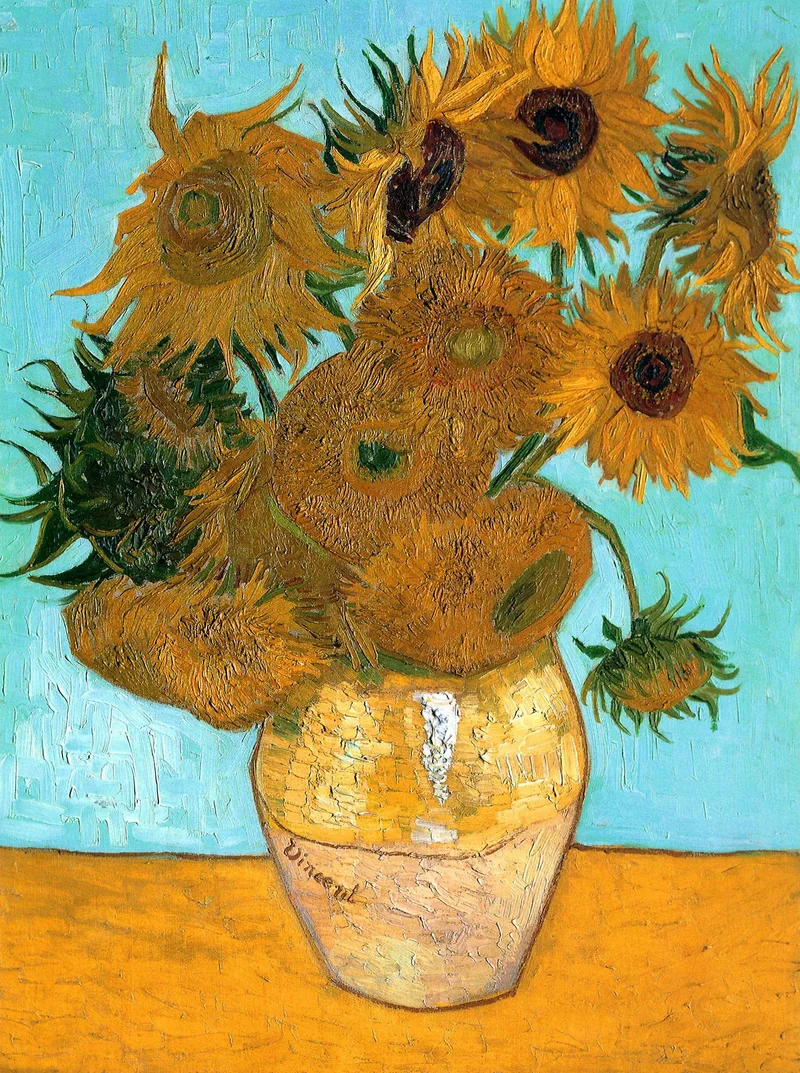
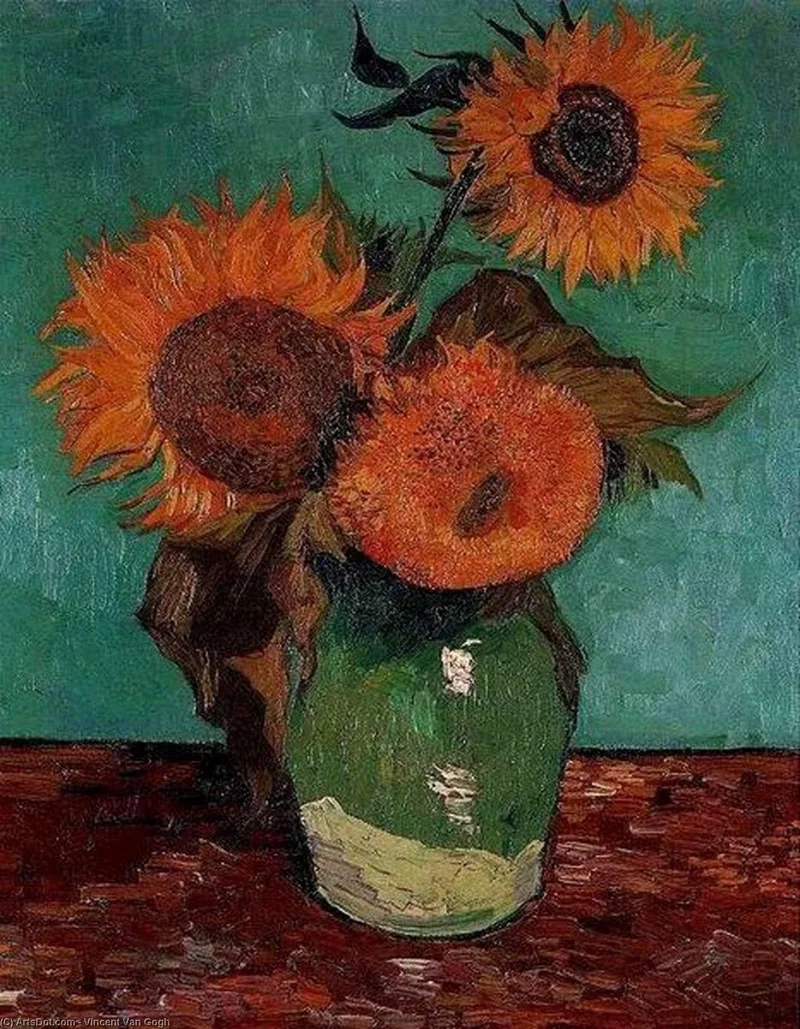
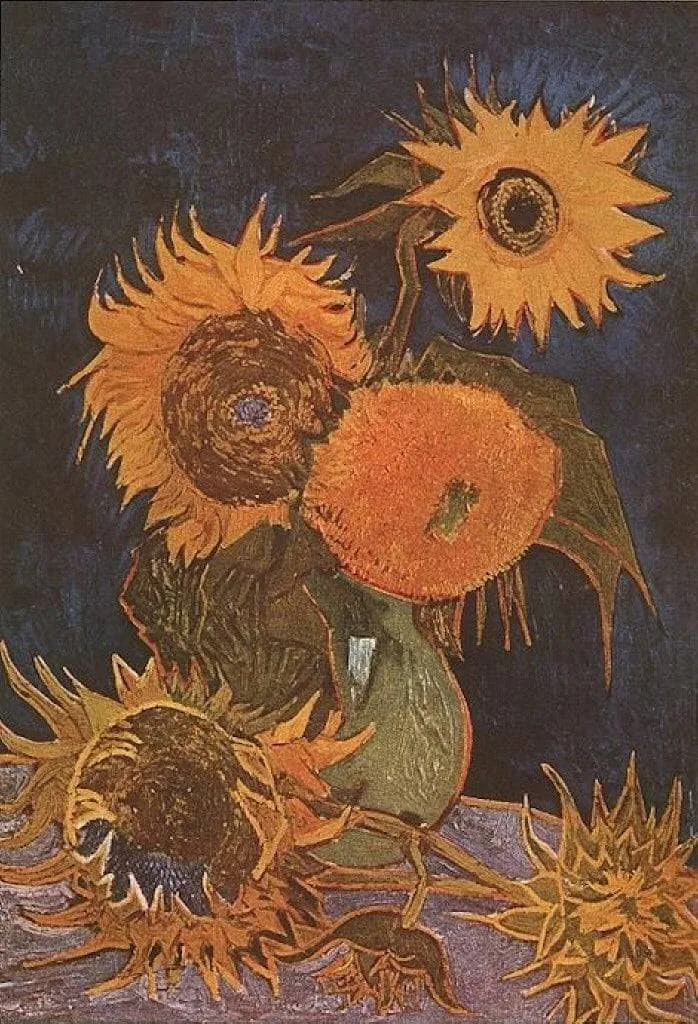
The first two canvases of the series were the one now in private hands, three flowers in a green vase, and the one lost to bombing, which had a dark blue background. [6] The twelve-flower canvas in Munich, painted in August 1888, shows how bright the series began: twelve flowers and buds in a yellow vase. [8]

Hand-painted in oilFrom $350See sizes
Hand-painted in oilFrom $350See sizes
What is happening to the yellow?
Chrome yellow came in several shades, and Van Gogh ordered them by name. In April 1888 he listed “the 3 chromes (the orange, the yellow, the lemon)” in a paint order. [7]
A 2015 study led by Letizia Monico, with the museum’s conservator Ella Hendriks among the authors, found two kinds in the Amsterdam canvas: a lightfast lead chromate and a light-sensitive variety rich in sulfur. The sensitive kind was the main yellow in the light-yellow tones; the lightfast kind dominated the yellow-orange ones. [3]
In two tiny paint samples, the team found degraded chromium right where the paint meets the varnish, around 35 percent of the chromium in one area. Their conclusion: a color change had happened at least at those two spots, and similar darkening was likely wherever the sensitive yellow was used. [3]
Where on the canvas is the risk?
In May 2018 the Guardian reported the next step. After two years of analysis, Dutch and Belgian scientists had scanned the painting section by section with macroscopic X-ray imaging, a process described as “chemical mapping.” More than half of the painting contains some of the more sensitive pigment. [4]
The areas expected to lose vibrancy are the pale-yellow background and the bright yellow petals and stems, where the sensitive yellow was mixed to get the right green. The orange parts of the background used a less sensitive yellow with less sulfur. [4]
The change was not yet visible to the naked eye. Frederik Vanmeert of the University of Antwerp said it was “very difficult to say how long it would take for the change to be obvious.” The scan also found emerald green and red lead in very small areas, which he expected to turn lighter over time. [4]
What happened to the red?
The yellow gets the headlines, but the museum names a second cause: a red paint, geranium lake, has faded. [1] Martin Bailey of The Art Newspaper put it plainly: the Amsterdam picture “was originally even brighter and more striking than it is today.” [5]
Van Gogh knew the risk. When the geranium lake arrived with his April 1888 order, he told Theo what he thought of such colors. [7] His iris paintings tell a related story about red paint; see why Van Gogh’s Irises changed color.
“…all the colours that Impressionism has made fashionable are unstable, all the more reason boldly to use them too raw, time will only soften them too much.”
What Museums Do: light, loans and a quiet map
The research ended with minor conservation treatment in January 2019, and the painting was back on display on 22 February 2019. [1] Its ground and paint layers are stable but very sensitive to vibration and to changes in humidity and temperature, so the museum decided that Sunflowers will no longer travel. Its last loan was to the National Gallery in London in 2014. [1][5]
Light is the other lever. The maximum light level on the painting was cut by two thirds, from 150 to 50 lux, and new LED bulbs with relatively low emissions in the violet-blue-green part of the spectrum went in. [1][5] For comparison, a National Gallery spokesman said in 2019 that the London version is normally shown at 150 lux. [5]
Some old damage cannot be undone. Several later layers of varnish are dirty and yellowed, but they cannot be removed because paint and varnish have mixed in places. A wax layer from the late 1990s, which had turned whitish, was to be removed in the 2019 treatment. [1]
Will you notice the change?
Nobody can say when. The research gives no date for when the darkening will become obvious, but it does give conservators a map of the areas to watch. [3][4] Van Gogh had his own race with the real flowers: in August 1888 he painted every morning from sunrise “Because the flowers wilt quickly and it’s a matter of doing the whole thing in one go.” [8]
The museum says the painting now stays in Amsterdam, where visitors can see it every day of the year, one of the must-see paintings at the Van Gogh Museum. [1] For the market side, see what the Sunflowers are worth, and for his own words about the series, how to read Van Gogh’s letters.
Questions and answers
Are Van Gogh's Sunflowers fading?
Why doesn't the Amsterdam Sunflowers travel anymore?
Research found it stable but fragile: its ground and paint layers are very sensitive to vibrations and to changes in humidity and temperature. To avoid any risk, the Van Gogh Museum decided in 2019 that Sunflowers will no longer travel. [1] Its last loan was to the National Gallery in London in 2014. [5]
What is Vincent van Gogh's famous sunflower art?
Usually it means Sunflowers, his still lifes of sunflowers in a vase painted in Arles in 1888 and 1889. [2] The Van Gogh Museum says he wanted to be known as the painter of sunflowers. [9] For his own words about them, read what Van Gogh said about flowers.
Written and fact-checked by the Vincent van Gogh Paintings editorial desk9 sourcesUpdated
Sources
- Van Gogh Museum: Conservation Treatment of Van Gogh’s SunflowersAccessed
- Van Gogh Museum: Sunflowers, January 1889, s0031V1962 (F458, JH1667)Accessed
- Monico et al., Evidence for Degradation of the Chrome Yellows in Van Gogh’s Sunflowers, Angewandte Chemie International Edition, 2015Accessed
- The Guardian: Van Gogh’s sunflowers are wilting as yellow paint fades to brown (31 May 2018)Accessed
- The Art Newspaper: Amsterdam Sunflowers will never again travel (25 January 2019)Accessed
- National Gallery, London: Sunflowers, 1888, NG3863Accessed
- Vincent van Gogh, The Letters: letter 595 to Theo, Arles, on or about 11 April 1888Accessed
- Vincent van Gogh, The Letters: letter 666 to Theo, Arles, 21 or 22 August 1888Accessed
- Van Gogh Museum: What You Need to Know About Van Gogh’s SunflowersAccessed
Hand-painted oil reproductions