Guide
Van Gogh's Irises Were Once Pink and Purple. Why They Faded
Four iris paintings lost the red in their paint, and museums have now rebuilt how each one looked when new.

Van Gogh’s Irises changed color because the red he mixed into his violets and pinks has faded in light: the violet petals of the Getty’s Irises now read blue, and a pink background in New York looks white. [1][5] Here is which painting is which, where each one hangs, and how Van Gogh described it.
Which Irises changed, and where are they?
Van Gogh painted irises in a field near Arles, in the asylum garden at Saint-Rémy and in two vase paintings, and red paint that fades in light runs through all four. [1][5][6][7] The two vases of May 1890 were made as a pair, one on pink and one on lemon yellow. [4][5] The table puts each painting next to Van Gogh’s own description of it.
| Painting | Painted | Where it is | What Van Gogh wrote | What you see now |
|---|---|---|---|---|
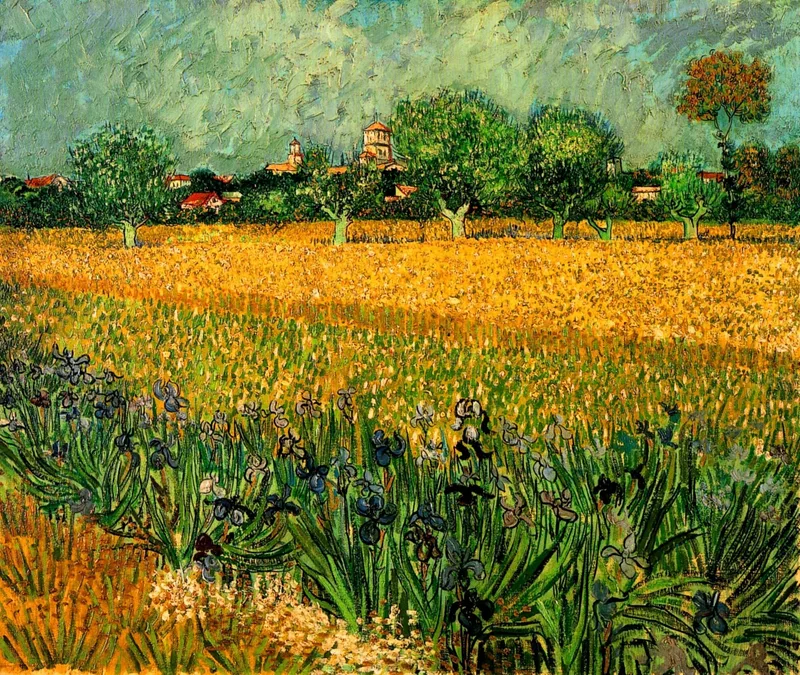
| Field with Irises near Arles | Arles, May 1888 | Van Gogh Museum, Amsterdam | “purple flowers” (letter 609) [7] | Most irises look more bluish than purple [7][8] |
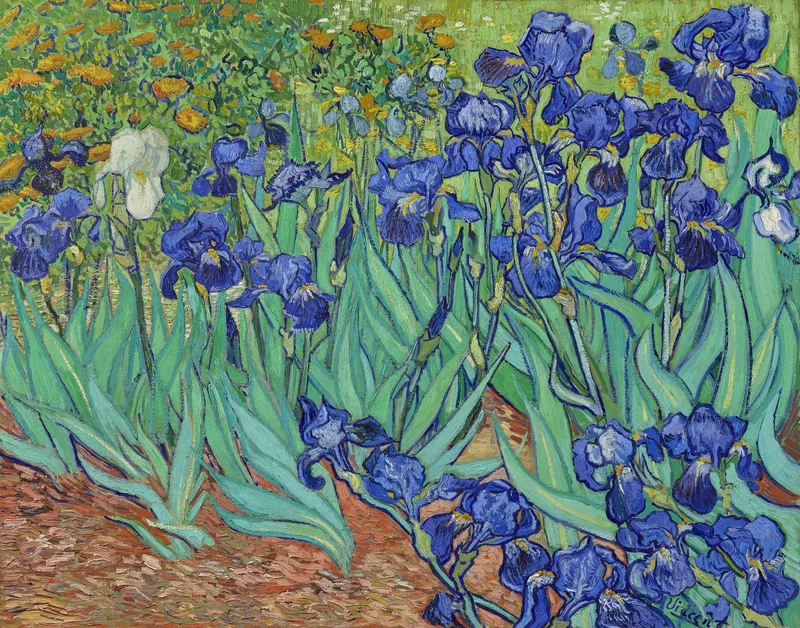
| Irises (garden bed) | Saint-Rémy, May 1889 | J. Paul Getty Museum, Los Angeles | “violet irises” (letter 772) [3] | Blue petals [1] |
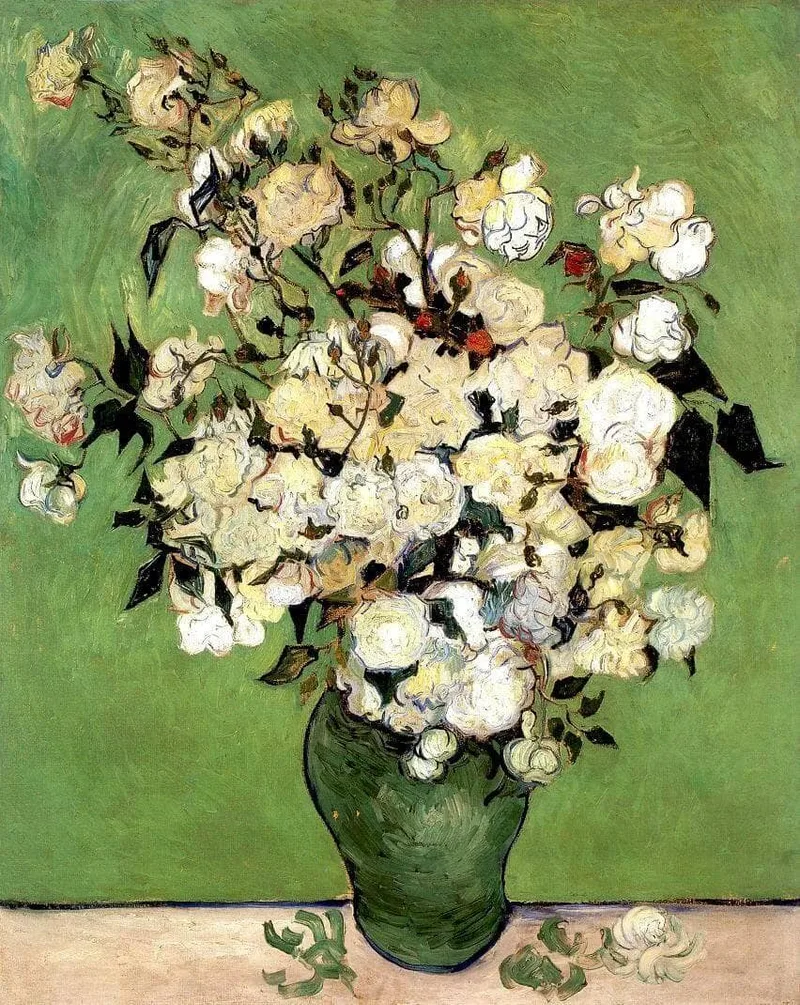
| Irises (vase, pink background) | Saint-Rémy, May 1890 | The Metropolitan Museum of Art, New York | “a pink background” (letter 870) [4] | A background that looks white [5] |
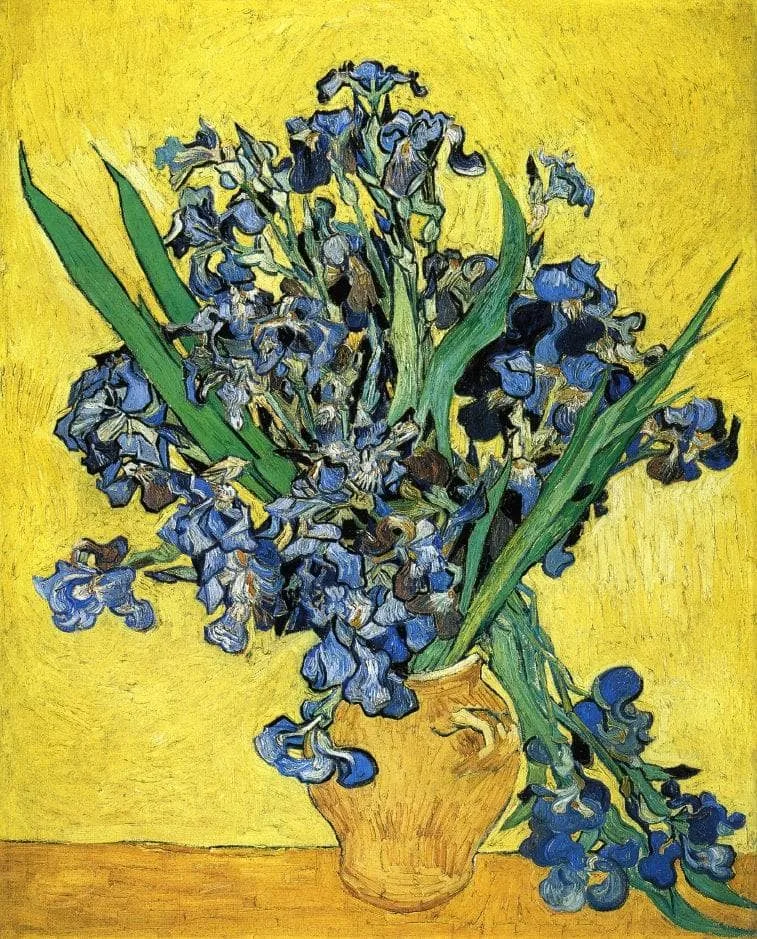
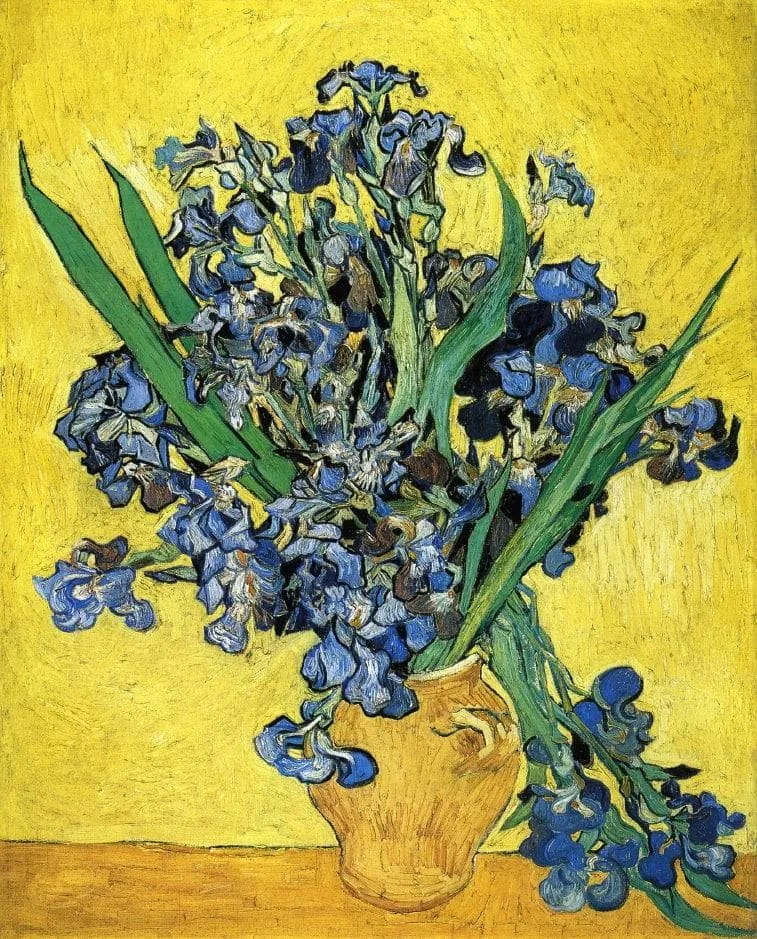
| Irises (vase, yellow background) | Saint-Rémy, May 1890 | Van Gogh Museum, Amsterdam | “violet Irises” on “lemon yellow” (letter 870) [4] | Flowers that have turned blue [6] |
Places and dates follow each museum record or the cited study; quotations are from the letters edition. [2][4][5][6][8]
Why did the Getty’s violet irises turn blue?
Van Gogh entered the asylum at Saint-Rémy in May 1889 and, according to the Getty, began Irises within the first week, working from nature in the garden. [2] On 9 May he told Theo and Jo he had “violet irises” and a lilac bush on the go: “Two subjects taken from the garden.” [3] The canvas is oil, 74.3 by 94.3 centimeters. [2]
Getty scientists scanned it with X-ray fluorescence and found bromine in many of the petals. Bromine points to geranium lake, the red Van Gogh mixed with blue to make violet. Light early in the painting’s history faded that red and left only the blue. [1]
The bromine map became a template for recreating the violet digitally, and the team also corrected yellows in the upper left that originally appeared more orange. Then they reproduced its texture with 3D imaging and printing. The work was shown in Ultra-Violet: New Light on Van Gogh’s Irises at the Getty Center, from October 1, 2024, to March 9, 2025. [1] The Getty has owned the painting since 1990 [2], and what Irises is worth tells the story of its sales.
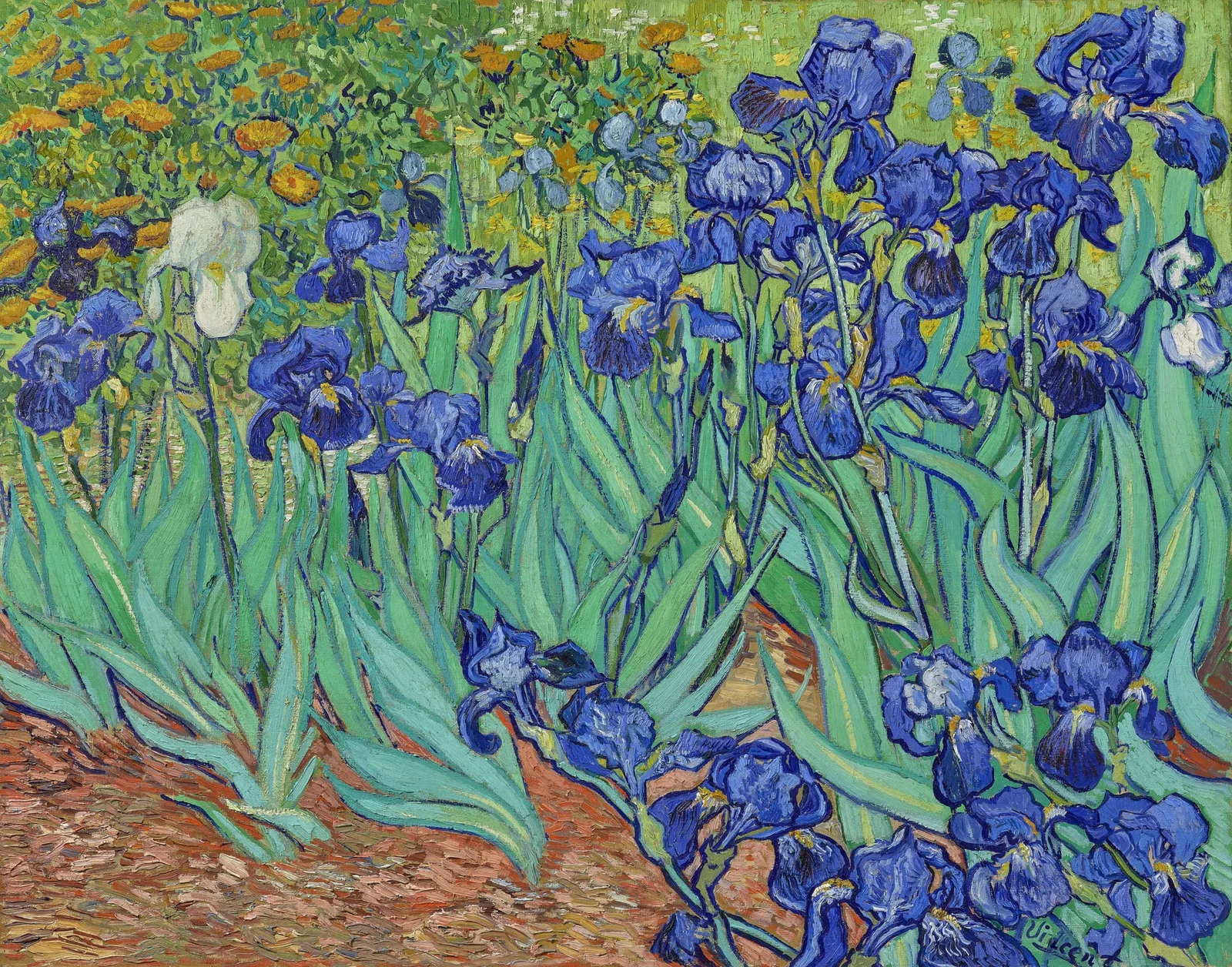
“It would have been surprising, given his interest in color, for Van Gogh to describe the irises as blue if they were actually violet.”
How did the Met’s pink background turn white?
A year later, on 11 May 1890, Van Gogh wrote that he was working on two canvases of large bouquets of violet irises, “one lot against a pink background in which the effect is harmonious and soft through the combination of greens, pinks, violets.” [4] That pink-ground picture is the Met’s Irises, examined in a 2017 study by scientists from the Met, the National Gallery of Art in Washington and the University of Antwerp. [5]
Today the background reads as white. At its edge the team found eosin red lake applied wet on wet with lead white. They concluded that the white surface is “part of the pink layer beneath and that it presently looks white due to fading of the eosin red lake.” Van Gogh had ordered eosin under the name geranium lake as soon as he reached Arles. [5]
The flowers changed too: “Fading of the red lakes has resulted in pink paints that now look white and in purple paints that now look blue.” [5] The Met reunited the four May 1890 still lifes in 2015, with digital color simulations. [5]

What changed in Amsterdam’s yellow Irises?
The other bouquet in that letter stood “against a striking lemon yellow background,” an effect, he wrote, “of terribly disparate complementaries that reinforce each other by their opposition.” [4] The edition’s notes identify it as F 678, the Van Gogh Museum’s Irises on a yellow background, 92.7 by 73.9 centimeters. [4][6]
The museum’s label is plain: “The irises were originally purple. But as the red pigment has faded, they have turned blue.” [6] So both halves of the pair lost their red. The soft harmony lost its pink, and the hard contrast of violet against yellow lost much of its violet. [5][6]
What about Field with Irises near Arles?
The earliest picture, painted in Arles in May 1888, shows the same problem outdoors. On 12 May Van Gogh described “a ditch with iris plants with green leaves, with purple flowers.” Researchers note that most of the irises in Field with Irises near Arles now “appear more bluish than purple due to fading of the red pigments,” and that he used the very light-sensitive reds cochineal and eosin here. [7]
In December 2014, Dutch News reported that researchers at Tilburg University, the Van Gogh Museum and the government’s cultural heritage service had found the blue irises were once purple. Senior museum researcher Ella Hendriks believed that, without action, the pigment would fade completely within a few decades. [9]
The Van Gogh Museum's REVIGO project then rebuilt this painting's colors. The team recreated the paints Van Gogh used from old recipes, photographed the canvas with a hyperspectral camera to work out the paint mix at each point, and swapped each faded mix for its original shade. The result shows a variety of purple irises, not the blue flowers we see now, against a more intensely yellow field, and it found that the white dots at the bottom had been pink. [10]
Not every change here is chemical. Between 2013 and 2015 the museum removed surface dirt and a varnish added in a 1927 restoration; the painting was meant to stay unvarnished. [7] The label sums it up: “The colours are now much brighter.” [8]
Which other paintings faded the same way?
The Van Gogh Museum's researchers searched his letters for “violet,” “lilac,” “purple” and “pink,” then looked at the paintings. In many cases the first three have given way to blue, and the pink has become off-white, because he mixed unstable red lakes with blue and white. [10] Another case is the Met's Roses: red lake turned up in roses that now look white. [5]
The museum's reconstruction of The Bedroom shows the effect starkly. It showed that the strikingly blue walls and doors were originally purple, and the floor a harder red. Many people found it hard to accept. [10]

Hand-painted in oilFrom $350See sizes

Can the original colors come back?
Not on the canvas. The Getty describes light as having “irrevocably changed” some colors of its Irises. [1] Eosin and brazilwood are the most fugitive red lakes Van Gogh used, and the worst fading tends to happen where they are mixed with lead white or zinc white, exactly as in these pinks. [5]
So the recoveries are digital. The Met showed color simulations in 2015, the Revigo project rebuilt Van Gogh’s paints in the lab to visualize the Arles field, and the Getty made a recolored digital model of its Irises. [1][5][7] Dutch News reported in 2014 that the paintings would not be restored to their original color, and that the digital reconstructions could help decide how museum lighting should change. [9]
For a related story about red and yellow paint, see whether Van Gogh’s Sunflowers are fading. For more of the subject, browse Van Gogh’s flower paintings or read what Van Gogh said about flowers.
Questions and answers
Were Van Gogh's Irises originally purple?
What do Irises symbolize in Van Gogh?
His letters about these paintings talk about color more than symbols. He called one bouquet “harmonious and soft” and the other an effect of “terribly disparate complementaries.” [4] The Getty adds that he considered its Irises a study, and that Japanese woodblock prints probably influenced its design. [2]
How many Van Gogh irises are there?
Will Van Gogh's iris paintings keep fading?
In 2014 researchers said the red was still fading. Senior museum researcher Ella Hendriks believed that without action the pigment in Field with Irises near Arles would completely fade within a few decades. The team said the paintings would not be restored, and that digital reconstructions could guide how museum lighting is adapted. [9]
Written and fact-checked by the Vincent van Gogh Paintings editorial desk10 sourcesUpdated
Sources
- J. Paul Getty Museum on Google Arts & Culture: A New Light on Van Gogh’s Irises (Ultra-Violet exhibition text)Accessed
- J. Paul Getty Museum: Irises, 1889, 90.PA.20Accessed
- Vincent van Gogh, The Letters: letter 772 to Theo and Jo, Saint-Rémy, 9 May 1889Accessed
- Vincent van Gogh, The Letters: letter 870 to Theo, Saint-Rémy, 11 May 1890Accessed
- Centeno et al., Van Gogh’s Irises and Roses: the contribution of chemical analyses and imaging to the assessment of color changes in the red lake pigments, Heritage Science, 2017Accessed
- Van Gogh Museum: Irises, May 1890, s0050V1962 (F678)Accessed
- Geldof et al., Reconstructing Van Gogh’s palette to determine the optical characteristics of his paints, Heritage Science, 2018Accessed
- Van Gogh Museum: Field with Irises near Arles, May 1888, s0037V1962Accessed
- DutchNews.nl: Van Gogh’s Irises were originally purple, red pigments are fading (6 December 2014)Accessed
- Van Gogh Museum: Research results REVIGO: paintings, and the PDF 'Original colours of Van Gogh’s paintings'Accessed
Hand-painted oil reproductions