
Reading Van Gogh’s Letters Alongside His Paintings
Published · Art & See editorial desk
A letter can supply valuable evidence about a painting, but only after the document and the artwork have both been identified. The scholarly edition of Van Gogh’s correspondence separates the original text, English translation, manuscript images and editorial notes, allowing those layers to be checked together. [1]
Start with the edition and the document
Record the letter number used by the edition, the sender, recipient and stated or reconstructed date. An older book may use a different number. The edition’s help page explains how to use its concordance or search options to translate between numbering systems. Searching a remembered number without checking the edition can lead to the wrong document. [2]
Use the original text and translation side by side when a particular word matters. Then open the notes. The edition’s illustrated artwork references belong to its annotations; their presence does not mean that Van Gogh used the modern catalogue title verbatim. [1]
A worked example: letter 691
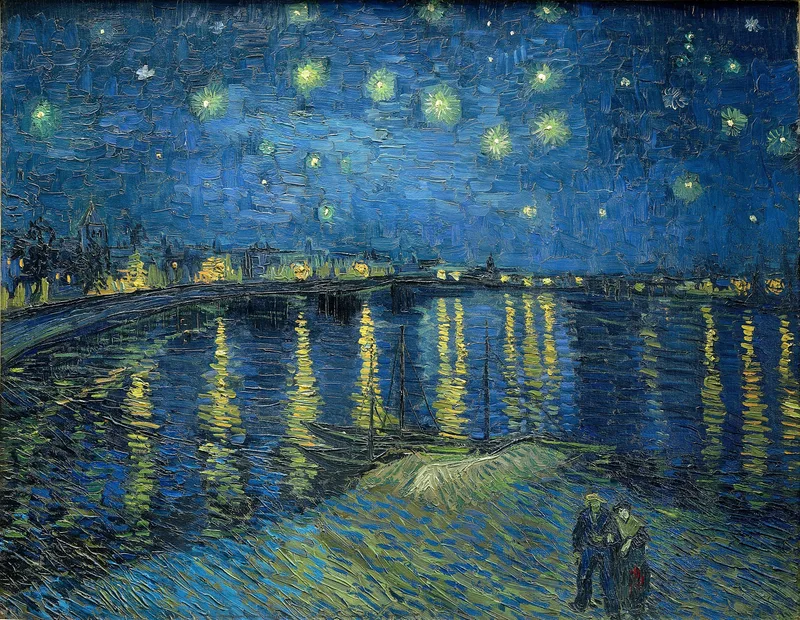
Letter 691 is addressed to Theo from Arles. Its date is approximately 29 September 1888, as reconstructed by the editors. In the English translation, Van Gogh describes a night scene with coloured water, gaslight and two figures. He also refers to an enclosed sketch. [3]
Editorial note 1 identifies that sketch as F1515/JH1593 and relates it to the painting Starry Night Over the Rhône, F474/JH1592. The sketch’s present whereabouts are unknown. These are two objects with different catalogue identifiers, even though the sketch represents the painting’s composition. [3]
What the example does and does not prove
The combination of text and annotation supports a relationship with the Rhône painting. It does not identify every other night view Van Gogh made, nor does it establish that the surviving canvas and the enclosed drawing have the same dimensions. Keep what the artist reports separate from what the editors identify.
The date’s qualification also matters. An editorially reconstructed date should remain approximate when cited. It is better to preserve that precision than to turn a scholarly estimate into an exact day written by the artist.
| Object | Catalogue numbers | What it is | What the edition records |
|---|---|---|---|
| Starry night over the Rhône | F474 / JH1592 | Painting | The work of the same name that the enclosed sketch is after [3] |
| Starry night over the Rhône | F1515 / JH1593 | Sketch enclosed with letter 691 | Dimensions unknown; present whereabouts unknown [3] |
Letter 691 is to Theo van Gogh from Arles, on or about Saturday 29 September 1888 — a date the editors reconstruct rather than one Van Gogh wrote. Note 1 records no dimensions for the sketch, so the edition gives no ground for saying the drawing and the canvas are the same size. [3]
Repeat the method for another painting
Find the work through the edition’s artwork search or its F and JH search fields, then inspect the matched letter and note. The help page explains both routes. A text search can be useful for discovery, but it is only the beginning of identification. [2]
Before citing the result, check whether the passage concerns a completed work, a sketch, a proposed painting or a broader subject. State which relationship the evidence supports and link directly to the document. A general remark about shoes, flowers or the night should not be attached to a particular canvas without that final check.