Hand-painted in oil
About this Artwork
1887, the second Paris year
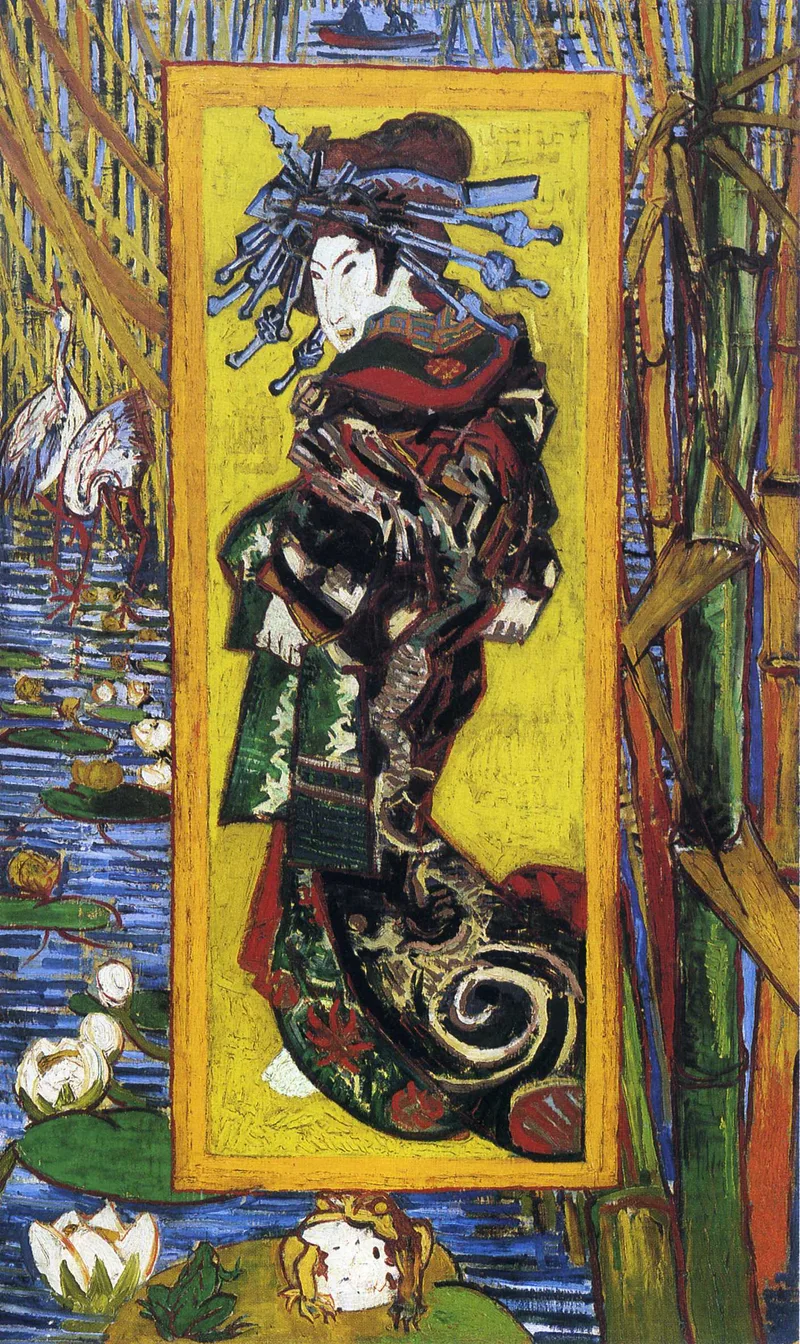
The record dates Japonaiserie Oiran (after Kesai Eisen) to 1887. The title carries its own attribution: this is a painted version after a print by the Japanese artist Keisai Eisen, and the record says so rather than leaving it to be inferred. Copying after another artist is a habit that returns with force two years later, when this catalogue records thirteen canvases dated 1889 with "after Millet" in the title.
What the record gives
The canvas is 60.5 x 105.5 cm, held by the Van Gogh Museum in Amsterdam. Those proportions are worth noting: it is nearly twice as wide as it is tall, and only six of the works whose measurements the record carries are laid out that wide. The measured palette returns yellow as the dominant family, consistent with 1887, the first year in which yellow becomes the most common dominant in this catalogue — 59% of works with a measured palette, against 41% the year before.
Where it sits in the arc
Paris is the period in which the painting gets lighter, and the record supports that as arithmetic rather than as an impression. This canvas belongs to the second Paris year, after which the record shows him in Arles. What he took from Japanese prints, beyond the fact of having copied one, is not something this catalogue can establish.
Sources
1 references- Vincent van Gogh — Wikipedia
Vincent Willem van Gogh (Dutch: [ˈvɪnsɛnt ˈʋɪləɱ vɑŋ ˈɣɔx] ; 30 March 1853 – 29 July 1890) was a Dutch Post-Impressionist painter who is among the most famous and influential figures in the history of Western art. In just over a decade he c